25 February 2024

First Impressions - Dragonbane RPG - Bestiary

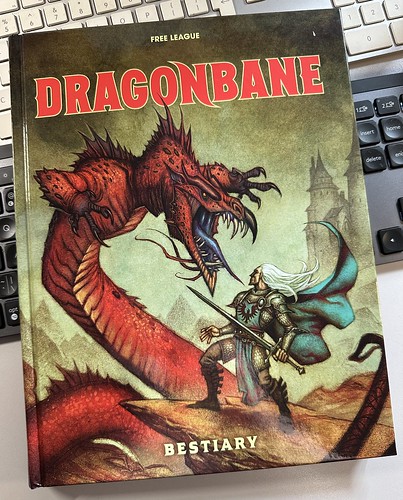
Picture of a book lying on a grey desk, with two keyboards underneath it, a black one in the middle of the screen and a white Apple one to the top above it. The book has an image of a knight with flowing white long hair and a blue-green cloak facing down a red coloured wingless dragon (perhaps a Lindworm) which rears above him as it's tail wraps around the base of the book. A castle looms out of the mist in the background on the right. The top of the book says "Free League" and has the red Dragonbane logo, and the bottom of the book says "Bestiary".
The Dragonbane Bestiary

This will be a short one, as this is a simple book. The Dragonbane Bestiary is a 148-page full colour hardback illustrated gorgeously by David Brasgalla. The artwork is in a similar style to the cover and other material provided by Johan Egerkrans for the core rules. This is the expanded monster manual for the Dragonbane roleplaying game; there is some overlap between the two books, but the entries in the Bestiary are significantly expanded. In addition, the book provides the information to make some of the kin usable as player characters. Goblins, Hobgoblins, Ogres, Orcs, Cat People, Frog People, Karkions, Lizard People and Satyrs are now available to join your adventuring party!

The conceit of the book is that it is the work of one Theodora Sneezewort, a halfling scholar who may have been lost in crevice while trying to enter the lair of Arknarath, the Father of all Dragons. The entries reflect this, starting with Theodora's commentary on the creature or kin, before being followed with an example random encounter and then a more extended adventure seed. There's an evocative illustration, and then the stat blocks plus details of the ability the kin would get if used by a player.

The general categories used are Nightkin (Goblins, Orcs etc), Rare Kin (the likes of Cat People and Satyrs), Insectoids, Beasts, Trolls, Giants, Undead, Dragons and Demons. Whereas the core book has one Demon example, the Bestiary gives six different types. Similarly, there are five different dragon examples (differing ages and the wingless Lindworm). Trolls and Giant have similarly expanded entries with several different flavours.

This is an unpretentious book; it delivers exactly what you'd expect, a large selection of potential allies and opponents. It isn't essential, but if you plan to run Dragonbane it will add some great options and flexibility to your game.

Recommended.

25 February 2024

12 February 2024

First Impressions - Dragonbane RPG - Rulebook

Dragonbane Core Rules lying on top of two keyboards on a desk. The book is in shades of green, showing green dragon standing on a monument with wings spread threatening a white long-haired warrior with a large cloak and a big sword. The top of the book reads ‘Free League’ with ‘Dragonbane’ in red below it, and ‘Rulebook’ at the bottom centre of the page.
Dragonbane core rulebook.

I backed the original Dragonbane Kickstarter and really liked the boxed set that arrived, but was loathe to read the softback books (because I reckoned I’d trash them), so I was delighted when Fría Ligan announced that they were producing a hardcover of the core rules and a bestiary. Here’s my first impressions of the core rules, only tempered by the fact that I read the QuickStart at the time of the initial release and also the influence of First Age, whose boundless enthusiasm for the game is somewhat catching.
TL;DR: Overall, I’m impressed with Dragonbane. It’s mechanically light enough to fade away but provide lots of fun. The boxed set promised mayhem and mirth, and this polished, well written, simple and beautifully illustrated rulebook gives you the tools for a lot of fun time adventuring. It reminds me of the old-school, but it takes the BRP-heritage and hones it to a sharp and effective modern point.
Dragonbane is a 124-page full colour hardback book which presents a full game system with introductory adventure. The interior art is gorgeous, produced by Johan Egerkrans and Niklas Brandt. It’s printed on matte pages rather than gloss, and feels nice. Layout is very clear and the text is easy to read. This is the second printing of the rules, so there is a list of errata changes at the front, something that reminds me of reading RuneQuest 2 back in the 1980s.

You can see the BRP (Chaosium’s Basic Role Playing percentile engine) lineage in the game engine. But, Dragonbane uses D20, you say… BRP does step into the D20 space; it was only after the first two editions of RuneQuest that the game moved away from 5% skill steps, and Pendragon was always a D20 version of the engine. However, Dragonbane is a fast and slick version of the game engine, married with some modern design concepts.

Characters are described with six attributes (Strength, Constitution, Agility, Intelligence, Willpower and Charisma) rolled on 4D6 with the worst die dropped. You can swap a pair around at the end of the rolls. They may be modified by the Kin that you select at the start. This are pretty traditional (Human, Halfling, Dwarf, Elf) until you get to the Mallard and Wolfkin. Mallards are very much a nod to the RQ heritage of Ducks. Each Kin is described, and has at least one heroic ability activated by spending Willpower points. You then choose (or roll) a profession for your adventurer, and there are ten on offer. They cover most of the fantasy tropes, and at least half of your skills must come from those in the profession. You also gain an additional heroic ability and a selection of starting gear builds. You can generate a name by using the name table for kin and the nickname table for profession. The number of skills depends on the age of your characters (with bonus attributes and less skills for the young and lowered physical attributes and more trained skills for the old). 

Derived attributes give movement (based on Kin and Agility), Hit Points, Willpower points (which fuel magic and abilities) and a damage bonus. Skills either start at a base derived from the governing attribute or are doubled if you are trained in them. An average character would have a skill of 5 for untrained skills and 10 for trained skills. Favoured attributes could push this as high as 6/12 or 7/14.  Characters can also chose to have a weakness; playing to it will give you a bonus on experience checks at the end of a session, and resisting it can gain you more in the short term, and end up causing a change. As well as the starting gear, you’ll have a memento that’s important to you that you can use once per session to recover an additional condition. 

Character generation rounds out with simple encumbrance rules and some ideas for appearance. Experience comes from rolling a Dragon (1) or a Demon (20) when making a skill roll. You also get it for answering certain questions at the end of a session. Each question answered or dragon/demon rolled gives you an attainment mark which can be placed against skill. You roll a D20 for each, looking to get more than the existing skill. If you do this, you can raise it by 1, up to a maximum of 18. Any skill raised to 18 gives an additional heroic ability. 

The game engine is a D20 roll equal-to or under, usually against skill but attributes can be an option in some limited cases. Rolling a Dragon is a critical, with extra damage, higher achievement etc. Rolling a Demon can’t be pushed and a fumble of some sort happens. Generally, you get a single chance to roll. Rather than having modifiers to the roll, you can have boon or bane.Unlike D&D, these can stack, so you can roll more than two D20s for task. Generally, one person can help, giving a boon. 

If it goes badly, there is an option rule to push rolls (like in the YZE engine); however, this gives you a condition which imposes bane on skill groups derived from the same attribute. If you get all six conditions you can no longer re-roll. You have to re-roll all the dice. 

Combat initiative is derived by drawing cards (much as used in most YZE games). When it gets to your turn, you can chose to wait, and swap your card with someone who hasn’t been. Monsters will often have multiple initiative cards. The action economy is simple. You get one action and can move. If you are forced to react to defend yourself (for example by parrying or dodging) then it uses your action if you still have one or cannot be done. There are a limited number of free actions like swapping weapons, shouting, getting off the ground or getting down to the ground. 

Melee combat is by a skill roll, and success means you deal damage (less armour). A Dragon means that you can roll double base damage, do a second attack against another enemy or bypass armour with a piercing weapon. When facing a non-monster, if your damage bonus is higher than theirs and you hit then you can shove them away from you. Demon rolls have a simple fumble table ranging from dropped weapons through to hitting yourself. If you use a reaction and parry an attack, your weapon can be damaged if the damage exceed the durability of your equipment. Mostly, you can’t parry monster attacks. However, you can dodge monster attacks. Ranged combat works similarly, but has a more limited set of options for rolling a dragon. You can parry a ranged attack with a shield (and with a weapon if you have the right ability) or you can dodge it. 

When your hit points reach 0, you fall to the ground and start to make death rolls versus your CON attribute. These work a bit like D&D5e and 3 successes see you recover D6 hit points and return to combat. Three failed rolls mean you are dead and gone. Demons and Dragons count double. Additional damage is treated as a failed death roll. If you ever take damage in a single attack that takes you to the negative score with the same magnitude as your hit points, you die instantly.

Other characters can help you: you can be rallied back to your feet to fight on at zero hit points (but you still make death rolls), or someone else can try to save your life with a healing roll. If you survive death rolls, you need to make a CON roll or suffer a long term injury. 

Magic is presented as resting in three schools; animism (deals with nature and the world), elementalism (deals with the elements) and mentalism (control of mind and body). There are lists of spells and magic tricks for each school. There is also a group of core spells and tricks. Mages have prepare a spell to use, with limits set by INT. Spells are also recorded in the mages’ grimoire, and at a push can be cast from there. Metal interferes with casting and enough can stop spells being used. Spells have power levels, needing Willpower points to activate. At a push, you can take damage to your hit points to gain Willpower to cast a spell, except for healing magic. Rolling Dragon boosts your spell, rolling a Demon causes a mishap. 

This section is followed by a decent equipment list, and then the bestiary which gives a small but interesting selection of monsters that cover the basics for most fantasy games. Some creatures are treated as NPCs; they follow the same basic rules as player characters. Goblins, Orcs and Skeletons are examples of these. More scarily, some creatures are Monsters. Monsters typically have multiple attacks and always hit, with the GM rolling or choosing from a table of nastiness (shades of Forbidden Lands and Alien). As Monsters will typically have more than one attack, they are to be feared. Monsters can also cause Fear, which needs a Willpower roll to resist, and a failure can cause conditions to be inflicted or a character to flee or freeze.

The book draws towards its close by covering Journeys, GM advice and Treasure. Characters take roles on when travelling; pathfinders will lead the party through, with others taking the action to make camp or hunt and forage for food. The GM section focuses heavily on using NPCs and creating adventures with some light guidance and random tables for adventures, treasures and NPCs. The book rounds out with a short introductory scenario (The Castle of the Robber Knight) which will reward thinking around the problems faced rather than a straight line combat solution.

The book concludes with a short selection of tables, the character sheet and a functional index.

Overall, I’m impressed with Dragonbane. It’s mechanically light enough to fade away but provide lots of fun. The boxed set promised mayhem and mirth, and this polished, well written, simple and beautifully illustrated rulebook gives you the tools for a lot of fun time adventuring. It reminds me of old school, but it takes the BRP-heritage and hones it to a sharp and effective point. Recommended. 

12 February 2024 

04 February 2024

First Impressions - Orbital 2100 - Cepheus (Hostile) setting [compatible with Traveller]

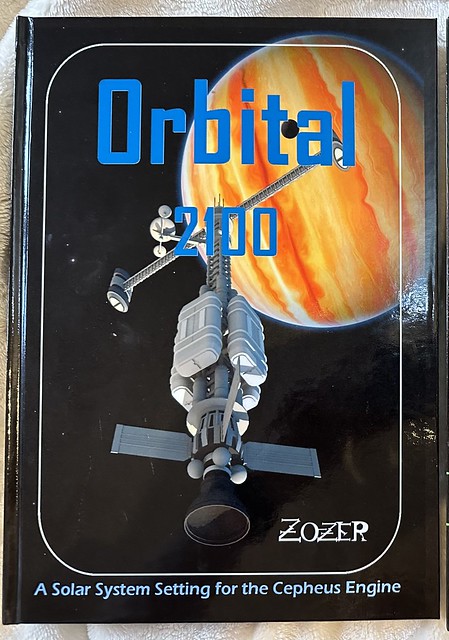
The cover of Orbital 2100, which shows an in-system spacecraft (with engines orientated to the bottom of the page) approaching Jupiter. The header is Orbital 2100 in Blue, and at the bottom of the page the sub-title says ‘A Solar System Setting for the Cepheus Engine’. The image is surrounded with an overlaid white rounded rectangle box.
Orbital 2100 - a setting usable with Traveller or Cepheus


Orbital 2100 is Zozer Games’ prequel to the popular Hostile setting. It uses the Cepheus Engine but should be easily usable with Mongoose Traveller (although you’ll need to tweak some space combat elements if you’re using either the 2nd edition or 2nd edition refresh). It is set in our solar system in 2100, one hundred and twenty-five years before the main Hostile settings. It is pre-FTL (faster-than-light) and the ships and vessels used to travel between planets are recognisable extension on what is possible today.

It is a 240-page colour hardcover print-on-demand book, ordered via Lulu. The copy that I have is the second edition, published in 2016. If you get the hard copy and reach out to Zozer, they will (very quickly) send you the PDFs on DriveThruRPG. The book is mainly black and white, with some effective images included. However, I really don't like the layout, which continues Zozer’s ‘use a bigger font-size than you need’ theme. As the font used looks like Tahoma with italics used liberally in a single column format, it looks like an essay or report in parts, especially as the page numbering is always on the same side whether on a left or right handed page. It's clear enough to read though. I don’t like their layout, but it doesn’t make my eyes bleed nor have quite the same visceral reaction as the ‘Made on Timeworks Publisher in the 1990s’ approach that rendered Sorcerors of Ur Turuk unreadable to me. There are a small number of typos scattered through the text. Overall, a functional book, rather than a pretty one. 

The book is structured into twelve chapters, beginning with an overview of the situation in the game setting and a variety of suggestions on how you could use the book; for example, as a set of mechanics to play in the past of another setting that uses more traditional SF-tropes.

The second chapter dives into the ongoing Cold War between the Earth Union and Luna. The setting predates the Expanse TV series, but there are echoes between the two. It also reminds me of Paul McAuley's 'Quiet War' novel series, which has a similar conflict over the resources of the solar system. There's a feeling of tension in the writing, and the two protagonists have just stepped back from the brink. An uneasy peace exists; Luna has the power to drop mass-driver rocks on Earth (and has, in the past) and Earth has enough space-based nuclear weapons to destroy the settlements on the Moon. This could be a backdrop to your game, or you could put the players right at the heart of it. The setting is Tech Level 9 with Tech Level 11 Computing & Electronics.

The third chapter looks at the various organisations in 2100. It starts with government agencies of the type that the players are likely to encounter (research, police, military) before moving into corporations. The corporations have some easter-eggs in them if you've already explored the Hostile line, as they are the precursors to those that dominate the future, 125 years later. A number of NGOs and criminal organisations are also described before the chapter rounds out a short piece of fiction to set the mood, sadly marred by the use of a large block of italics for the text.

Chapter four talks about how to alter the Cepheus mechanics for the setting when creating characters. The main changes are that social standing is no longer linked to aristocratic titles, but a combination of fame and wealth, and the background skill selection is more tailored. Careers in 2100 are mapped against the careers in the core book, and there are tweaks to some of the skills and how they cascade. Military and spacer ranks are also adjusted to fit the setting background, along with some changes to the mustering out process to reflect that characters are more likely to still be in employment within their career than having retired from it. Finally, the chapter presents Nikolay Kamov, a plain clothes agent of the Space Activities Regulatory Agency. The character is reassuringly summarised with a short UPP code and skills list that will be familiar to anyone who has played Traveller in the past.

The fifth chapter gets technical, exploring spacecraft design. Orbital lacks jump-drives or other FTL, and also does not have artificial gravity. Starships use thrust or spin to create gravity; the technology is more akin to 2001: A Space Odyssey, 2010, or the Expanse than the classic Third Imperium setting. Ships use chemical reaction based rockets or nuclear-thermal rocket engines for propulsion. The latter are the main drives for ships, and an extrapolation of work explored in the mid-20th Century. A nuclear fission reactor is used to superheat liquid hydrogen as reaction mass. Ships will usually boost to the required velocity, and then burn to slow down and rendezvous with their destination after coasting for much of the journey, with the same kind of orbital mechanics that probes sent out by NASA and the ESA use today. 

Radiation has significant effects, and drives need shielding. Deep Space Vessels also carry flare dampers that create an artificial magnetosphere to protect the crew and vessel from radiation from Saturn and Jupiter, and usually also have storm shelters which are protected. Low berths are used for long haul flights, and are slightly more survivable than usual.

The design sequence approach will be familiar to anyone who has used Traveller before; you select a hull size and fill it with components. All hulls are distributed, very much lattice-works of components not designed to enter an atmosphere. Weapon systems can be fitted with a combination of railguns, particle beams, missiles and lasers. Autonomous Kill Vehicles have station and ship killing capabilities. They're large weapons likely to cause a huge amount of damage, available in kinetic kill, nuclear, bomb-pumped X-ray laser and ground strike variants. 

Engineering defines function, and most DSVs will have a similar design with the reactor and NTR drive at the rear with fuel clustered nearby. The crew and passengers will be located as far away from the drives as possible, with radiation shielding between.

There is an alternative nuclear pulse fusion drive detailed in the book, a TL10 system similar to that seen in the Expanse. This drive removes the need to burn and coast, which means overall a much faster transit time (eight days to Jupiter from Earth rather than eight months). The constant thrust will mean a different style of ship, more skyscraper like rather than International Space Station style.

The design sequence then moves onto orbital vehicles, which may be designed to enter an atmosphere. These are the small craft of the setting. Technology includes chemical reaction rockets, fuel cells and solar panels. Flare dampers may be included to protect crew, but the power demands of these system means that their duration of their protection is too short to be effective in Jovian and Saturn space. In those areas, small DSVs fill the orbital ferry role. The section concludes with guidance on how to modify the orbital vehicle design sequence to make a launch vehicle. It's interesting that when the book was written, SpaceX had yet to successfully carry out a controlled Falcon-9 booster landing, but there are rules to design rockets with that feature.

The sixth chapter explores operating spacecraft, and has a simple system to account for the movement of the planets in the inner system. This uses a template to track movement through the various orbits. Outer system travel ignores this on the basis that the outer planets will tend to be broadly in the same place in any ten year time frame. There's discussion of LaGrange points, Gas Giant Moons and how fuel impacts operations. Fuel is a limiting factor, with even DSVs needing husband supplies; two thirds of their typical fuel tankage will be used for the burn to leave orbit and enter orbit at the destination planet. Simple mechanics are presented for maintenance and revenue during starship operations. There's an encounter table, which varies based on which part of the solar system you're in. This is followed by guidance on how to run space combat in this kind of environment. This isn't stand alone, but does modify the sequences in the core rules.

The next chapter is entitled 'Hardware' and is the equipment list. There's a significant section on space suit designs, which makes sense as they are much more critical in this kind of lower technology setting compared to Traveller's Third Imperium. Rovers, computers, orbital vehicles, launch vehicles and deep space vehicles all get a variety of examples, more than enough to run most of what you need for a campaign. The space station section gives examples of multiple 10-ton modules that can be used to quickly construct a space-station. 

Chapter 8 covers Orbital Society, starting with law enforcement, but moving on to art and culture (including the Eros Wrap, a massive lighting installation around the asteroid), and then a discussion of the kinds of towns, outposts and bases you may encounter. Most of these will rely on oxygen and fuel refineries if installed planet-side. Regolith-bags or burying modules provides protection from solar flares. On Europa, the installations are underwater, below the ice-crust. There are examples of orbital module stations (and how to recover older, abandoned ones) and also larger space colonies such the three O'Neill stations in Earth space in the L4 and L5 Lagrange points. The section also covers typical DSV operations and treaties and regulations agreed between Luna and Earth, before concluding with a short description of the 'Earth Orbit Network' of launch facilities and low and high orbit stations.

The ninth chapter makes it real by exploring the challenges of working in Zero-G before looking at ways to die is space. This starts with 'blow-outs' (pressure loss) and explores how to puncture the hull (and the speed of decompression following) and the effect of vacuum on the human body (you'll stay conscious for 12 seconds or so). Alternatives to guns are suggested. Other exciting ways to die include exposure to extremes of temperature (get cooked on Mercury and Venus, or frozen on Mars or Titan), or poison gases in the atmosphere of Venus or Titan. Finally, radiation is the pervasive killer. If a ship loses its flare damper, or you're caught outside in a solar storm or just in Jovian space, then you are likely to become very sick. Airlocks are described in some detail. The chapter has sections on asteroid mining and establishing an outpost to wrap things up. 

The tenth chapter looks at the worlds in the Sol system. They're all presented with their Traveller style UWPs (Planetary Profiles), then the significant ones all have entries with an image, more detail on the world, its planetology, human development and places of interest. There's enough painted in broad brushstrokes to give hooks for the referee to dig into when running the game. 

The penultimate chapter discusses running Orbital. It gives ideas of the kind of activities characters could get involved in and guidance on how to build a campaign. This is important; I can remember reading Transhuman Space, really liking it but struggling to work out how to run it. The author recommends giving the players secret agendas; links to the organisations in the setting that may create friction or slightly different needs on the mission that they are undertaking. Imagine the slightly different motivations you see in the characters in the Expanse. There's an example mission to show this (which looks like a fun session with enough friction to create some interesting interactions). The section rounds out with example NPCs and then a discussion on Aliens and are they out there (answer = 'yes'). Ruins have been found on Mars and there are other intriguing hints, some of which are explored further in Hostile. 

The final chapter lists recommended movies, TV series, books, roleplaying games and web-links to look at for inspiration. An Appendix N for the setting. There's some really good recommendations there. 

The book rounds out with the Cepheus Engine Compatibility Statement, Mongoose Traveller OGL and the NASA/JPL declaration. 

I really like this setting. It feels fresh and different to many other SF-games and it feels real. Space is a frontier and dangerous and humanity is confined to a single solar-system and is in a period of Cold War. Corporations are gaining influence and there's an opportunity to make difference. 

I've rated it four stars out of five (content 5 star, layout 3 star). 
Highly recommended.

4 February 2024
18 January 2024

Building Xyntillan on Roll20 - tables, dynamic lighting and maps

Roll20 Xyntillan Build
The kind of message you don’t want as you start to run a game

Last night was the fortnightly session for my Achtung! Cthulhu campaign, run on Roll20 for two sessions now that Role has dropped AV support. I was really looking forward to the session, especially as the game Trail of Cthulhu session for Eternal Lies was cancelled the day before before because the GM was unwell. I’d used the time I got back to do some proper preparation, rereading the scenario and the core rules to try and make things as slick as possible. I connected to the game in good time, and then - after about ten minutes when we were waiting for one of the players to arrive - the error message above popped up. I reconnected AV, relaunched the browser and fiddled until I realised that it was an issue with VirginMedia’s fibre connected, not Roll20, not Firefox, and not my WiFi mesh. To say I was disappointed was an understatement. I ended up having an earlier bed than planned.

I got woken up by the better half being restless around 4am, and by 5am I realised I wasn’t going to get any more sleep. The internet connection was back, so I put on the All About Eve Fairy Light Night gig recordings and reconnected to Roll20 to start on the next map section.

I had some issues getting the grid right. The pixel size written on the map didn’t match the reality of the file and it was a struggle to align the grid. Eventually, I used the size marked on the map and the option key to move the map to align to the grid; I’d forgotten that you can precise locate a map item or token with  that key press as a modifier. I need to remember to do that next map (part of the reason I’m writing this entry). In honesty, the instructions for using the map with Roll20 were good, it was just the final alignment that was tricky.

Roll20 window in Firefox browser showing a map from Castle Xyntillan with green lines overlaid for dynamic lighting and also doors. There is a single oblique line which was a test draw for the mouse pointer position but the pointer didn’t screenshot.
Working in the mapping layer

I started to add in the dynamic lighting. You do this by drawing on the mapping layer. You add walls/windows and one way fittings in by drawing them on. You can snap to the grid where it aligns by shift clicking, but it’s a little annoying when you do it free style (having to go off the grid intersections). The mouse pointer changes to a pen, and the line node is drawn below and to the left of the pen nib. I’d prefer a crosshair there as used in a lot of graphic programs, as it’s a bit hit and miss in getting an exact position. This also saw me adding some torches (for light from fireplaces) as light sources on the lighting layer, and some doors. The doors are easy to do, but the big round nodes at the ends make it hard to be precise. I’ll need to do some testing to make sure they’re right in the future.
 
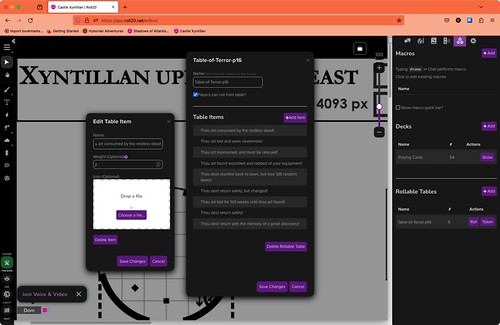
Another Roll20 window in Firefox. Again, this shows a map from Castle Xyntillan but a table is open entitled ‘Table-of-Terror-p16’. A second dialog box is open, allowing the edit of a table row showing the weighting option set at ‘2’ and the entry text.
Building a table

I also started to build out a table; this was pretty simple. A point to note was that you can account for items  which have more than one entry on a table (for example, rolling 1&2 on a dice gets the same result) by adjusting the weighting. The principle should be the same for a multi-dice table, you’ll just need to work out how they weight against each other (for example, a roll of 7 on 2d6 would have a weighting of 6, whereas a roll on 12 or 2 would have a weighting of 1).

Overall, I’m enjoying learning this in a bit more depth. Most of the games I’ve run before on Roll20 have been pretty much using as built material with the odd simple map or NPC and token added.  I’ve still got a fair bit to do before I can open this game up for play.

18 January 2024

16 January 2024

WOTB - TS-5 Mastery - Canyon


3850 damage, 4 kills, 1890 blocked, 955 assistance.
This tank is a monster in the right situation.

WOTB - Bofors Tornvagn Mastery - Ghost Factory


This one just happened perfectly, giving a Kolobanov (1 vs 4) and Radley-Walters (5 kills) as well as the ace. They came at me one by one and let me use the terrain.

5 kills, 3685 damage, 2920 bounced and an Ace tanker.

14 January 2024

Post Pandemic Challenges with Convention Running

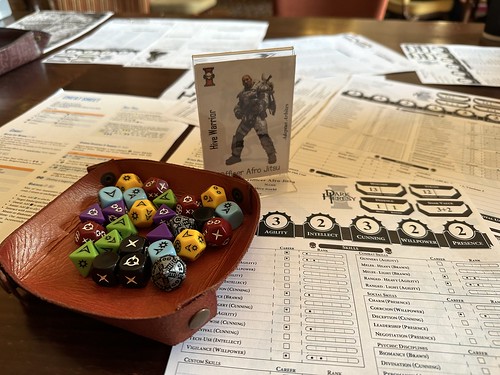
A game of WH40K hacked to Genesys at North Star 2023. The photo shows a character sheet, a dice tray with multi-coloured Genesys dice and a character standee entitled 'Hive Warrior'.
A game at a Garricon

This is written from the perspective of running four different cons at the Garrison Hotel in Sheffield, UK (Furnace, North Star, Revelation, and hopefully LongCon). They're all different in style:
  • Furnace is a generic 'any system welcome' convention ("It's all about the games") which attracted 70-80 people pre-pandemic (and filled the Garrison Hotel's space).
  • Revelation is a tighter focused Powered by the Apocalypse and Forged in the Dark focused convention. A different crowd to Furnace, but some overlap. Typically 30 to 45 people.
  • North Star is an 'any game welcome as long as it's Science Fiction' con, which attracts 50-60 attendees.
  • LongCon is an enigma, and hasn't run for some time. If we get 30 odd people I think we'd judge it a success (we need that many to cover event costs).
The post-pandemic recovery in numbers has been slow. We've started reaching the bottom end of some of the attendance levels but we aren't quite there yet. The current ongoing rail network strikes don't help us; I know that a number of people haven't joined us in recent years because travel just isn't viable.

We've also seen a huge change in sign ups; people leave it much later to register, to the point that we've actively discussed cancelling a convention at least once; we've never had to do that before, but post-pandemic we now have to deal with a deposit which we could lose.

In some ways, running the cons with slightly less people there isn't a bad thing; increasingly, people are pitching games for four players rather than the five or six that were common before. That's not a bad thing with the size of some of our smaller cons, but it does leave us with a risk that the fuller cons may not have enough player spaces to cover everyone. We usually lose about 10% of people on the weekend, and I think we're possibly seeing more single day attendees than before. What it does mean is that Elaine or I end up asking for GMs to add an extra space in, which may not be used.

I think the four people thing is partly related to the kind of games run. You can focus more on a table of four than six and there's less GM overload.

However, the more worrying trend is a drop off in GM numbers. Normally, we'd cap GMs at running two games in a five slot weekend; this was initially put in to enable more GMs to run because the active folks (our Iron GMs) would pitch four game slots and close the calendar. However, we've increasingly had to open up to three or four slots available for GMs because far less people are offering than before. 

This comes with a risk, one that the restriction to two games addressed previously. If a GM has to drop out at short notice, or they become ill at the con (I've had a migraine develop, for example), it leaves the organisers a challenge to fill the gap. I used to bring the 'big bag of boardgames' but haven't recently as it's not been called on for a while. We do try to get reserve GMs for slots, but often they're already running games. 

Of all these things, the GM numbers part is the most concerning. All three of the core cons have suffered from it. We used to incentivise the higher volume GMs beyond the priority in booking playing slots, but I don't think that this is the solution.

Curious if anyone else who's running conventions has seen these trends. Is it just us, because if it is it may be a reflection on the convention organisation or perhaps geography? What's your experience?

14 January 2024

First Impressions - Forbidden Lands RPG - initial kickstarter bundle

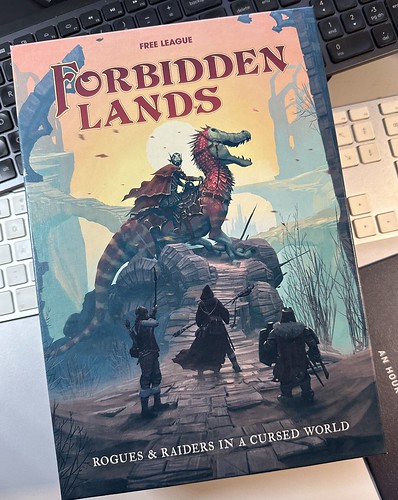
Forbidden Lands box set lying on a desk on top of two keyboard (lower one silver & white Apple, upper gunmetal and black Logi MX). The cover of the box shows ruins with a lizard creature with a rider on stopped on a bridge. The foreground shows three adventurers, one with a drawn bow, looking ready to confront the enemy. Text on box: "Free League - Forbidden Lands - Rogues & Raiders in a Cursed World"
The Forbidden Lands Core Box Set.

I originally wrote this back in January 2019 after I'd read the material from the Forbidden Lands initial kickstarter bundle over the Christmas period from Fria Ligan. However, it was buried in a general books post so I'm extracting it now. This is a game that I've yet to get to the table, but I'd like to. I've a hankering to visit the Bitter Reach.

Forbidden Lands RPG

The Forbidden Lands RPG comprises two hardbound leather-effect books; the Player’s Handbook (character generation, the game engine, combat, spells, journeys, strongholds) and the Gamesmaster’s Guide (principles of the game, history, gods, kin, a bestiary, artefacts, encounters, creating adventure sites and three sample locations). There’s also a large map of the Raven Lands and stickers to go with it, plus a more detailed handout guide to give characters a deeper background.

The game uses the Year Zero engine, as seen in Coriolis and Tales from the Loop. Like both those games, it has been tweaked to fit the setting. In this case, it has become significantly more lethal and dangerous. Characters are fragile, like those in early D&D. The dice pool rolls generate negative outcomes which can seriously mess your character up, making them ‘broken’ and vulnerable to critical. The game engine also moves away from just D6s. Although these are the standard dice, you can sometimes roll a D8, D10 or even D12, all of which can bring much more successes than the D6. You’ll need to be clever and alert to avoid injury.

The game engine also generates willpower points, which are a limited currency. They fuel spells and talents and can only be obtained by failing a roll in certain circumstances. If you don’t fail, you don’t refill your points pool.

There is a big focus on the exploration side of the game, and it is definitely influenced by The One Ring*. Players take different roles, and you need to ensure enough food and - especially - water or treks across the wilderness can go horribly wrong. The map doesn’t assume the location of any of the adventure sites in much detail from those presented in the book or in Raven’s Purge. The GM can position them, and use the stickers to mark up the map. If you clear an old ruin or watchtower, you can turn it into a stronghold, creating a mini-game not unlike high level D&D or Pendragon. Of course, setting up a stronghold is only the start of the story; holding on to it is the challenge.

[*In some ways ironic, because Fria Ligan have subsequently acquired the rights to The One Ring and have published a second edition.]

The rules have random tables for the creation of adventure sites, using a D66 in many cases, and wearing the OSR movement inspiration on its sleeve. The usage dice concept from The Black Hack is also adopted for consumables. The principles section would not seem out of place in a Powered by the Apocalypse Game

All in all, the game is a thoroughly modern take on a wilderness D&D style game, with hints of Stormbringer. It reminds me very much of many of the early Fighting Fantasy games, especially with the gorgeous B&W art (which is in a similar style to that which I grew up on). I would like to run or play this.

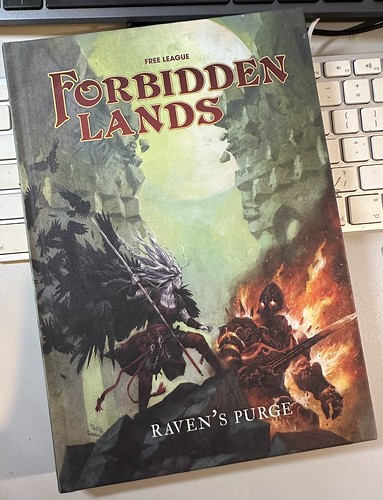
The hardcover roleplaying supplement 'Raven's Purge' lying on a desk and a silver and white Apple keyboard. The cover shows an pale elf-like warrior with a cloak of ravens facing down a burning armoured figure. Text on book: "Free League - Forbidden Lands - Raven's Purge".
Raven's Purge - the first campaign book

Raven’s Purge

Raven's Purge is the default adventure campaign for the game, but don't think you are getting something like The Temple of Elemental Evil or one of the other epic TSR sets. Instead, expect a pretty well written group of adventure locations which mesh together in a unique way for every GM as they will have to place artefacts and use rumours and NPCs to draw the PCs into the heart of the plot. This has more in common with GDW's Twilight's Peak for Traveller than the old epic D&D scenarios.

There's a lot to draw on here, nicely presented. That said, I think the GM will have to put some work in getting this ready (or be ready to manipulate it on the fly). There are a lot of core NPCs which can have varying motivations at varying places. I think the key to this would be to bring it in as a slow burn; ultimately, the characters may end up leading an army to attach the evil Sorcerer that dominates the Forbidden Lands, but they need to grow into that.

The only concern I have is that the game is very lethal, so the chance of playing through with the same characters may be lower than you'd like. That said, this is good stuff.

The hardcover roleplaying book 'The Spire of Quetzel' lying on a desk on a white & silver Apple keyboard, with a black and gunmetal keyboard just showing about. The cover shows a sorceress dressed in red, in front of a spire with clouds in the background. The Text says: "Free League - Forbidden Lands - The Spire of Quetzel"
The Spire of Quetzel - dangerous scenarios.

Spire of Quetzel

The Spire of Quetzel is a scenario book for Fria Ligan's Forbidden Lands RPG. This is a homage to the OSR movement and presents four adventure locations. The title adventure, written by Patrick Stuart, has the characters entering a spire to face a Demon-Queen. The blurb claims that it is very Moorcockian, and I think that's right as I could easily imagine running this with Stormbringer. The second adventure, 'The Bright Vault', sees the characters entering a vault that imprisons demon-spawn that could threaten the world. The sibling spawn all have different needs and motivations which can be played against each other. 

The third scenario, Hexenwald, has witches and necromancy, set in an area of forests and lakes not unlike the Black Forest or Russia. The NPCs all have interesting motivations and rivalries that leave plenty of opportunities for adventure. The final scenario, The Graveyard of Thunder, has the characters drawn to an adventure site where one of the last of the Thunder Lizards prepares for its death. They face orc rivals and the threats of a guardian.

I liked this collection, my favourites being 'Hexenwald' and 'The Spire of Quetzel', both of which I'd like to run. This is a short collection of good adventures that will certainly be remembered by the players.

13 January 2024

[reMarkable 2] 3 Years On…

A reMarkable 2 tablet held in a grey polymer folio case with the reMarkable logo on the bottom right in white.
Well used reMarkable 2

I’ve been using my reMarkable 2 since November 2020 (Batch 5 preorder).  It’s worked solidly since then, used multiple times daily at work and for home activities. I know at least five people who’ve bought one having tried mine (plus one who got a Kindle Scribe and another who got a Boox). I bought my eldest a second hand rM1 for college which he loves (I do like the robustness of that version). 


I keep it in the tablet sleeve you can see behind it when I’m not using it. I finished the first lot of nibs about 3 months ago. I have the marker plus and it’s still working fine. I did clean the folio last year following advice from here. The edges are a little frayed and you can see the use, but it looks smart still. 


The battery life is good (but I mainly work in airport mode). 


I’ve tried the Lamy, the Norris Jumbo and the HP pens and each of them are great for the right mood but I keep coming back to the marker plus. 


I love using it outside in the summer; sometimes I’ll step away from the teams calls and just use the phone. 


It’s been updated at least 20 times as the software has got much better (the only bit I’m not so hot on is the way OCR works now). I’ve never gone beta as this is a work tool for me. 


I scanned my old Leuchterm and Moleskine notebooks to PDF and added them in as a reference. 


It just works. 


I do treat it like a £500 device (which it was with the accessories) and look after it. I’d replace it in an instant if it broke. 


I’m posting this because all too often all we see are the stories when something has gone wrong. After three years, this still delights me everyday.