19 March 2023

First Impressions - Pirate Borg roleplaying game

Pirate Borg
Pirate Swag

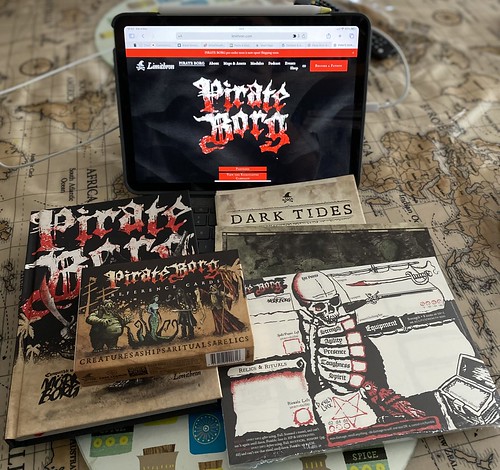
Pirate Borg is a pirate flavoured take on the art-punk Mörk Borg roleplaying game, which I’ve previously covered in its cyberpunk version CY_BORG. Published by Fria Ligan under the Free League Workshop, Pirate Borg is a 168-page small hardcover, packed fill of thematic artwork, with two ribbons. The cover is matte in black, brown, white and red, with some clever use of spot UV to emphasise certain aspects of the images. Written by Limithron (Luke Stratton), it packs a lot into a small space. As usual, the end sheets contain useful reference material. The artwork impacts the readability significantly less than it does in CY_BORG and Mörk Borg; it’s still striking but works much more sympathetically with the eye, not impacting legibility. The book is not yet on general release; my copy was a late pledge on the kickstarter which came with a map, cards, zine and character sheets for use at the table. 

TL;DR: Pirate Borg is very well done; it takes the Mörk Borg engine and turns it into an evocative and thematic pirate game. It is beautifully presented and clearly written. You could easily use a large part of this book as a reference for other games, lifting the copious random tables to inspire a game using another system. The example setting is a flavourful sandbox. This deserves to be a big hit when it gets into general release.

The general release has been delayed as one of the zombie images caused concerns as it was being interpreted as racist; as a result, amendments have been made and the retail version will be a different printing. Stickers will be made for the the remaining stock. It’s a solid response to an unintended situation, as it’s clear from the credits page that the author is well aware of the potential for elements of the setting’s source to cause distress.

“Pirate Borg is a game about grog-swilling pirates, undead galleons, arcane treasures found in ancient temples, and high seas adventure. It's not a game about slavery, sexual violence, genocide, or any of the other abhorrent real parts of our history. Please treat these topics with the respect they deserve, or leave them out of the game altogether and go hunt some skeletons.” (from the first page) 

The book is set in the Dark Caribbean, a twisted echo on our worlds. It is a paradise threatened by the Scourge, a rising wave of undead and horrific monsters which have emerged from the sea. The burnt remains of undead are used as a psychedelic drug called ASH. The pirate faction, the Brethren of the Coast, formed the Republic of Pirates based out of the ruins of Nassau Town on New Providence Island and Tortuga. The old colonial powers are there: the British with a weakly supported Royal Navy supporting the Machiavellian West India Company; the French remain, decadent, dissolute and corrupt, everything is for sale in the French Indies; the Viceroyalty of New Spain has its heart in Cuba, but the Inquisition also resides in a citadel on the mainland. The Yucatan keeps its secrets close and expeditions such as Cortes’ just disappear, but the rumours of gold endure. Finally, sailors tell tales of The Sunken One returning, as foretold in the Necronomicon, and the Abyss opening up. It’s a well constructed mix ready for the player characters to light the spark.

There is a d66 table, detailing how the Dark Caribbean will move towards the Apocalypse (unless the players intervene). Unlike its sibling games, there is less direction on how to apply the history of events and happenings to drive the plot; it is left to the choice of the scurvy dog who runs the game. There are six threads, with six stages of escalation each. It does remind me a little of a simplified Dungeon World adventure or campaign front. There’s a lot to inspire an extended campaign; this is one of the strengths of the book. There are a lot of ideas and tables which could easily be lifted to run with other engines in a setting (for example D&D or the long out of print Pirates of the Spanish Main).

Character generation starts with the player rolling for the basic equipment they have; a container (which could range from a bucket to a dinghy), something cheap, and something fancy. Next up are ability scores; these are rolled on 3d6 and modified by class (unless you’re a classless landlubber and roll 4d6 and drop the lowest dice). A table turns these into a modifier from -3 to +3. The abilities are strength, agility, presence, toughness and spirit. 

Tests are made by rolling a d20 and adding the ability modifier. The base difficulty rating is DR12 - a target number of 12 to roll above (ie a 40% chance of success for a character with zero modifier). The game is player-facing for tests that affect characters (but GM can roll if appropriate - for example a creature climbing up a mast after a character). The failure rate is something to be aware of; if you want more competent - dare I say heroic? - characters they’ll need to gain experience (but the modifiers top out at +6, so there will always be a 30% chance of failing a DR12 roll). Starter characters do have a risk of being like the comedy duo from Pirates of the Caribbean if they aren’t careful.

The next rule presented is ‘holding your breath’, as drowning is likely to be a commonly present danger.

Combat is pretty similar to its siblings; there are initiative options for group or individual rolls. You critical for double damage and degrade armour on a natural 20 attacking or can make a free attack if defending, and you fumble on a natural 1 (breaking or losing your weapon if attacking and taking double damage and armour degradation if defending). Fumbling a black powder weapon has its own table.

Core character classes start with the Brute, a rough melee combatant whose trick in trade is violence; they cannot use arcane rituals. There’s the Rapscallion, a sneaky, backstabbing thief and swindler, with the luck of the devil until the devil comes to take them to hell. The Buccaneer is a skilled tracker and survivalist, and a specialist sharpshooter with a musket. It wouldn’t be a pirate game without a swashbuckler; they’ll have their own flamboyant fighting style and a feat that brings out their swagger and bravado. Zealots are often members of the clergy, but could be a cultist or a shaman. They have prayers (spells), an affinity to arcane rituals and relics and plenty of luck from whoever they serve. The final core class is the sorcerer, a conduit for spirits and necromancies entities. They too have an affinity for arcane spells and rituals, but cold iron and metal inhibits their powers. 

There are also optional character classes which are slightly more offbeat in flavour. They each add something a little different, which may not be for everyone. The first option is the "Haunted Soul" which I mentioned earlier. This includes all manner of different supernatural creatures including ghosts, spiritual conduits, zombies, vampires, skeletons and eldritch minds (you're drawn to the deep and have visions of antediluvian horrors). All these classes are twinned with a core class. Hence, if you die, you could come back as a zombie or ghost. 

The other optional class is the "Tall Taled". You can be a merfolk (fish-tailed, but with an additional core class); an aquatic mutant (some kind of union between man & the sea, also gaining a core class) or a sentient animal (no additional class). Drawing on a variety of genre appropriate sources, all of these give a chance to be something a little different. 

Base hit points are d10 + toughness if you’re a landlubber, or class dependent. Zero hit points breaks you - negative hit points kills you. If you’re unlucky you may be allowed to bring a dead character back as a haunted soul. Otherwise you recover some HP from a short rest (d4) of around 10 minutes or more (d8) from a longer rest overnight. There are reaction tables for creatures (which mean they won’t always attack) and also morale rules to see when they will break.

There are random tables for backgrounds (which give you starting cash and additional equipment), distinctive flaws, physical trademarks, idiosyncrasies, and then unfortunate incidents and conditions that you have suffered from in the past. Finally, your character gets a 'thing of importance', an item that means a lot to them, but you'll have to decide why. All of these are decent hooks to hand a character around. I hope that there will be an online generator for characters, similar to those for CY_BORG and Mausrítter. 

Experience can boost or reduce your ability modifiers (but they’ll never go down so long as they’re at +1 or less), raise your hit points, give you a new class feature and a new item. There’s no set trigger for experience.

Weapons range from blunt force implements like Belaying Pins through swords and axes to black powder weapons like flintlock pistols and muskets.

Magic is approached via arcane rituals and ancient relics. There are twenty example relics, drawing on all manner of inspirations (Christian relics, Mayan and Lovecraftian artefacts are all included). Arcane rituals can produce quite powerful effects (for example summoning the Kraken or controlling the weather) but failure results in a roll on the mishap table, which can be quite devastating at both a personal and regional level (for example, causing a significant earthquake, breaking the laws of physics, going insane, or being attacked by creatures). 

Sea Shanties are a more subtle form of magic; if a ship’s crew can manage to sing them together harmoniously (or at least by passing a skill test), then they can get a benefit. The Captain’s Spirit Ability rating influences the number of shanties a crew can use in a day. Effects range from changing the weather through, to helping carry out tasks to affecting other vessels.

Alchemy is also available as an option, with tables for the kind of potion, effect and the DR (difficulty rating) to resist (should you want to). You can roll randomly or just choose the outcome.

Naval combat is covered in detail, with a simple but effective hex based system. Ships are defined with a simple set of statistics, and hit points scale between people and vessels by a factor of five (so a 20HP ship has 100HP if attacked with a personal weapon, and a ship’s cannon doing d8 damage to another ship would do d8x5 to a PC if it hit them). Rounds are typically 30 seconds long, although there’s some flex in that. Ships move, then non-Captain PCs can take a crew action. Crew action examples include firing a broadside, raking a ship with small arms fire, coming about, dropping and weighting anchor or sending a boarding party to capture another vessel. Crew actions cannot be taken once a ship is in close combat.

As well as combat, other maritime operational aspects are covered such as speciality crew, skills and morale, and all manners of operational needs such as careening the hull to remove barnacles and carry out repairs. There are rules for wether and wind, plus a good selection of random tables for encounters and events and the flotsam and jetsam your ship encounters when travelling around the Dark Caribbean. There are plenty of example ships ranging from the raft you escape from your shipwreck on, through to a Ship of  the Line that you may encounter from the Royal Navy or French fleet. Of course, there are also more mysterious vessels such as Ghost Ships and Vessels that have risen from the Deeps.

There’s a decent bestiary with a variety of interesting examples, and then procedures for creating your own enemies. Skeletons, Zombies, and Ghosts all get their own spreads and are nicely illustrated. There are more esoteric and weird creatures, including drowned sailors, Sirens, Deep Ones and the fearsome Coral Shoggoth. Of course, all these pale into insignificance in the face of the fearsome Kraken when it rises from the depths, and the less said about the Leviathan or Davy Jones, the better. There are also examples of Naval crews and the Inquisition, along with more unnatural enemies such as necromancers and the Sunken Ones. A more unique option is for ‘marrow cannons’, sentient undead cannons, created by necromancers. There’s a lot in this to sustain an extended campaign without needing to create more. 

Ship encounters are covered by random tables including their cargoes. Derelict vessels are also covered with extensive options, as is buried treasure (what pirate game would be complete without this?) and treasure maps (including riddles and clues). There’s a section written by Jacob Hurst [Swordfish Islands] to generate Uncharted Islands. This is done in a similar style to the Dark of Hot Spring Island, which is great (and you should check out those books if you get a chance). The plethora of GM material rounds out with a random pirate generator and a section giving random jobs and quests, plus rumours that could be rife in the port the crew find themselves in. 

The book concludes with ‘The Curse of Skeleton Point’, a 33-page ambitious sandbox setting to kick off a campaign, set on the small pirate run island of Black Coral Bay. There are multiple sites to explore, factions to provoke and ally with, and plenty of hooks. There’s a basic plot line that will develop if the characters don’t interfere which raises the stakes tremendously. Will the characters work with the Governor or ally with Captain Davies?

The book concludes with a reference spread for character generation on a single spread and indexes for the book and for creatures. The end sheets have useful material for encounters at the front of the book, and for naval combat, abilities and tests and violence at the back.

So what do I think?

Pirate Borg is done very well; it takes the Mörk Borg engine and turns it into a evocative and thematic pirate game. It is beautifully presented and clearly written. You could easily use a large part of this book as a reference for other games, lifting the copious random tables to inspire a game using another system. The example setting is a flavourful sandbox. This deserves to be a big hit when it gets into general release.

19 March 2023


18 March 2023

Curse of Strahd - Initial thoughts on ending


The campaign ended this week with an appropriately brutal finale, which I will write up later.

We started on 20th November 2019, before the pandemic, and ended on 15 March 2023. We started off with a session every two weeks and then a one to two month break between seasons, but accelerated for the last few seasons to mostly weekly, adopting the rule that we would run if three of the four players were available.

We had four players make it all the way through; Paul (Ser Adon), Tom (Ser Alys), Graham (Kelwarin) and Alex (Gaddock). Jag (Roscoe) played in the early campaign and his character returned for a cameo at the Amber Temple towards the end.

We ran using Roll20 as the VTT throughout (as I bought the module) but used Discord for the audio for the first few seasons (and ironically for the last session as audio was flaky).

I clocked 345 hours on the VTT, as there was a fair bit of prep work that I did. By the end of the campaign I'd upgraded to a paid for Roll20 membership and had started using scripts. I'd also picked up most of the core Dungeons and Dragons 5E books on the platform (except Tasha's which had very poor reviews). Roll20's core engine was solid and there were continuous improvements throughout. It's not my favourite VTT but it does the job well. I used two different Chromebooks and later a MacBook Pro for running.

I used the Beast of Graenseskov as an introduction to take the characters from Level 1 to 3 and enter Barovia. I also drew upon The Stygian Library when the characters visited the Abbey of St Markova. When they returned, I also worked in The Carnival using a modern reinterpretation and the original AD&D2e book as references. I also drew heavily upon the MandyMod and DragnaCarta remixes for Curse of Strahd from the r/CurseofStrahd Subreddit and they added a depth and flavour beyond the core book. If anything, I followed MandyMod for the treatment of the Fanes and leaned into DragnaCarta for some of the set-pieces. The subreddit was an invaluable source of ideas and maps for the VTT.

I ended up buying the campaign on DNDBeyond (along with core books) as it was an easier way to reference it when travelling with work. I was generally happy with that, until Wizards started the whole OGL shenanigans and that kind of put me off fifth edition for a bit (it delayed our restart by about six weeks after Christmas). 

I went into the campaign owning the core D&D books, Curse of Strahd and Tomb of Annihilation, and by the end of it I had ended up buying a lifetime worth of books for the pace that I run. I may well want to revisit some of these campaigns, perhaps the shorter ones.

5E
Too many D&D 5E books (and some stray troubleshooters)?

The final combat was full on; Alex recorded Strahd (and his armour) taking around 542 hit points damage. But how is that the case? The first 100+ hit points damage went into the armour which they full on attacked assuming it was Strahd. The Heart of Sorrow absorbed another 100 hit points (yes, that’s upgraded from the core book). Strahd himself had 161 hit points (again, using the CR27 version). However, he could regenerate 30 hit points per round if he didn’t get hit by sunlight or radiant damage, which I made liberal use of. In some ways, forcing the battle to the larger outdoor space of an island gave Strahd the opportunity to disengage. The lake wasn’t enough to be running water, and he didn’t need to breathe, and there was plenty of mist around, even before you consider the potential for greater invisibility. In honesty, I’m confident I could have engineered an escape from the island (easy enough when the villain can summon a huge cone of bats and transform into one) but I’d realised the players wanted to end this. Redoing it at the Castle would have been frustrating. The ending, with a ennui laden Strahd challenging Ser Adon to a fight felt very apt. He didn’t expect the Paladin to try to cheat.

Several of the characters went down, and were on death saves, but the others brought them back and generally made it difficult for Strahd to take them out via massive damage (despite the significant levels of necrotic damage they’d taken) by being in the way. Luck played a part, but that’s a good thing.

It was a strange feeling when they took Strahd down, but I enjoyed that they way that they did it left a hint of ambiguity. More on that when I write up.

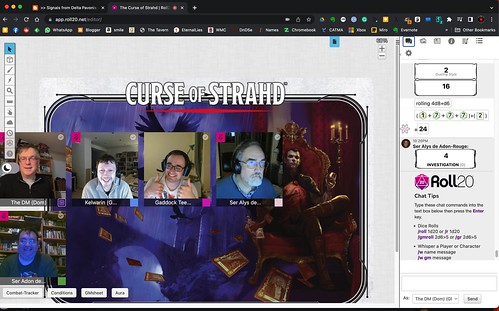
Last screenshot from the campaign is below… mostly all smiles.

I’m sure I’ll think of more as I write this up.

18 March 2023

The End of Curse of Strahd
The end of the road.

08 March 2023

Games update


The latest doughnut of games

Have started slowly, Revelation helped my game count for the year considerably. The mix looks very different at the moment with a single D&D5e game (today) as I returned to Curse of Strahd after a couple of months hiatus (thanks to OGL casting a shadow and some work and life complications). We're very close to the end now.

My most played game remains the Yellow King, but City of Mist is close behind. Just under half the games have been face to face. I expect that we will have another few sessions of Strahd, and then D&D5e will fade away for a while, but Trail of Cthulhu will reappear as Eternal Lies is restarting this month.

I've a few sessions of Graham's Heroic Fantasy 2nd edition Playtest to do as well, which should be fun.

The next big question for me is what will I replace the tent pole in my gaming that Strahd has been with. I suspect that it may be a shorter form campaign, but what exactly I'm not sure.

8th March 2023


04 March 2023

Books in February 2023


Reading Track

February 2023 saw me read 10 books with a total of 1,932 pages. 3 novels, 1 graphic novel and 6 roleplaying books. I managed to read every day again. So that's 17 books in the first two months of the year.

The novels included a re-read of The Silmarillion (which has been by audiobook over January and February), the first of First Age's reading challenges. This was a delightful re-read of a favourite; the audio book brought out aspects of the story that my natural reading style doesn't, and also embarrassed me about nearly four decades of mispronunciations with certain characters! I also read the first book in Joe Abercrombie's First Law trilogy (again thanks to First Age's February challenge) and enjoyed it a lot more than I expected. I also returned to an SF favourite (Neal Asher, the David Gemmell of SF for me), with a new standalone novel, Weaponized. There a subtle hints on how it is a prequel to some already published books that are later in the Polity Timeline. I enjoyed all the books for different reasons so there's not really a standout this month.

The graphic novel was the sequel to the Blade Runner - Black Lotus anime, which was enjoyable, but not really earth shattering. However, it's lore to draw upon with the roleplaying game.

I read Godbound, the demi-god level roleplaying game by Kevin Crawford with was excellent. I do find his writing hard going; there's a lot of text and I think I'll definitely need to go through this again and make notes if I want to run it (which I do). The MÖRK BORG supplements Heretic and Feretory were great additions and both of Chris Bissette's scenarios for the same (Treasures of the Troll King and Into the Bluelight) were excellent and I can imagine getting them to the table.

I didn't really connect with Lukas Rolim's Pacts and Blades, a Moorcockian flavour micro-roleplaying game. It didn't really work for me; I've passed it on to First Age to see if he gets some more from it.

Overall, a good month for reading.

Overview here - https://app.thestorygraph.com/books-read/cybergoths?month=2&year=2023

4 March 2023


14 February 2023

The Seventh Revelation (After Con Thoughts)

This weekend saw the seventh (!) run of our Powered by the Apocalypse and Forged in the Dark themed roleplaying game convention, Revelation. As usual, it was held at the Garrison Hotel in Sheffield.

The run up was relatively smooth, but we did have to give a nudge to get the player numbers to the right place (people seem to be committing a bit later post-pandemic) and a harder nudge to get the number of games offered to the right levels. That included lifting the usual restriction of two games per GM that we operate with. As a result I found myself preparing and offering three games rather than the usual two.

I drove up on the morning, to find that Graham and Elaine had set up bar the signs and the badges that I brought with me. With little hesitation, we were off.

The main challenge that we had with the convention was ill-health. We’ve noticed that post-pandemic people have changed; if they aren’t well, they’ll tend not to come to the convention to avoid spreading ill-health and illness amongst the attendees. We had a drop out rate of over 25% this time, which was worse than the great plague year at Furnace (which disproportionately hit GMs) but managed calmly and effectively by Elaine. As the convention is fully pre-booked, we knew which games had spaces and could direct people in the right way. 

Revelation - Kult
Kult - first slot

My first slot was in a game of Kult. This is a setting and system that has intrigued me for a while. I know that there is some kind of cosmic horror behind it with our reality separating us from it in some way. I saw a session from a GM that I rate and signed up. We played broken individuals who were on a fifty mile hike through the Peak District. Two of us were ex-SAS, along with an ex-Army Medic and one of the SAS veteran’s siblings (a model). The game started off well, with people getting into character pretty well; the pre-generated characters had some great hooks. There were some wonderful props, which added to the atmosphere. Needless to say, it didn’t go well for us. Although Kult isn’t folk horror, the scenario had that vibe, right up to the reveal at the end. My character died horribly, but it tied off his backstory nicely. 

Kult is Powered by the Apocalypse, but uses 2d10. It seems a decent iteration of the engine, although I do wonder how it will work in a shorter campaign as it felt that you could spiral into a breakdown really easily. I don’t think it has hooked me enough to buy a copy, but I would definitely try it again.

Lunch was a salad from the limited selection at the local Morrisons. Limited because two of their fridge units were down.

Revelation 2023
Behind the City of Mist Screen

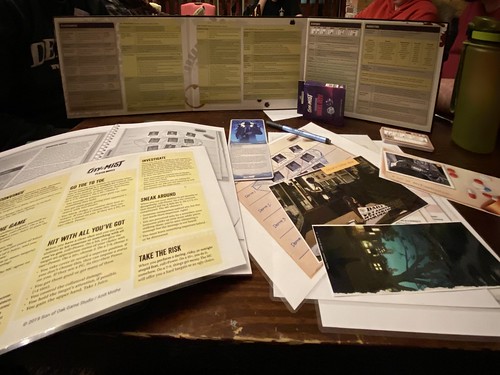
The afternoon saw my first City of Mist scenario, “Beating Hearts”. City of Mist is now my most run convention system and probably my most run PbtA game engine. I have all the bling and I intend to use it. It’s set in ‘the City’, a metropolis not unlike New York where Rifts walk the streets manifesting mythical powers, hidden by a magical mist. The feel is very much Netflix Marvel; lower powered heroes in a noir-like setting. The players picked a good variety of options; three of the them had signed up for both sessions I was running, so it gave a degree of continuity. The scenario itself went reasonably well; I’d picked it up from the City of Mist Garage on DrivethruRPG and it was the first non-official one that I’ve brought to the table. Overall, I think it went well, but there were some areas of the scenario which were a little bit inconsistent and it did expect a certain route to resolution. In the end, we finished earlier, with the crew taking down a local mobster and the rift controlling her in a warehouse by the river. It felt an apt conclusion, albeit a bit rushed. Both Elaine (who was playing) and I thought the slot finished at 1830, but in fact it was 1800. Oops!

Traditional trip to KFC with Keary for a good natter for dinner.

Revelation 2023
The Amnesia Town Crew.

The evening brought my second City of Mist scenario, “Amnesia Town”. This is quite a different scenario to the ones that I have run before, as it introduces the Gatekeepers, an organisation which uses the Mist to suppress knowledge of Rift activity. They’re a big player in the overall setting, but sit in the background. The scenario aims for a 1950s dystopian feel, with government agents suppressing knowledge in a conspiracy. The scenario delivered in spades, especially when I started to hit characters with impediments to their memories as they started get in the Gatekeeper’s way. All the way through, the Gatekeepers were referred to as the ‘Federal Bureau of Weather’ (because they deal with the Mist) and they really rubbed the players up the wrong way (which is part of the scenario’s aim).

Revelation 2023
A lesser spotted picture with me on.

As well as the memory issue, there was look of horror from one of the characters when I burnt out some of their mythos power tags as they threatened an Agent. In the end, the characters saved the day by working with the Agents. It seemed to down well.

Revelation 2023
Ready to play a|state

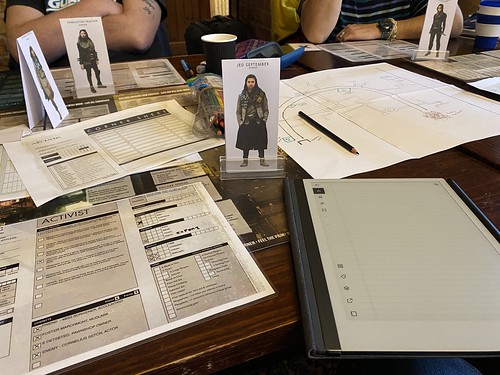
Sunday morning saw we trying to pin the slipperiness that is Forged in the Dark into my brain, ready for a|state in the afternoon. As part of that preparation, I signed up for Graham’s run of the same game that morning. He was using ‘The Machine’ as a basis, whereas I’d gone with ‘Gone to the Dogs’. He gave a masterclass in energy and characterisation. We stumbled through a bureaucratic nightmare, becoming activists working against a corrupt planning decision that had our whole neighbourhood under threat. It was very Dickensian and very British in feel. We secured a good initial win, but ran out of time to bring the full case to closure.

Revelation 2023
Clocks Galore

Both Graham and I had been nervous about running the system, but I don’t think he needed to be, as he showed how clocks should be used and kept us on our toes. Mission broke out and were resolved during the session, as we moved from free-play to mission to downtime. 

Revelation 2023
All set up but illness wins…

I set up for my game of a|state, only to find I would be down to two players which wouldn’t be viable. Tiredness and lurgy had struck again. I may take some of the learnings I got from Graham and tweak the material I’ve prepared and use the scenario at North Star as it is dystopian SF at heart. I found one of the player’s another berth via Elaine, and made my goodbyes, leaving a Garricon early for the first time I recall. 

Overall, I enjoyed the convention a lot; the mix of players is always different at Revelation and the games have a slightly different style. All in all, good stuff and I hope we’ll run another next year. Thanks to all the attendees and my fellow convention organisers.

14 February 2023

04 February 2023

Books in January 2023


I managed to read every day this month

So, the first reading update in a while. I’m now trying StoryGraph to log my reading as it’s faster than Goodreads and also more flexible in adding obscure books to the database (ie roleplaying books).

Seven books read in January, 2079 pages, 4 roleplaying games and 3 novels. The novels were a thriller, fantasy and science-fiction.

The 7 books this month

The Red Scholar’s Wake by Aliette de Bodard was the best book I read; a SF romance between a human and an AI set against the tensions between factions of a pirate fleet. Highly recommended.

The best roleplaying game I read was Blade Runner, but a||state came very close.

Although I managed the daily reading challenge, I did finish the Silmarillion a couple of days late in the ‘read along with First Age’ group on the Gaming Tavern.

4 February 2023


29 January 2023

The Bird Site Massacre

Victims of the Bird Site Massacre

So, as I feared, the worst was confirmed; Twitter deliberately killed off the third party clients without notice, despite their helping drive the service's development and often being used by the more active users. Twitterrific and Tweetbot and more gone without warning to company or users. Twitter's developer terms and conditions retroactively changed to make such services unacceptable. 

Confirmation of death - Twitterrific
Confirmation of Ollie's demise

This made the decision to leave the bird site quite easy for me; I exported archives of my data (which come as a funky HTML set up so you can explore them and closed down both my accounts. They'll auto delete in less than a month. The BITS Traveller account is still there but we're discussing what to do with that (and, to be honest, it's mostly been dormant since the pandemic hit). So if you want to find me on social media, you can hook up with me on Mastodon, where I'm on the Dice Camp server using my usual Cybergoths tag (something from university, don't ask!).

It was a strange feeling killing the accounts. I opened the private one on Friday 3 April 2009 at 7:24 in the morning and closed it at 21:40 on 22 January 2023. The public account was started later - Sunday 5 June 2011 at 10:14 - and closed last at 12:19 on 26 Jan 2023. They've been there a while, but increasingly had less value and engagement as the algorithms that drive toward contention made Tweeting more and more like shouting into the void. Twitterrific combated that, but the reduced API access that the application got over time didn't help the bird site be more approachable. Functionally, Twitter has been dying for me for quite some time, so I guess I should thank Space Karen for pushing me over the line to decide to leave. To be honest, using the official Twitter app and website made it clear it wasn't for me anymore.

Failing Twitter Engagement

The failure of Twitter on engagement was shown by a Mastodon toot by Ged Maheux, one of the Iconfactory team. They've 16.1k followers on Twitter and 4.1k on Mastodon. They tweeted the same material on both sites and got 9 likes and 3 retweets on Twitter and 287 favourites and 163 boots on Mastodon. Others are reporting the same.

I like what I see on Mastodon, especially now Tapbots have released Ivory, a Mastodon app for iOS which uses their experience on Tweetbot to create an excellent application which is actively being developed. The basic Mastodon app was fine, but Ivory jumps it to another level. Mastodon reminds me of early Twitter crossed with Google+, which is a good thing. I do get a bit annoyed with some of the others who have fled from Twitter or are hedging their bets on both sites who keep on using Twitter conventions and posting Tweets. I don't want Mastodon to just be another Twitter, I want it to be it's own thing.

Project Phoenix - Twitterrific
Project Phoenix About dialog box.

I do hope that The Iconfactory re-enter the space using their experience from Twitterrific but Tapbots are also doing a great job and winning me over. I had a connection to Twitterrific because it was how I discovered Twitter, and I'd also backed the Kickstarter to update the macOS version of the app to match the iOS one.

Thank you to The Iconfactory for 14 years of excellence, and thank you to Tapbots for making the jump to Mastodon and bringing a great experience.

Let's see where the herd takes us. 

29 January 2023

28 January 2023

A fork in the road

A Fork in the Road - CC-BY 2.0 (Attribution Generic)

Last night, Wizards of the Coast finally started to get ahead of the crisis curve that has engulfed them since #OGL 1.1 leaked less than a month ago. They announced that OGL1.0a was not going to be removed (thus avoiding the potential for litigation had they done so) and that the entire D&D 5.1 system reference document was being released under a creative commons licence. They did this in the post, with a linked file. That sent a shockwave through the community as people hadn't expected Wizards to roll back this far, this quickly. Now, it's arguable that Wizards didn't actually have the rights to licence some of the material that's in the SRD (as it isn't copyrightable in principle) but in placing it into the commons, they've taken a lot of ambiguity away for third parties. 

Wizards' crisis communication and public relations throughout this has been a disaster, and the whole affair has cost them goodwill and trust. It also cost them financially; many people have cancelled D&D Beyond subscriptions, a lot of people have bought alternative games (for example Pathfinder and Paizo selling huge amounts of stock) and much of the third party industry has started a move away from the OGL to either new systems or careful use of language to avoid infringement.

So we won, right?

From a certain perspective, I think we did. I expect to see most of the industry drop the OGL (even on legacy documents) and switch to the Creative Commons SRD. This is a smart thing to do, because it avoids any risk of a repeat from Wizards of the Coast or another, future, IP owner. This secures livelihoods and allows third parties to release material without fear. The SRD also includes terms which weren't there before (like Strahd, Mind Flayer and Beholder) and were withheld as D&D IP(*).

However, I think this is a fork in the road.

The senior leadership at Wizards is committed to a video-game like future, with micro-payments and increased monetisation. A good section of the existing player-base may not follow the pivot to this as OneD&D is released, preferring to stick with pen, paper and dice even if played over the current generation of VTTs. 

Imagine a future when all new D&D releases are digital and you can't use them beyond Wizards VTT ("We've made it easier by hiding all the rules and stats - you just tell it what kind of test you want"). Imagine a future when Wizards remove D&D5e compatible material from D&D Beyond in favour of OneD&D. And by remove, I mean stop you having access to the material you've paid for. They'll sweeten it of course, probably giving access to the new core rules for free if you own the older version, and perhaps discounts on settings. Imagine them pulling the plug for material you've bought on other platforms like Roll20(**)?

Doesn't feel likely? Remember that they did this before with PDFs on RPGNow without warning. The current D&D Beyond terms allow them to do this.

2.1. License. Subject to your compliance with these Terms, Wizards provides you a limited, personal, non-exclusive, nontransferable, non-assignable, fully revocable license to use the Websites and Services solely for your individual and non-commercial use. Wizards may terminate or suspend any or all portions or features of the Websites, Games, or Services at any time and for any reason or for no reason with no liability to you. This license does not give you any ownership rights in the Websites, Games, or Services. Any rights you do acquire in the aforementioned will forever be owned by and inure to the benefit of Wizards, and as applicable, its successors and assigns.

Think of the SRD passing into Creative Commons as a parting gift; we can play on, do our own things, but the brand of Dungeons & Dragons may be going somewhere else, somewhere the current management (who aren't role-players but video-gamers) think that you'll have more fun and that will make them more money.

28 January 2023

(*) I wonder if this was unintentional, as the release may have been rushed?

(**) Roll20's Marketplace FAQ suggests that Wizards can't pull material you've paid for if they remove it from sale, but we don't know what the commercial terms are between the two companies (which incidentally includes DriveThruRPG).
 

19 January 2023

Winter has come

Winter has arrived

Away with work in deepest darkest East Anglia at the moment; glorious skies last night with a fantastic view unimpeded by clouds or light pollution meant a deep frost this morning. Winter has definitely come.

19 January 2023