29 July 2023

The unwritten posts

Looking at Blogger today, I realised that I’ve got at least four posts that are hanging around and need to be written.

In no particular order:

1) The third part of the review of the Helvéczia roleplaying game box set. Mainly delayed because I got distracted by other things and need to read the Ammertal and the Oberammsbund module again. I really should do this, if only because that set of reviews are probably the most read on my blog overall.

2) The review of the Swords of the Serpentine roleplaying game. This is 80% written on my reMarkable. I suspect it will now involve skimming the book again as it’s been probably a year since I started this. Maybe I should run it a Furnace to get the motivation together to complete this?

3) The review of the Liminal roleplaying game line. I started this once I finally read through the books over the Easter holidays. However, I was having second thoughts; I regularly play with Dr Mitch and was a play tester in some of the casebook scenarios. Can I do this objectively enough? Does it matter if I just be upfront about my links to the game?

4) The final Curse of Strahd post, covering the last two sessions and the aftermath. I’ve been delaying on this, partly as it means admitting that it’s over and partly because it means going back to a discussion which nearly had me abandon the campaign before the final battle. I’m being silly and should do this.

I’m also conscious that #RPGaDay is upon us in a few days and the questions look decent this year.

Note to self - get a grip and get these written!

29 July 2023

First Impressions - Baklin: Jewel of the Seas - city supplement [OSR]

Baklin: Jewel of the Seas
Welcome to Baklin...

I was away on business this week so I slipped another of the EMDT zines into my bag to read in the hotel. This time it was Baklin: Jewel of the Seas which is a medium sized city supplement with statistics for most OSR games. It's 70 pages long with the inner coversheets being used for maps. As you can probably see from the picture above, there are two A3 maps provided. One is a player facing city map, while the second gives the same map with details for the GM and further maps of the three levels of the undercity. It comes with the PDF, fulfilled via DriveThruRPG.

Baklin is set on the island of Erillion, and is a seat of merchant power. Erillion is has been explored in EMDT's Echoes from Fomalhaut zine, especially over the first five issues. However, I haven't read those (although I intend to remedy that) and I picked this up because I'm a sucker for a city supplement. The introduction by the author states that Baklin has two objectives; to serve as a base for an adventuring party to work from and to act as an adventure site on its own. I think that the book nails this. 

The layout is clear and illustrations - all black and white - which are evocative. The text is better than that produced by some native English-speaking publishers (EMDT are Hungarian). It's clear for the GM to review but perhaps not as sharp and bullet-pointed as you'd see for an OSE book.

The city is built around a safe harbour in the limestone hillside; it is the dominant town in Erillion after the old capital fell. It sits at the midpoint of trade between the Coastlands of Kassadia and the Twelve Kingdoms to the northwest. The city is ruled by Prince Lodovic and his beautiful wife Arkella, but governed by the city bureaucracy, an arrangement agreed to some seventy years ago when the family became the rulers. Sadly, the Prince and Princess have not produced an heir and there is likely to be a succession crisis some time in the near-term future.

The city is has two rule codes; the Sea Laws (harsh, brutal and fast, governed by the Captain's Council) and the Old Ways (the common law of Erillion, less brutal and based on precedent, adjudicated by the Prince). In most areas except the Hightowne, the Sea Law holds sway. This is corrupt; there are arrangements with the Thieves Guild and an appropriate (but swift) payment to the Maritime Fund can result in a miscreant's discharge from the law without consequence. However, those that fall foul may find themselves sent to the Sack, hung in a leather man-sized sack and beaten to death. 

The Council provides security with the City Watch, and the Prince has his own guards, the High Watch. They include a unit which carries out espionage and acts on matters of state interest; you don't want to fall foul to this unit as you may come to a nasty or unknown end. The Knights of Yolanthus Kar, historically significant in the fall of the Wrath Queen Arxenia, are also based in the city, but they mainly serve to deal with the dead to prevent an outbreak of undeath. They have far less respect in Baklin, because Baklin is interested in the maritime trade routes and not the interior roads that the Knights keep safe.

The Thieves of Baklin are preeminent in the city, but increasingly under pressure from the assassins of Gont, mainly as the present Guildmaster Hyacintho Eskumar (referred to as 'the Popinjay' disrespectfully) is more interesting in living the high life than keeping his house in order. As a result, foreign thieves are more common in the city, whereas in the past they'd have been driven off, killed or sent to the Sack. The Gontsmen are increasingly becoming active in the city. 

Access to magic beyond third level spells requires a candidate to visit the mage tower to undertake a Trial. This can be done once; if you fail, although you will get the spell slots, you won't get the higher level spells. Likewise, Clerics must undertake a holy quest to access higher level powers. However, Baklin does not encourage religion, so Cleric characters may have to keep a low profile or at least avoid making enemies. 

Naturally, a random table is presented for encounters in the city, before the zine embarks on a tour of locations (39), all of which provide hooks and very short descriptions to build from. Any needed NPC stats are provided. Many parts of the city's cellars provide access into the undercity; you can travel across town without going on the surface if you know the way. However, it is dangerous; underground is out of sight and most of the dark and dangerous things that happen in the city are down there. However, there are several fine pubs too which can provide access. The undercity is extensive with 112 locations. There's a random encounter table. It feels like the kind of place that you'd enter with a good reason, or perhaps by accident when escaping trouble.

Overall, this is a great supplement. There's enough there to build a campaign from, or just use as an occasional place to rest and recuperate. It doesn't have as immediate hooks as The Well of Frogs or In the Shadow of the City-God, but they're designed as adventure modules ready to run. This is a setting that will become unique to each party that explores it. Although it is written in the lingua-franca of the OSR, you could easily use this for other roleplaying games.

Recommended.
29 July 2023


23 July 2023

First Impressions - "Well of Frogs" and "In the Shadow of the City-God" [OSR]

EMDT books
Two OSR modules from EMDT

I picked up several zines published by EMDT, the First Hungarian D20 Society recently. It took about ten days for the order to arrive in the UK from Hungary, and they were very well packaged. The older books received PDFs straight away, but the newer ones (those less than 6 months old) will get their PDFs at 6 months. That's the way the publisher rolls (I guess to encourage hardcopy sales).

These are two OSR modules. One is labelled as Swords & Wizardry compatible, but you should have no issues using any of these with any older D&D ruleset. I suspect they'd also be a breeze to run with D&D 5e if that's how you roll. I think I'd just use Old-School Essentials, but Blueholme or Swords & Wizardry would work too. The style is reminiscent of that period before AD&D 2nd Edition when you ran any D&D module from any edition with whatever rules that you had to hand.

Both of the modules were written by Istvan Boldog-Bernad, and translated and published by Gabor Lux. They're A5 zines, B&W printing, clean layout and 30 pages of content (including inside covers); both come with a separate map printed at A3. This is basic presentation but very readable and clear. There's a mix of art; including some sourced from 'Dead Victorians' and 'Robot Overlords'.

The Well of Frogs is the one that caught my attention most. An introductory adventure set in Cassidium, a city which has fallen from its previous splendour. There's an Italian feel to this and the adventure all takes place around the Piazza dei Rospi, a city district that surrounds the well the book is named after. The piazza has seen better times and many of the former palaces and public buildings are decayed and partly abandoned, mostly inhabited by stray cats. There are two Guilds vying for control of the area, one of which (the Barber's Guild) is especially cut-throat. There are two solid hooks to enter the dungeons below the well (robbery or rescuing a child), plus a more open sandbox-like one. The table of rumours gives plenty of hinted background and nudges and the random encounters flavourful. The key locations around the piazza are described.

If everything goes as it should, the players will find their characters entering the Well of Frogs, which is a 29 room dungeon below the city. The introductory text explains that it's unlikely that the party can take hirelings on this adventure (probably because of the way it develops and the attention that a large, heavily armed party would garner) so recommends giving each player two characters. The well is varied, multi-level and dangerous. I think it's likely to kill first level characters whose players don't have their wits about them. The cartography is interesting; the dungeon is presented in the form of a side view. The A3 map has a GM side showing the Well of Frogs, including the random encounters table, and a player side showing the piazza above (for the early stages of the adventure).

Having read this through, I was itching to pick up my copy of OSE and take a party down it. It gave me the GM-tingles, and I think I will try to get this to the table. I like the feel of the city-setting with factions, interesting locations and the potential for adventure for loot or heroism.

In the Shadow of the City-God is a different beast. This is more of a sandbox campaign, a larger scale thing than the Well of Frogs. Again, there's an Italian feel. The City of Mur makes its money from tear salt, a magical liquid that can heal and protect. The two springs that the tear salt comes from are controlled by rival families; the Falconi and the Capullo. The city's god, Muri, forbids open conflict as all must labour for the good of the City (the god's physical embodiment), but there are cloak-and-dagger intrigues and low level violence. It's a dangerous thing to be obvious, as troublemakers and criminals can be interred within the City's walls to face judgement. Citizens are likewise interred when they die, but at least they aren't alive when they're walled in. The city does have a problem with undead.

Tension between the factions is high as the scenario opens, and there are hidden aspects that make the situation more dangerous for the survival of the city than is immediately obvious. The characters will only have a number of days before disaster is upon them. There's a main hook (find a kidnapped noble) and some alternatives in case that doesn't engage your player's imaginations. The module has background on the city, the factions and key players. There's a random encounter table for day and night, and the key locations are described. This is very much a sandbox with levers to pull. The levers are likely to lead to one of three dungeons described in the text. Two of them have 17 locations (and very different feels) and they're illustrated with side-on maps (takes me back to reading Holmes Basic D&D for the first time). The third dungeon is a bit shorter and more mythical. There's also a location outside the City to explore, the Valley of the Skull which contains ruins of the Circus Corvallis, built by the long dead Emperor Nerbanus. 

In the Shadow of the City-God feels perfect for a short campaign which will come to a dramatic climax should the characters fail to stop the plots that are going on. This will need more work than The Well of Frogs to run, but should pay off more. I'd be interested in exploring this further, but it doesn't call to me quite as much as the first zine I read.

I'd recommend both these books.

23 July 2023

17 July 2023

First Impressions - One Breath Left

One Breath Left
Do I run with the loot from this ship or risk dying as it falls apart?

One Breath Left is a procedurally generated solo journaling sci-fi horror game which I bought on a whim when I ordered the second edition of Ultraviolet Grasslands and the Black City from Exalted Funeral. Later I realised that the publisher was UK based and I could have picked it up direct from them.

The game riffs on tropes you’ve seen before, but is a fun, gentle game. I decided to try it one evening while away with work in a Premier Inn.

One Breath Left
Ready to play

It comes in a small box secured with a red card band, and inside there are three books, a meeple, and several sets of cards. The cards represent corridors, standard rooms, special rooms and items. When they are shuffled, they drive the procedural element. The components are of nice quality; not top end but more than good enough.

You start by setting the game up and choosing an ID card for your character. There are 5 to choose from. I went for ‘The Analyst’, although there are other options (‘The Applicant’ - a student, ‘The Nomad’, ‘The Patient’ and ‘The Radical’). Each are defined by their lung capacity (how quickly they consume their air supply), a unique skill and their desires which can be achieved with cash or favours. There’s also an interview log - a set of prompts to build your character’s background.

My Analyst - who I’m going to call Orva Ping - is dispassionate, careful and bureaucratic; a cog in the machine. They work for the Nosmok Metals Corporation, in the structural reclamation department where they are responsible for the survey of salvaged vessels before they’re broken up. They report to Yuri Nosmok, a family member and the Operations Director, who has taken a shine to Orva. 

Orva lives the good life - or would if they weren’t glued to their desk. They have a luxury space condo with a full holographic reality (TM) fit out including suspensor fields. It’s a nice neighbourhood on the orbital, clean and safe with lots of similar corporate blocks nearby, but they never really see this as time at home is rare. Yuri is concerned, so told Orva to get a better life/work balance and assigned them a pet allowance. However, they spent the allowance on whisky and sleep suppressants. And now Audit want to come and check on the pet’s health! Orva needs to get a pet, which will cost them between 5 and 7 cash, or they’ll be fired!

Fortunately, they realise that a new ship has been brought in, and perhaps some unlicensed asset acquisition is in order…

There are several contracts you can attempt to fulfil, all of which offer different payouts. The most simple is the unlicensed asset acquisition mentioned above. You explore and investigate rooms to find loot and then try to haul it out. Alternatively, you can explore a ship for incriminating footage, carry out an insurance verification, try and build evidence that the ship’s loss was the fault of a crew member, or rescue a ship from a renegade AI. Each contract has rules to modify the set up, additional rules (if needed) and details on payouts and prompts to roleplay out your failure should you escape but fail to complete the contract.

There are five manifests - the different vessels involved; the Breached (a failing vessel breaking up in orbit); the Infected (a corporate science vessel where things have gone horribly wrong); the Raided (an abandoned military vessel which is likely to attract the interest of raiders and scavengers); the Shifted (a ship whose experimental temporal shift drive has made reality unstable); and the Stalked (a long range merchant that has encountered an alien horror). I’m sure you’re mentally mapping films against each of this. Each manifest describes any set up changes, special rules and then Peril Events which happen as your  character hits certain levels of oxygen use.

So we have a game with five characters, five contracts and five ships so you can mix up the mission nicely.

Orva heads off the Drikleen store on their way to visit the vessel, because they need to have their super-sharp ironed jumpsuits with shiny press-studs ready for the meeting with audit the next day. That done, they get a space suit and take a runabout out to the wreck…

The game plays quite simply; you start in the airlock, and open doors to find rooms and choose to enter them. But opening a door costs a point of oxygen. And entering a room costs a point of oxygen…

One Breath Left
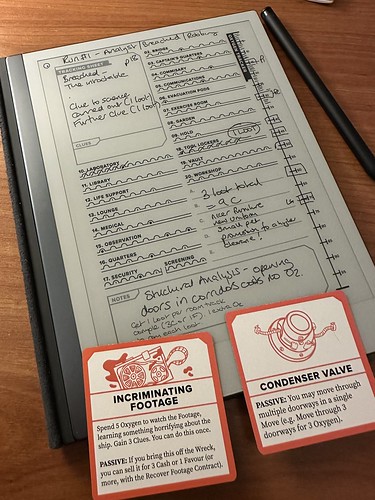
Tracking progress and also some items I’ve found.

You track progress on a simple sheet. Each room you enter has an entry in the Navigator’s guide which gives you details and you can just resolve the outcome. If your oxygen use hits a peril event, you follow the instructions under the manifest. Once you use your oxygen, you’re on your last breath. You start drawing unused cards from the deck every time you use oxygen, and if there are none left, you succumb and die, but you may leave a legacy to another explorer. If you find tools, they can change rules around which may help you. 

In the game I played (Analyst/Unauthorised Acquisition/Breached), the amount of loot I was carrying became an issue. I had three loot, each of which - in that contract - cost me 1 oxygen when I moved. So I used 4 oxygen to move from room to room. My character only had seventy oxygen to the Last Gasp, and nasty things started to happen to the shop from 15 oxygen onwards. So there is a balance between how far you dare explore because if you don’t find a way out, you could well succumb.

I entered the airlock and cycled it, revealing a library mess area beyond; lots of potential information, but very little opportunity to get me cash. Opening the other doors from the library revealed a tool locker areas, and off to the side, a scanning room with screens show images from around the ship. The tool locker looked more of a certainty and I started to ransack it. Surprisingly, I found an incriminating holo-recording of my supervisor which proved they’d been involved in the decision which had led to the ship foundering. Interesting, I suspect I can use that later on. I also found a condenser valve which made it easier to move quickly, and some circuits I could sell for cash (1 loot). I followed the room around and discovered a laboratory; as I opened the hatch in, the ship shook. Looking at the feed from my runabout, I could see a large section of the ship had broken loose, perhaps the hold (which meant I was losing opportunities to loot). Fortunately, the lab was well stocked; I pocketed lots of scientific kit and some interesting looking test reports, and then decided that it was time to get out of here. Turning round, the weight of the material that I was carrying made my oxygen consumption rise. As I reached the library, there was another horrifying screech of metal failing and the tool locker roof twisted in and collapsed. Had I stayed there, I would have been trapped. I quickly exited the ship and headed off to meet a contact that I knew to offload the kit I’d rescued.

Once the mission ends, there are roleplaying prompts to let you close out the game. They’re pretty fun and vary depending on whether you live and succeed, live and fail or succumb to your fate. In the latter, it’s all about your legacy. In the former, it all about the impact on you.

Orva retrieved three loot and a couple of clues to the ship’s fate (which didn’t have any interest). There was also the matter of the incriminating evidence. As the loot generated 9 cash, it was used to get a small pet, some nicer furniture and some more fashionable workwear. The incriminating recording was handed over to Yuri, in return for a promotion for the discretion shown.

All in all, I like this game. It’s a gentle procedural with some nice themes and a lot of replayability. I’ll have to try it again on another work trip.

17 July 2023

02 July 2023

Games in June 2023


25 sessions into the year

June saw First Ages' 'Shadow of the Sorcerer' Conan 2d20 campaign take equal footing with Trail of Cthulhu 'Eternal Lies' as my most played games. I expect it to take the lead sometime soon. I'm enjoying both campaigns which are completely different in flavour and style even though there is an overlap in players. 

I am increasingly getting the itch to run something again; I've only run six games this year, which is massively down for me. The question is what..?

I've definitely moved to the point that I like the Modiphius 2d20 engine a lot and look forward to getting it to the table.

2 July 2023


Books in June 2023


June 2023 - 7 books and 1791 pages

June 2023 saw me read two novels and five roleplaying books; a similar page count to other months.

The novels were Ken MacLeod's 'Beyond the Reach of Earth' and Ian R. MacLeod's 'The Light Ages'.

'Beyond the Reach of Earth' probably edges out 'The Light Ages' for me, even though it's not the strongest novel that Ken McLeod has written. The middle book of a trilogy, it maintains pace and throws interesting twists into the mix as it explores around artificial intelligence, competing blocks of aligned states (Scotland is part of the Union with mainland Europe, England part of the Alliance) and the impact of FTL travel. It's more plot-led than character-led. I'm looking forward to the last part.

'The Light Ages' has a Victorian feel alternative universe where magic is tangible and the aether that powers it is mined underground. Much of the novel deals with a revolutionary agenda against the guilds and social classes that dominate. This was pretty slow paced, but I found myself savouring the writing in some parts; perhaps not as much as a M John Harrison novel, but it was very rich. I will read the sequel to this as I'm intrigued where it will go.

I impulse bought 'Achtung! Cthulhu' in the new 2d20 edition and much of the roleplaying related reading this month was related to it. I worked my way through the Player's and Gamesmaster's Guides and also the first major campaign, Shadows of Atlantis. You can find my reviews of the core books here; I'll probably add something around Shadows of Atlantis later this month. However, suffice it to say that it intrigues me enough to consider running it.

I also read 'Archives of the Sky', a story game that explores big concept SF which is heavily inspired by Alastair Reynolds' House of Suns (which happens to be one of my favourite novels). I reviewed it here as well so won't say any more.

The final roleplaying book was 'Good Strong Hands'. This was a kickstarter I backed on impulse (well, I backed the first supplement and got the core book as well) and was delivered really quickly. You play fairytale creatures in the world of Reverie who are drawn into a conflict to defend against the rise of the Void. There's a bit of a Dark Crystal vibe, certainly. I like the dice pool system that powers the game, and the core ideas are strong, but I found many of the example plots and story hooks a bit too direct for my liking; I expected creeping horror and found more direct conflict. That's probably on me having the wrong expectations. I'm going to read the supplement and decide what I do with this; it's giving me ideas so I may try it at a convention or as a one-shot.

2 July 2023

30 June 2023

Books in May 2023


May 2023 - 5 books, 1,870 pages

I read five books in May 2023, three novels and two gaming supplements

The novels were 'Ready Player Two' (Ernest Cline); 'Before they are Hanged' (Joe Abercrombie) and 'Children of Memory' (Adrian Tchaikovsky). The Tchaikovsky was by far the best novel; intriguing, clever SF that brings together elements from the previous two novels in the Children of Time series. 

'Ready Player Two' nearly didn't get completed, which is rare for me in a novel. The main character repelled me with his behaviour for the first quarter of the novel, but then the plot started to pick up. However, this book is a shadow of its predecessor, sometimes feeling like an excuse just to throw in a huge pile of 80s.90s references to the point of tedium. I guess I loved the first book, and that set a high bar to judge this against.

The Abercrombie is the second of the series that we're doing as a read along at the Tavern. I found it dragged a bit, and I didn't feel it was going anywhere especially fast or original. There have been some interesting twists along the way that kept me engaged though. I'll read the final book, but I'm not certain if I'll explore this universe anymore. However, that may change after I see how I feel at the end.

My gaming reading was all for the CY_BORG #ttrpg, as two Kickstarters arrived; gutter_PVNKs, a collection of useful characters and snippets to flesh out CY, and then Timescape. The latter allows you to play a campaign heavily influenced by Terminator, and then for fun adds in the information to mix it up with Predators and Xenomorphs. Both well written, well presented and useful.

30 June 2023

18 June 2023

First Impressions - Archives of the Sky (tabletop storygame)

Archives of the Sky
Archives of the Sky: How did I miss this when it came out?

Archives of the Sky is a tabletop story game about the turn of the galaxy. It's very much inspired by one of my favourite Alastair Reynolds books, "House of Suns". The players take the part of humans who have stepped outside the hurly-burly of civilisations in the galaxy, travelling onwards and acting as observers and archivists to the changes that happen over eons. 

These Houses are defined by their values, one of which is that they will always remain human. The players take the part of members of the House, each defined by their own personal values. Nominally, there is no GM required, but there is a role of Archivist (the person who knows the rules best). If I was bringing this to a convention, I'd probably take that role to facilitate a better game. The game is built for three to six players.

Archives of the Sky is suitable for both one-shot and episodic campaign play. In an episode, the characters arrive in a star system and play through a series of scenes. These are framed with a question, and the questions will drive towards a dilemma. The dilemma will put two values (either House or Personal) into conflict, and ultimately force the players to choose what value they hold to. This is very much a collaborative story game, so the players are encouraged to mix things up. The conflict the dilemma generates isn't meant to be player-vs-player (or more accurately character-vs-character); rather, it's an exploration of a conflict about values and how it is resolved.

Each player takes a turn as narrator as scenes move on; another player will be responsible for making sure that the scene is as Epic as possible, while someone else will be responsible for drawing out the human and Intimate side of the scene. The scenes may well involve three Others of equal or greater power; an Ally, an Opponent and a Mystery. These are other Houses, Civilisations or things that are happening. In a campaign game, it is possible that further such Others can be introduced into scenes by the players.

Scenes also have a moment of reflection at the end, where the players speculate on the plot or comment on where their character is. This is designed to provide inspiration for the following scenes. During play, the trove can also be consulted. This is a list of words to inspire ideas. There is a sample list provided, but the game suggests that each player brings a favourite SF novel with them to the game and adds a selection of words from that, which is cool. 

There's a decent QuickStart guide and also a worksheet to allow you to run the game more quickly (a typical episode should take four hours, but the sheet will get it to around three). There are also a selection of other settings (for example the Wild West or Post-apocalypse) that the players can explore. 

The print copy is lovely; lots of good use of white space and evocative images, along with clear writing. It's 104-pages full colour and available on DriveThruRPG. I'd have loved a hardcover, but sadly that isn't an option.

I like the idea of this game; not only does it riff on one of my favourite books, but it is a more gentle, epic form of SF game which gives a chance to explore the kind of values judgements not often addressed with more traditional space-opera and cyberpunk SF. I think I may bring this to North Star or possibly Furnace in the future. Recommended

18 June 2023


17 June 2023

First Impressions - Achtung! Cthulhu 2d20 core rules

Achtung! Cthulhu
Achtung! Cthulhu core rules

Towards the end of April, I was a bit impulsive. I was preparing for North Star, and enjoying re-reading the Star Trek Adventures Tricorder edition. I was also selling off books and games on one of the Facebook groups for shelf space and marital harmony, when I stumbling upon one of those perils that selling online brings. You also see the things that others are selling. Anyway, a nice chap in Wallasey was selling off his copy of Achtung! Cthulhu's core rules as he didn't get along with the 2d20 system, so I decided to indulge. Previously, I'd nearly picked up the books in the Modiphius sale at Christmas.

I've got a conflicted relationship with Cthulhu based roleplaying games, despite Call of Cthulhu 2nd edition having been the first roleplaying game I bought. I read all of Lovecraft and most of the associated authors and still dip my toes in every now and again. However, from a gaming perspective, I'm very selective. I overplayed Call of Cthulhu until I lost the joy for it; the mystery went once everyone had read the books and had their own copy of the roleplaying game. I had some great experiences, but put it to one-side for a long time. I returned when Delta Green came out, and loved the completely different feel that it had. I bounced off Call of Cthulhu 7th Edition (oh, I tried), but I really like the Trail of Cthulhu Gumshoe take (probably because I like the engine and the writing standard seems to be at a different level) and am loving playing the Eternal Lies campaign. My mythos based game of choice would be the new Delta Green (and possibly the Gumshoe take), and I'm slowly selling off my old Call of Cthulhu back catalogue.

I'd looked at the previous two takes of Achtung! Cthulhu (Savage Worlds and FATE) and really couldn't see the point. However, there was always something about the idea of a pulp World War 2 game where the players could be action heroes against the mythos. Hence I decided to try.

The core rules for the 2d20 edition are split across two gorgeously laid out and illustrated hard backs, both of which have a ribbon for reference. The covers are done in the style of a pulp comic. The Player's Guide is 188 pages long and contains the rules and character generation. The Gamesmaster's Guide is 268 pages long and has background and guidance on running the game. 

The Player's Guide kicks off with a taster introduction to the organisations involved in the Secret War against the Nazi Occult and quickly moves into explaining the core mechanics of 2d20. This is followed by a section on action; environment, combat, injury and momentum are all explained. Characters have a single stress track but resist damage differently dependent upon whether it is physical (armour) or mental (courage). If you suffer an injury, there's a chance that it could leave a permanent physical or mental scar on the character. The rules in this book are probably the clearest expression of the 2d20 engine that I've seen, at least as good as the Tricorder edition of Star Trek Adventures. 

Characters start with the selection of an archetype from the following list; Boffin, Commander, Con Artist, Grease Monkey, Infiltrator, Investigation, Occultist or Soldier. They'll be working either for Section M (the British Intelligence organisation tasked with opposing the Nazi Occult) or Majestic (the US organisation with similar aims). Section M and Majestic have slightly different focuses, very much like the Nazi organisations, Black Sun and Nachtwölfe. You tailor your archetype with your nationality and your background. Finally, you pick a unique characteristic that makes you stand out (for example, you could be a conscientious objector, be raised in the colonies or even own an occult artefact). Throughout this process you gain talents, which are unique abilities.

There's a chapter on weapons and equipment, and another on vehicles. This is bolstered with a chapter on the history and more conventional aspects of the Second World War. There's also a short chapter with some statistics for allied forces and the kind of non-player characters that the players will encounter. 

Magic is also covered in depth. There are two disciplines; battlefield magic and ritualistic magic. Section M tends to draw on the occult, especially from Celtic and Norse sources. Majestic draws on Native American sources, aspects of the occult as studied by the Miskatonic University and increasingly on paranormal and psychic powers. Casting spells cost the sorcerer mental stress, setting a natural limit to how many spells can be cast without taking harm. Momentum can be used to temporarily boost courage to resist this effect. Ritual magic is cast in a similar way, but uses a variation on the extended task rules. They could require sacrifices, perhaps even human ones.

So, overall the Player's Guide is an excellent resource, with a clear expression of the 2d20 engine and the details to produce interesting and very playable characters.

The Gamesmaster's Guide provides the lore for the setting. It opens by describing the organisations involved in more detail. The Section M part gives an overview of the various campaigns that it is involved in during the war (which are presently being converted and re-released from the previous editions). Organisation, structure, bases and history are touched upon.

The two Nazi Occult organisations are detailed. Black Sun is the more traditional occult organisation, with pacts established with Nyarlathotep to Yog-Sothoth, and a link to the Lovecraftian Dreamlands. Nachtwölfe is a splinter organisation, reporting directly to Adolf Hitler, focussed upon developing and applying wonder-weapons based upon ancient Atlantean technologies. Both organisations regularly come into conflict, albeit somewhat clandestinely. Arguably, Black Sun is evil, and Nachtwölfe is amoral, interested in power and technology (giving me a feeling echoing of the Shield operations in the MCU). The machinations of the Mi-Go and the threat of the Deep Ones are also discussed.

Another chapter covers the secret weapons and technologies used by the various organisations along with their game statistics. A chaper on magic dives deeper, with details of Allied and Axis Battlefield magic traditions and details of spells that are available. There are details of known tomes and how to study them, and as expected, they aren't good for your mental health.

There's a large chapter for the Gamesmaster, going over the rules and providing more detail and guidance. This is generally very useful and I'll be reflecting on what was said here when I play other 2d20 games. There's a lot of guidance on building NPCs. 

This is followed by a chapter detailing heroes and villains of the Secret War. This starts with the more general forces than moves into the various organisations, providing key non-player characters and significant figures on both sides. The following chapter is a bestiary of mundane and mythos creatures to delight and threaten your player characters with. 

Both books round out with useful (but not extensive) indexes. There is no introductory scenario but I believe the free QuickStart has one.

I also picked up the Gamesmaster's Toolkit. This includes a four-panel GM Screen (my initial thoughts being that half the panels would see most of the use), and a booklet which acts a prompt to build your own  adventures. There's an outline structure with a bunch of random tables for inspirations. Let's try it out.

Rolling some d20s...

16 - The adventure takes place between Jan 1945 and May 1945 (so the closing part of the European War).
18 - It takes place in Greece

I could have rolled for a specific Battle or Operation but I'm cool with the details above.

20 - An alignment of the stars is needed to fulfil the plot

12 - In a lost city

A supporting NPC

1 - British

4 - Pilot

15 - Lieutenant Level NPC

23 - extremely stiff and formal

The opening scene...

13 - A town, in a rocky area (7).

NPC in the area

Indifferent (12), Doctor or Nurse (3)

Specific scene

Empty (13) Hospital (11) located in a Scorched (4) Military Base (2)

Obstacles and Reversals

12 - a superior despises you

5 - a former foe returns from the dead

Anyway, hopefully you get the idea. It's a booklet full of inspiration, whether you roll randomly or pick a choice. The toolkit isn't essential, but it is useful.

So what do I think? 

Overall, I love the way that 2d20 has been expressed here; it feels like it will grab the pulp feel really well and give you plenty of opportunities to blaze away at evil occult-using Nazi forces with your Sten sub-machine gun. I like the ideas in this and the different flavour to the harder edged takes I usually go for with the Cthulhu mythos. You could use these rules to run a pulp World War Two game and drop all the mythos, but I really fancy exploring Lovecraft with a hint of Indiana Jones and the wartime comic strips that were around when I was growing up. Bravo, Modiphius.

17 June 2023