23 October 2023

Achtung! Cthulhu - Reading the opening to Shadows of Atlantis

 An image of the city of Atlantis, gold against blues and greens of canals and land. A central temple is surrounded by concentric city sections, alternating between canals and buildings. The Achtung! Cthulhu logo is shown at the lower part of the image, right justified but filling most of the length of the image.

[Very minor spoilers below, but you’d guessed this was about Atlantis, hadn’t you?]

Starting to work my way through the campaign with a focus on running it. The set up is good, but there are aspects that could be improved, especially around the exposition to the GM. For example, the past location of Atlantis isn’t ever called out, despite it being implicit from the final mission. The backstory is a little vague. 

The overall plot arc isn’t really outlined, except in terms of locations. Again, you need to draw what is doing to happen at each location out from the missions themselves. Knowing how the story is supposed to go, and the objectives for each mission really should have been called out at the start as it’s key knowledge for the GM to understand what is going on. Having read this previously, one of my objectives in reviewing this is to pull it together as I go along, along with key clues and interlinks between missions.

There’s nothing that’s bad about the way that this is put together, but it lacks sharpness. This is done much better in The Serpent & The Sands which has a top level bullet point overview of each mission in the campaign preamble. It draws the big picture together at the start.

I may also read the works by Plato that reference Atlantis - Timaeus and Critias - as they’re on Gutenberg and provide part of the deep backstory.

The other thing I noticed was that although the text says only missions 1, 2 and 8 are fixed in time and the others can be run in any order, the campaign as presented does assume that they are run in sequence. Two of the missions felt like they should have been run with other characters when I read the book originally, I’m going to be interested if I still feel the same when I read them again.

It would have been useful to have had a paragraph on travel routes and methods between locations and potential times (especially as the campaign is expected to run from August 1939 to June 1940, before the Phoney War ends). I realise that this may have been avoided because of ‘run in any order’ idea and concept, and is quickly fixed, but again it would have been helpful. I do wonder if that this is a deliberate pulp play-style choice (the camera pulls back as our brave heroes board the vehicle they’re leaving on) but   I was left wanting to have this easily to hand. I suspect there’s enough information in the Gamesmaster’s Guide or one of the many Call of Cthulhu books gathering dust on my shelves if I need to do this myself.

Overall, the campaign looks great. The one concern I have is that the maps may not be useable with the players, as this was published before VTT support versions became common. Hopefully, if that’s the case, they can be edited with Affinity Designer.

Anyway, these were my main take outs from reading the first chapter again. I have a couple of pages of scribbled notes on my reMarkable now.

23 October 2023

22 October 2023

Making a splash

I've started swimming again as an effort to raise my fitness levels. I'd started running during the pandemic, but as I worked my way up through the couch-to-5k I found that I'd get five to six weeks in then my left ankle or right knee would go, so I'd end up having to stop for a while. When we were on holiday, I was swimming pretty casually every day, but noticed that my ankle was much better generally. That gave me the gem of the thought that maybe I should start swimming more seriously, something I've not done since before university.

I ended up getting myself some prescription goggles (as wearing contacts under normal goggles isn't really that viable now I've stopped wearing my lenses regularly). I also spotted a set of IP8X (waterproof) bone conducting earphones, which are magic and work great in a pool. The final thing was to get the local council leisure centre pass for the year. Altogether, the plan was to have no excuses and a lot of good reasons to want to be actively out there swimming.

So far, I've mainly done breaststroke. Started at 32 lengths the first session which quickly became 36 then 40. I'm now at 48 lengths as a baseline (1200m) and will hold that for the next few weeks as I get my fitness up. I suspect that - at my current speed - I'll max out around 64 lengths if I can get there at the very start of the lane swimming session.

There are three different swimming speed lanes in the lane sessions, slow, medium and fast. I'm not quite fast enough for medium (most of the swimmers there probably pull a half length on me over two lengths) but I'm at the top end of slow (most of the time). Overtaking can be a challenge if it's busy, which makes quite an impact on pace. 

Anyway, hopefully I'll keep this going.
22 October 2023

21 October 2023

Achtung! Cthulhu - Prelude to the Secret War

An image of the city of Atlantis, gold against blues and greens of canals and land. A central temple is surrounded by concentric city sections, alternating between canals and buildings. The Achtung! Cthulhu logo is shown at the lower part of the image, right justified but filling most of the length of the image.

I've only run five game sessions since Curse of Strahd finished at the start of the year, which is odd for me as I'm usually running something. All those sessions have been at conventions, and I've enjoyed them immensely. Running at Furnace a fortnight ago confirmed to me that I really wanted to start again. 

The Wednesday group - Graham, Tom, Dr Mitch and Alex - continued after we left Barovia with the Shadow of the Sorcerer campaign for Conan 2d20, run by Graham (another eternal GM). It was great fun as we carved our way across Hyperborea, in a quest that involved cultists, serpent people, ancient magics and enemies rising again, and lots of genre appropriate fun. We finished on Wednesday.

Conan 2d20 is an earlier iteration of the 2d20 engines and it shows it, as the edges are still a bit rough. It's not as smooth as later iterations, but in play that wasn't a barrier. The talents for characters stack up to let you do crazy things. I'd focussed my character as a rogue type, a burglar and liar, rather than going for a strong fighting build. There were times when I kind of regretted not building the character with a bit more focus on combat, then I had moments when her ridiculously good acrobatics talents kicked in and it made it all worthwhile. Anyway, I digress.

We'd agreed in principle that we'd run another campaign once the Conan game finished. I'd pitched Mutant Year Zero: Elysium and Achtung! Cthulhu 2d20. We opted for the latter, as one of the players didn't fancy the character-vs-character shenanigans that come with that setting, plus you get to punch Nazis. Pulp WW2 felt like a good option. Achtung! Cthulhu does a good job at holding the mythos at arms length, and then shooting it repeatedly with a Sten gun (you can read my review of this here).

I had two options; Shadows of Atlantis (the first campaign released) or the more recent The Serpent & the Sands. Reading both of these, there's a slightly different design ethos from other settings. Some of the scenarios feel very episodic, and quite often they're constructed with a particular end-game in mind (the villain escaping having shown some more of their threat is quite common). Initially, this jarred for me as I read Shadows of Atlantis, but once I imagined this playing out as a Saturday morning cinema drama with something like the Pathé News fanfare at the start and a voice over, it worked. I had been looking for more direct connections between the missions, but in some cases it's just the boffins back at Section M who use the material the characters find to get them their next mission. The Serpent & the Sands does have much more taught interlinks between missions, but sometimes it is a clear plot direction from the GM.

In the end I've opted for Shadows of Atlantis as the players gave me the choice of which to use. I think that The Serpent & the Sands is a stronger campaign narratively, but it has too many echoes of the Conan game we just played. Deserts, Serpent-People, Ancient threats rising again, they're all there. It's set chronologically after Shadows so I'm going to keep it in reserve in case people want to revisit the setting later. That said, Shadows of Atlantis is a fun campaign which does a grand job of showcasing the difference from the traditional Lovecraftian mythos, so I'm really looking forward to it.

Sadly, Alex has decided to take a break from the group, so we've looked for a new player. Simon (who also does the admin for the Tavern) has expressed and interest, so I hope we're sorted. Alex has said he intends to return, once he's had a little time and space. 

Now the campaign is decided, the next choice is the VTT. At the moment, I'm leaning towards using Role, as it's a nice, light and rock-solid platform. It's probably my favourite VTT. There appears to be a good sheet on Roll20, but at the moment Paypal and Roll20 have managed to lock my account(*), so I don't think I'll explore that further. The plus for me with Role is that it runs happily on my iPad Air, so I don't need to take the MacBook Pro with me if I'm travelling for work. I did consider Foundry (there's a good unofficial set up there), but I've come to the conclusion that I'd prefer to stick to something I know. Although there are character sheets on Role, I'm going to suggest that the players use the form-fillable PDFs and we just have a shared set of sheets for journals and meta-currencies (threat and momentum). I'll probably post more on this as I finalise.

Anyway, new beginnings. The Secret War begins.

21 October 2023


13 October 2023

Furnace XVIII (2023) after action report

A picture showing the Garrison Hotel across the cobbled street in Hillsborough Barracks. This is a former gaol house made of stone, with arches at the front veranda.
Leaving the Garrison again

Last weekend saw the eighteenth Furnace roleplaying convention held at the Garrison Hotel in Sheffield. We had a healthy recovery in numbers (with 65 people attended), but still not quite at the levels we saw pre-pandemic. The pre-planning came together mostly smoothly, as this isn’t Graham, Elaine or my first rodeo. There were a few misfires (from my side, mainly because we took the launch decision when I was on holiday so couldn’t access the comms templates or build the registration) but nothing that was critical. Graham had to deal with a new team at the hotel who had very little idea of the history of the relationship, so we couldn’t assume.

I’d planned to keep the afternoon before the convention free, taking some time back that I was owed from work, but I ended up with meetings scheduled until five on Friday, plus trips to sites during the week that ate into my preparation time. That said, I was weirdly much more prepared than previous years, with my games mainly ready to run in September. That didn’t stop me leaving the characters for one of the games on the printer (fortunately, the hotel reception helped me out here) or leaving the lovely Roll 4 Initiative dice I’d bought to use at the convention on the desk adjacent to them. 

The family headed off to a fencing competition for the weekend, at RAF Cosford, so I was left in the house alone. I had considered bringing a big pile of stuff for the bring and buy, but in the end abandoned that idea to get to the convention earlier and maintain my sanity. I arrived to find the bar full of gamers, and had a pint of Moonshine while quickly catching up with old friends. However, I didn’t stay up late, sloping off for an earlier night and the chance to read through “A Town Called Malice” to remind myself of how it worked. That was the point I realised that I’d left the characters behind.

Graham had asked me to move the trestle tables up to the room with him before breakfast so they were ready for Patriot Games and All Rolled Up when they arrived. So the day started with a little light exercise, before digging into one of the Garrison’s lovely cooked breakfasts. 

Slot 1 saw me finally get to play Sue Savage’s Witchlight, a scenario for Things from the Flood. I’d wanted to play this at North Star, failed to get into it using my GM booking, but managing to get in with my Player pre-book, until I had to step out when we had a GM pull out and leave us in the lurch and I needed to create spaces for players. I’d planned to run Things from the Flood myself a few years ago, but the unfortunate events at UK Games Expo meant that the game wrongly got a bad reputation. Sue’s adventure was set in the Norfolk Broads (bizarrely not that far from one of the sites I’m responsible for at work), and our bunch of 16-year olds set out to shoot a documentary for a BBC competition. We had fun riffing off each other and generally behaving as teenagers. Having a sixteen-year old at home helped me imagine how to do this. I ended up with the hacker, and we set off into the Fens at night to try and find the source of the witchlight, carrying Chinese lanterns and a smoke machine in case we had to fake something for the film. Much shenanigans happened as a result.

The afternoon saw me running ‘A Town Called Malice” down in the Dungeon area. I’d run this previously back in the pre-pandemic before times, and it had gone well. This time, I chose another play set, and we started to explore what was going wrong in Malice, Oregon. All the players were new to the game, which is a structured story-game. It’s kind of like Fiasco in idea, but has more moving parts. The theme is Nordic Noir; the town (by default ‘Malice’) is beset with a problem that needs to be addressed with an event, and there is a creeping darkness that will emerge that also needs to be defeated. It all starts when a body is found. It’s very much ‘play-to-find-out’ and relies heavily on the input from the players. Unsurprising as it’s designed to be run without a GM. I’d managed to forget my light coloured d6 block so ended up picking a lovely slightly pearlescent set to use in the game. The players were great, and leaned into creating a dark tale of death and horror. The biggest challenge we had was the game playing near us; the players were loud enough to make it difficult to hear. It’s not something I’ve experienced in that area of the Garrison before. I do wonder if the privacy screens we put up make it easier to forget the games around because you don’t see them. There was a big change in atmosphere once the room fell silent, which it did as we over ran. I think that this could have been a brilliant game if the atmosphere was right; next time I may book a Cell, but that tends to limit the number of players who are happy to scrunch up. We were a little rushed at the end and had to skip half of the final act; this actually made it a little easier for the players in the final confrontation, but it’s always nice to end on a high when the heroes (or in this case, the flawed folk of Malice) prevail.

Dinner was the traditional trip to KFC with Keary, but sadly missing John Ossoway who couldn’t attend this year. We had a good natter about gaming and books, and then I sloped back to my room to quickly re-read ‘The Zone’ for the next session.

The Zone riffs on themes from stories such an Annihilation (the Southern Reach Trilogy) and Roadside Stalker. Something alien has appeared on Earth, creating an area which the government has sealed off. You play the 13th expedition into the zone, a group of volunteers with little in common beyond their hope that they will find the answer to their deepest wish if they can discover the secret at the heart of the Zone. The game is play-to-lose; all but one of the characters will die. However, it is set up so that the players remain involved throughout, and those that have died influence the final outcome for the character that reaches the heart of the mysterious area. There is a free-to-play full version of the game available online, and the physical copy was kickstarted, but ended up a little delayed as is the way of these things. I made my own set from the print-and-play digital copy.

The game is card driven; characters are archetypes driven by phobias and obsessions. The game has a set number of locations, determined randomly from a deck, and there are pre-defined points where a character will meet their fate and exit the story (it doesn’t have to be a death). On reaching a location, the player who is directing (has initial narrative control) chooses one of three descriptions of the place to set the scene. They then pose a challenge with a scene card, and all the players reach. There’s a formal move to drive description and narrative which can be triggered by anyone (‘take stock’) which helps to move the story on. There’s a move to bring out that there’s something wrong in the area, which automatically triggers an escalation (‘and it’s even worse than that’). When a character takes a challenging action, someone at the table can call out ‘that’s no sot easy’, which triggers a ‘not so easy’ card that can mutate, twist or expose the character acting with a threat from the zone. You can stay in a location as long as you want; we deliberately lingered in the swamp for three turns, because it built the tension which worked really well. 
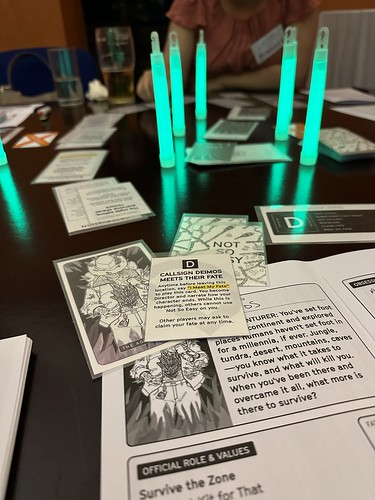
I picture of a game table, in the foreground the adventurer character sheet, in the background, a trail of cards and locations surrounded by green glowsticks
The Zone RPG complete with Glowsticks

The game was my highlight for the convention; I ended up playing as well as facilitating as one of our players never arrived. Hat tip to Keary, Elaine and Elina for a wonderful experience. Part way through, we ended up joking that the game was all about Elina’s character, Belladonna, an actress, and serendipity in the randomness of the fate cards meant it truly was. My adventurer exited the story by deciding not to press on once they were crippled in the way that their former best friend was when they abandoned them on a mountain years before. Elaine’s criminal, who was transforming into something bear like, ended up dying to protect the others when some kind of bear creature attacked in a long grass field in the former zoo, and Keary’s world-weary detective faded away when they realised that their partner in work and life had never really loved them. Elina’s actress reached the centre and chose to reset her life to age sixteen, and take the path not followed to be with her true love. However, she knew it would cost her the relationship with her driving mother, and that it may not work out. She rejected the fame and emptiness she had experienced. Fantastic game, fantastic players, and I’ll definitely do it again.

I considered the bar for a few moments, but instead just had a quick natter with Elina and others as they had a cigarette, and I headed to bed. Sadly, I woke up the next morning with a splitting head like I had a hangover (a pressure headache in my sinuses) so I had breakfast and bailed on the game of Ironsworn I was due to play. Fortunately, Guy had a substitute player. I guess I’ll have to try that game some other time.

I was back up in the gaming room for the raffle, when Lynn was so close to another Golden Ticket for the next con, but not quite. We gave vouchers for the Patriot Games store this time, which seemed to go down well.

After a two hour nap, I checked out and went to the bar. I had a coffee in the sunshine, and read the scenario I was running that afternoon, a Swords of the Serpentine adventure called ‘Murder Most Foul’. I was cheeky and asked Pelgrane Press if I could have a demo scenario as I was running at a con. They gave me a choice, and a murder at a masked ball sounded great. I’ve played a lot of GUMSHOE, but never run it, so I had some nerves. I had a fantastic bunch of players, and one of them enjoyed it enough that they wanted to buy their own copy of the game. The game felt much more action orientated than other GUMSHOE games, particularly with the amped up refresh pools and the ability to burn investigative abilities for cool effects. Suffice it to say, they solved the case! I definitely want to run this again.

And then it was over. I’m hoping to see some after con reports from others to get a feel how this went for attendees.

I enjoyed the convention a lot; it was the first time that it really started to feel a bit like the pre-COVID conventions. Generally, everyone had a good time and I’m looking forward to doing it all again! Next time I hope to return to remembering everything I need to bring with me, and booking the Friday off work to get me some calm to prepare!

Furnace XIX is coming.

13 October 2023


01 October 2023

Books in September 2023


Graph showing day by day breakdown of the 977 pages that I read in September 2023
A slow month

September 2023, was a quiet month for reading, mainly because I was working through several non-fiction books. I tend to be slower when I read non-fiction, as it doesn't lend itself to skim reading, which is how I consume much of the fiction that I read. I read three books, for a total of 977 pages. 

One of these books was a graphic novel, the latest tie-in with the Blade Runner franchise, "Blade Runner 2039, volume 1". This continues the stories that link between the original film and the more recent Denis Villeneuve movie. This is done well and will be entertainingly useful when I start to play the roleplaying game.

The first of the non-fiction books was Michael Wood's classic "In Search of the Dark Ages", in its newly refreshed form. This brings the book up-to-date with current knowledge, especially from more recent archaeology. It also increases the number of historical female characters that it describes. I enjoyed this, and I learned a lot about "the dark ages" that I never knew before. The book was one of First Age's picks for his virtual bookclub on the Tavern, but also happens to be a favourite of my better half.

There's something in this that makes me want to run or play a roleplaying game which is set after an empire withdraws or collapses, a setting where the ruins the past surround the present. Of course, that would work just as well in Traveller's New Era or Milieu Zero as it would in a fantasy or historical setting. My enjoyment of this book was enhanced by a different book on the dark ages which I was listening to on audible while driving across the country for work. I nearly finished that other book this month, but I have about 90 minutes more to work through. They complimented each other nicely, one focusing on people, the other, focusing on lost kingdoms. On this one to follow.

The second of the non-fiction books was "The North will Rise Again" by Alex Niven. I wanted to like this book, but ultimately, I felt it ended up being too parochial around the north-east (the author's experience) and not delivering what it originally promised (a broader view of the north and an agenda to take things forward progressively). I think I preferred Lisa Nandy's analysis which I read some months ago. It was definitely interesting, but it just didn't work for me. 

I've now read 81 books for a total of 21,854 pages. As I write this, my reading streak sits on 266 days. I still think that breaking through the hundred book barrier is a possibility this year.

1st October 2023


30 September 2023

First Impressions - Playdate, a retro-handheld by Panic

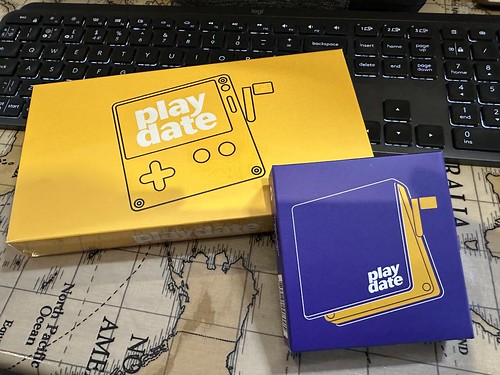
Picture of a yellow rectangular box with a picture of a Playdate handheld and a smaller purple square box showing a Playdate cover, both resting on a table with a world map on it, and inclined on a black keyboard at the top of the picture.
The Playdate packaging is cute.

Back in March 2023, I impulsively ordered a Playdate handheld. I’d been intrigued when they first came out, but resisted. However, I’d seen a few reviews, and as I’ve been travelling more, it seemed like a cute option to do some casual gaming when I was away. Plus, Panic had announced there was a price increase coming so it seemed like a good time to lock in a device at the launch price. 


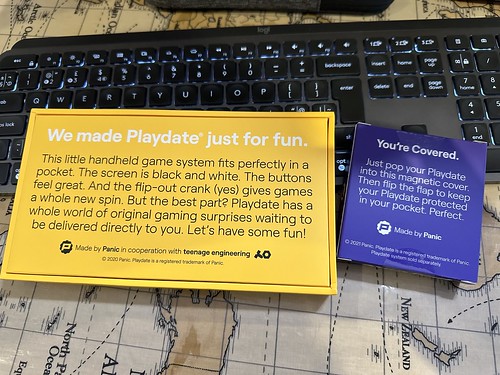
Same set up as the first picture, but showing the back of the boxes
The back of the boxes

The Playdate is Panic’s first foray into hardware; usually they produce software, mainly for macOS (but they have also published for Windows and XBox with games like Firewatch and Untitled Goose Game). The little yellow handheld they’ve produced is pretty open; they encourage side loading of games and there’s an active Itch.io community. Most of the games are pretty cheap; an expensive one would be around the $12 range, but many are Pay-what-you-want or in the $2 to $4 range.


The Playdate box opened, showing the little yellow handheld in foam at a jaunty angle, alongside a similarly jauntil placed black cardboard sleeved yellow USB cable with the words “Have Fun” written on the sleeve
Unboxed…

The device is really cute looking and very small. It has a highly reflective black and white LCD screen, a D-Pad and two buttons (A and B) for gaming, plus a button at the top right to access menus, and another button on the top right to power on and off. And then there’s the crank, an analogue controller which is used in some games and also in some system functions like buying and opening games. It charges and connects over USB-C and a 3.5mm headphone stereo jack at the bottom. The device’s speakers are mono and sound decent enough. There’s also a microphone, but I’ve not seen anything use that yet. The Playdate connects to WiFi and you can download games and updates from Panic.

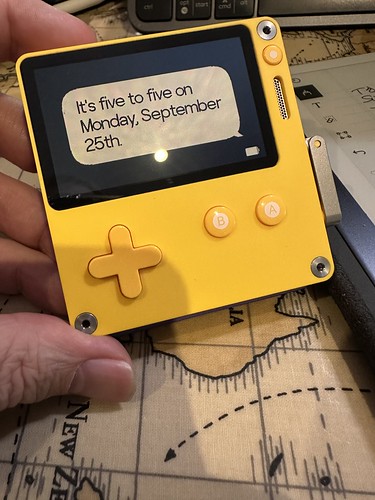
Playdate held in my hand, showing the clock in sleep mode. The clock is set to “words” mode, rather than digital or analogue. It says “It’s five to five on Monday September 25”
Tiny handheld, interesting clock options 

There are three routes to getting games; the device comes some (‘Season One’) arriving with two, and then having more two more games drop for free each week. In total there are 24 games, with a wide variety of options. The second route is to install the Catalog app, and you can buy from a curated collection of games hosted by Panic. Finally, you can buy games from other sources like Itch.io or even code them yourself and sideload them over WiFi or over USB. 


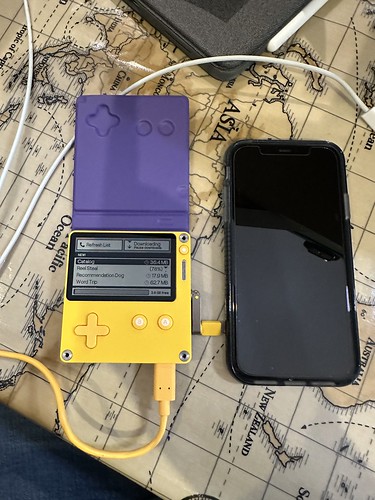
Playdate handheld, purple cover open, showing the Catalog app loading games. It’s connected to USB to charge with an iPhone 11 to the right of it to provide scale.
Playdate charging while downloading games on the Catalog app, with iPhone 11 for scale.

I’m very much a casual gamer (mostly). Playing through the whole of Firewatch in two evenings is probably the most extended play that I’ve done recently, although I do have a World of Tanks Blitz habit. Most of the games I’ve downloaded are very much bite-size games; they’re your classic arcade games. It actually reminds me of the ZX81 and ZX Spectrum days; I do hope someone comes up with a decent take on 3D Monster Maze soon! I’ve sideloaded a lot of the classics like Frogger, Invaders and Pac Man. There are some great puzzle games; these range from more Sudoku / Minesweeper like games, through to arcade puzzlers where you push and pull things to solve a level. There are adventure games, although I haven’t really explored these properly yet. 

Most games are the kind of entertainment you can play for a bite-sized bit of fun, but it’s also easy to lose an hour.

The screen can be challenging in artificial light; there’s no backlight so you have to angle it right to get the best view. I’ve not really found that an issue, but I have seen people moan about it on the internet.

My favourite games at the moment are SlitherlinkPD (a minesweeper/sudoku style puzzler using the crank to wind back time), Gravity Express (Lunar landings, using the crank to orientate the ship), Grand Tour Legends (crank-driven cycling), Gatecrasher (pilot a ship through a series of gates, kind of Tempest style, using the crank) and Four Corners (kind of Tetris like block clearing game).

I’ve no regrets picking this up, even the wait built some anticipation. (Panic batch manufacture Playdate, so you effectively pre-order; mine took six months to arrive).

The yellow Playdate handheld, sandwiched in its purple cover, held in a hand with a decorative window behind
The Playdate in its cover - reminds me of an ice-cream sandwich.

I’ll leave you with a cute picture of the Playdate in its cover above. I look at it and it makes me smile. Teeny. Cute. Fun.

30 September 2023

24 September 2023

First Impressions - The Hunt

A picture of The Hunt boardgame standing on a table with a world map on it. The box stands vertically with a striking image of a Royal Navy officer dressed in white with a cap, their face covered by a pair of binoculars which have red glass with the reflection of a warship. The background has a red sky, reflected on the sea, with a naval vessels in the background. The title of the game is at the bottom left.
The Hunt

The Hunt is a two-player naval wargame set in the Second World War based around the hunt for the German pocket battleship, the Admiral Graf Spee. Historically, the concluded with the scuttling of the ship after the Battle of the River Plate when the ship’s captain felt they had no chance of escape when the time they had in the neutral port of Montevideo expired. Ironically, we had the same outcome. The game is published by Salt and Pepper Games and was funded on Gamefound.

The game has been lovingly made, and the components are great quality. The board is clearly printed and well constructed, and the is a mix of cardboard counters for ships and naval forces and wooden counters for damage and hints to the Graf Spee’s location. The artwork is evocative and the cards come with sleeves. There’s a small screen for the German player to hide their movement record.

A look across the game board from the Royal Navy perspective. Merchant vessels have been sunk and my eldest son is planning his next move. A hand of cards lies in the foreground.
A few turns in, and already the merchant ships are sinking.

The game is asymmetric, with hidden movement and driven by cards. Both players start with a hand of five cards; the Royal Navy always draws back to a full hand, but the German player is limited to drawing back to three cards unless they are within a hex of the Altmark, their supply ship. If that’s the case, they can redraw a full hand, but that will give their location away to some extent, as they have to tell the British player how many cards they are drawing.

Victory is achieved for the Germans by sinking five merchant vessels, or doing more damage than the British if brought to battle. The Royal Navy wins by getting five merchants to safety, by doing more damage to the Graf Spee than they receive, or by playing the “Scuttling in Montevideo” card in response to the German player playing the “Montevideo” card in the final round of the battle. Most of the British forces have an advantage in battle.

The Hunt
British forces closing on the Graf Spee (which is within one hex of the yellow hint marker)

The advantage in the game shifts towards the Royal Navy throughout. At the start, only one patrol force is in play, but by the end, three forces can be operating.

There are usually two merchant ships in play, but the German player has a card that can force additional vessels to leave port. They move one hex per turn to different locations.

The German player goes first and plays cards for either their event status, or for action points. Events do things like force a merchant to restart its journey, add calm weather for better searches or move the British forces (based on false radio messages). Some event cards are one-shot and have to be permanently discarded once used.

When played for action points, the cards allow movement, searches, repair of the ship’s sea plane or building of reserves. Movement is a maximum of three hexes (costing 1,2 or 4 action points). The Altmark (which cannot be attacked) is not hidden and moves once per turn, but the Graf Spee can move twice (move, attack, move). The Graf Spee has hidden movement; the German player must declare how many action points they are spending honestly, but doesn’t have to move any or all of the hexes (i.e. they spend 4 action points and must tell the Royal Navy commander this, but they could stay in the same place or move up to three hexes away). Once the Graf Spee moves after an attack, it disappears again.

Searching requires 2 action points, and then a dice roll. If a d6 rolls 5+, the German player finds or sinks the merchant vessel. If the German player uses the sea plane, they get +2 to this roll. However, the plane must be repaired before being used again. Only a single search and attack can be carried out each turn. Repairing the sea plane costs an action point, and requires a dice roll higher than the number of permanently discarded cards the German player has. If you roll badly, the plane is permanently lost; as the game progresses, the likelihood of this happening increases.

Finally, the German player can lay a reserve of up to two action points, which effectively means they can run for two hexes or carry out an attack even if their hand is poor.

The British player starts their turn by moving merchant ships towards their destinations and adding in an extra ship if they’re lost any. They follow this with a card phase like the German’s but with subtle differences. They can move each force (with the same costs per force as the German player). Each of the forces can search to find the Graf Spee in the space they are in at the cost of a single action point. The chance of finding the commerce raider is the same as finding a merchant ship, but without the option of a sea plane to help. If the Graf Spee is found, it is brought to battle which triggers the end game.

The British player can also spend an action point to use the intelligence actions which are found on most of their cards. These either force the German player to place a hint marker on the board within a hex of the Graf Spee, or give the Royal Navy a bonus on their search roll. This action can be picked multiple times and up to three hint markers placed. The markers are removed once the Graf Spee moves.

The Royal Navy can increase the forces deployed by spending 2 actions points to advance them on the strategy track; this can only be done with one of the two reserve forces. Once the force completes the track, it is deployed. Typically, the new forces have an edge in combat.

After the cards phase, the British player redraws their entire hand. 

If brought to battle, both players redraw to five cards in their hand. The players play cards for their action point value in five rounds. The British player adds the value from the force that’s engaged. The loser takes a point of damage; ties mean no damage. If a card has a battle event, then it is played as well as the action value. The player with the least hits wins (and on a tie, the Royal Navy prevails). 

The Royal Navy Battle cards played, ending with “Scuttling in Montevideo”.
The final battle

In our game, I was lucky and drew high cards, which meant I was ahead enough that the “Montevideo” card that the eldest played wouldn’t have shifted the game enough that I would have lost even if I hadn’t responded with the “Scuttling in Montevideo” card.

Overall, this was a short, tense game that nails its theme well. At no point did I think I was winning as the Royal Navy. N felt he had the advantage right until I played an event card that forced him to discard and made his location pretty obvious. It feels balanced and fun.

Recommended.

23 September 2023

WOTB - ASTRON Rex on Castilla

Another mastery came along, unexpectedly as I was playing another made up tank in World of Tanks Blitz.

I suspect my opposition wasn’t that high win rate. They’d have killed me if they’d pushed while I reloaded.


17 September 2023

WOTB - A tale of two Himmelsdorfs - KPz 50t

Two battles on Himmelsdorf today, the first of which had me thinking “How much XP do I need to ace this tank”? Well, I found out next battle. To be fair, I made a lot of mistakes in the first battle which I got away with.


First Class

Mastery