 |
| Reading Svalbard just before I ran it at North Star. |
16 May 2023
Second thoughts - Svalbard - Lovecraftian Modern Day Horror [Spoilers]
North Star 2023 (VI) - After Action Report
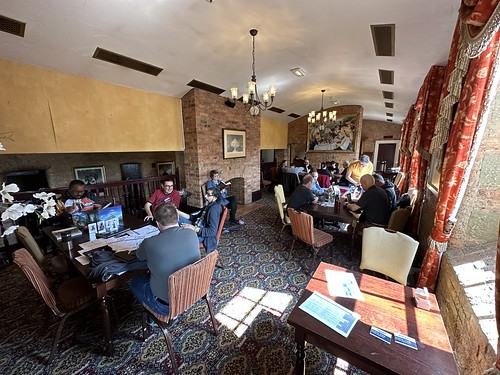 |
| North Star, our SF TTRPG convention underway |
Overall, the run up was smooth and the game allocation went well. A few GMs were disappointed (and I feel for them, because I've been there) but they all got games. We had reduced numbers on our peak, and lost some more in the run up. However, we got there and no game ran with less than three players and most games were full to capacity. It would be nice to get another ten people at the convention though.
I've pretty much got the method sorted now, so processing is simple. Everyone knew what game they were in coming out of the Bank Holiday weekend before. I do have to thank Dr Bob, as they were very accommodating about my need to move them from a game after I made a small error in allocation. Fortunately, their second choice was available.
I arrived to find the Garrison set up, just waiting for me to do table names, X-cards and get the allocation out. Graham had stayed over the night before to prepare. As we'd decided to have a bring and buy because we had no traders, I'd spent Friday night filling two boxes of games that I wanted to sell and happily the attendees made good in-roads into them.
Graham did his opening speech, and we were off.
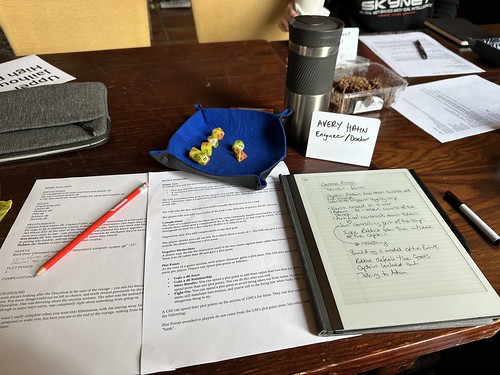 |
| I was typecast as an engineer (!) |
I didn't play the game I'd planned to in Slot 1, because one of the perks of being the games organiser is making sure that games happen. I dropped out of the game that I'd been planning to play to make sure we had the minimum number of people when someone's car broke down, and found myself playing Dr Mitch's "New Eden", a Cortex Prime game set on a colony sleeper ship where we got to wake up early and deal with the issue of a megalomaniac starship Captain who had stayed up the whole voyage and then work out an accord with an AI lest we lost the last survivors of humanity in a pointless war. I really enjoyed this, and we had some fun discussions of ethics and psychohistory led by our humaniform android played by Graham. A lovely game run by a GM on form. It was the first time that I'd played Cortex Prime and I liked it. Echoes of Savage Worlds.
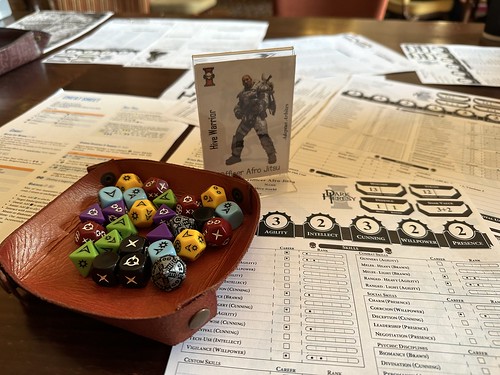 |
| What Dark Heresy is this? |
Slot 2 saw me in another game that I hadn't planned to play. I'd stepped into it at the end of allocation to make sure it went ahead. This was a hack of Dark Heresy, a game set in the Warhammer 40k universe, into the Genesys engine. Now, I've never really played Genesys before and the system seemed to give the Remi, our GM, a huge amount to do try interpret the runes dice symbols. I didn't really feel that the system added a huge amount, not to knock the huge amount of work that someone has done hacking an existing game to the engine. Remi did a splendid job though; it was in effect a police procedural, except that we couldn't really use our official status openly to avoid upsetting the nobility. I enjoyed the scenario, but the system didn't doing anything for me. However, I've no idea what the original game engine was like, so it could well be a billion times better!
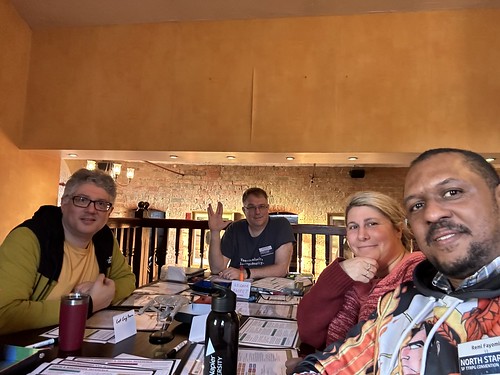 |
| Live long and prosper, TOS style |
Slot 3 brought my first game, a duo of games set in both The Original Series (TOS) and The Next Generation (TNG) of Star Trek using Modiphius' Star Trek Adventures. I ran the TOS side, and Dr Mitch ran TNG. We'd originally planned to run this last year, but my absence stopped it happening. Due to a player dropping out, I ended up with three players and Dr Mitch with four. I'd put a fair bit of effort up front, getting some Eaglemoss models for the ships and also making sure the character sheets were nicely presented in some menu holders that you could dry wipe. We'd never really finished writing the scenarios, and it's fair to say that we put the finishing touches in on Wednesday the week before. It was a delight riffing ideas backwards and forwards with Paul, and I think we ended up with a fun pair of adventures. Naturally, it involved time-lines going awry, characters swapping between past and future and then a set of walkie-talkies when the characters worked out how to build a temporal communicator. The players took great delight when they got myself and Dr Mitch to role-play the two Romulan Captains talking to each other.
My favourite bits? Debbie's young TNG Science Officer pointing out to Declan's TOS Captain that she looked like her mother. When she disappeared back to the future, the rest of the TOS crew said that Debbie's character was like a younger version of Captain Moore, who then replied "I was never that cheeky"! I also enjoyed Shachar's Lt. T'Pren stashing a vacuum frozen Romulan body in a shuttle 'for the good of science', directly against the gung-ho first officer's instructions. Overall, all the players embracing the genre and the scenario and it was fun.
I had been terrified of the game system before I ran, but overall the 2d20 engine worked smoothly, and Remi also was a star as he managed the momentum pool like a pro. I'm not a huge Trekkie (I have fond memories of TOS, but never really got into TNG or Deep Space 9 as I preferred Babylon 5 at that time) but I hope we caught the feel of the setting. Dr Mitch and I have been asked to do a sequel and some ideas have started to be exchanged.
I had time for a nice pint of Guiness with Jag, Dr Mitch and Glenn before last orders, and got a good night's sleep. I was up not long after seven in the morning and started to dive deep into Svalbard, the afternoon game I was running.
 |
| Happiness is Mandatory. |
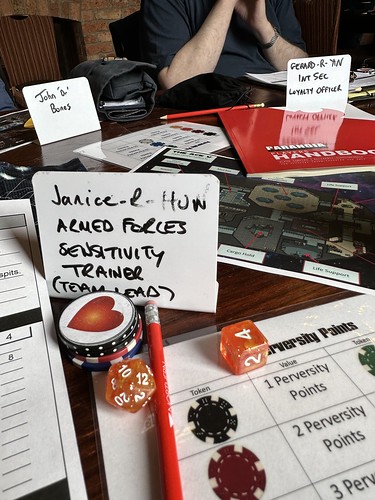
My first game on Sunday was 'The Traitors Among Us', a mash up of Among Us and Paranoia prepared with Declan. We all had the usual Alpha Complex hidden agendas from mutation and secret society, but we also had the issue that perhaps all of us were under some kind of alien influence. Which, naturally, was treasonous. A humorous PVP (or more accurately, Character vs Character) game followed. In the end, bizarrely, I managed to come to a deal with Simon's gelatinous imposter by feeding him Craig's clone bodies. It was fun, and a nice return to a game that I have not played for perhaps thirty years. I've never played a sensitivity trainer before either.
|
| Preparing on the veranda |
The last game was Svalbard, which was standalone game and setting. I'll post some separate notes on running this later in the week, but our brave players didn't hesitate to put their lives on the line repeatedly to try and save the world from destruction. I was a bit nervous with this because I thought that it could have become a bit dry and mechanical, so I stole some session 0 approaches from indie games to try and make things work properly. The players managed to succeed; their characters saved the world, but according to the number of runs they did, they died in their helicopter evacuation when rocks came down from the side of the mountain above the Secret Underground Base (tm) that they'd just destroyed. I think everyone one had a good time; we'd a great group and they riffed off each other well. I forgot to take a picture of the players at the table, so I've used one of my final prep looking out from the Garrison's roof veranda.
The game wrapped at 17:45, and I cleared up and then headed out, just in front of the last few attendees. It was nice to see happy chatter about the games that had been played and the fun that had been had.
North Star will return in 2024.
Thanks to everyone who attended.
16 May 2023
03 May 2023
Books in April 2023
 |
| April’s reading rate. |
April was a steady month. I read 10 books (which brings me to 38 for the year), reading every day again for a total of 2,328 pages.
The mix this month was tilted heavily towards roleplaying books, including re-reads of Svalbard and Star Trek Adventures in preparation for North Star in just under a fortnight. I read the whole Liminal roleplaying game line (4 books) and loved it, along with Thay: Land of the Red Wizards for D&D, inspired by the recent movie.
I spent a chunk of time in the car so listened to two reasonably serious non-fiction audiobooks. One “We Own This City”, by Justin Fenton, covered police corruption in Baltimore and the operation that brought it down, and was fascinating. The other was “All In” by Lisa Nandy. I don’t often read political books but I was interested on her take on ‘levelling up’, especially as she’s looking at it from a Northern perspective. It was an agenda focused on localism and empowering communities, and leaves me with hope that if Labour win the election we may see something different rather than more of the same unmanaged decline in favour of London which we’ve faced since the late 1970s.
The only novel I read was N K Jemisin’s “The City We Became”, which I enjoyed a lot, a tale of New York’s avatar’s awakening. Five different people develop powers reflecting different boroughs as the city attains consciousness and they become aware that something is attacking them. Enjoyable.
Overall, a good month in books, except I failed to read First Age’s reading challenge set on the https://www.gamingtavern.uk/ so I shall have to return to that and read the book for this month as well.
3 May 2023
30 April 2023
First Impressions - Thay - Land of the Red Wizards (D&D)
 |
| Welcome to Thay... |
TL;DR: Overall, I'm impressed with this book and setting. The content could easily be used for other D&D editions and even other game systems. It would have been easy to write a much more simple book with cardboard cut-out evil Red Wizards and a cartoon-like treatment of Thayan culture. Instead, we have a properly realised and believable fantasy society. Thay is a repressive police state ruled by an undead lich which exploits slavery, but it's also a place full of energy, hope and opportunity. It feels real, full of conflicts and contradictions.
I picked up the premium colour hardback version. It's 108-pages long and packed with gorgeously evocative images that relate well to the text. Nominally written by Greenwood's fantasy alter-ego, Elminster, most of the book is system neutral setting material.
The book opens with a section on the people of Thay, and how the society works. It's written sensitively, something which is necessary because Thay is controlled by the powerful Lich, Svass Tam, who operates an arcane police state employs undead and slaves. The undead are mostly used in armies and to support state objectives (for example, mining or building infrastructure such as roads). The text is clear that the rest of the Forgotten Realms find Thayan slave ownership abhorrent (partly because they've often been a source of slaves) and also shows that opinions and attitudes are shifting within the country itself. The book describes how Thay is ruled, and how the Red Wizards are organised (including how to enter the order, and the internal rivalries). The relations with the rest of the Realms are touched upon (TL;DR: they aren't good). Svass Tam has a council of Zulkirs who advise him, each representing a different form of magic, but all are subservient to him. That said, he does allow dissent and different views to avoid the risk of the whole leadership of the country having the long-lived perspective of an evil rich-lord.
There's an internal cold war ongoing between Svass Tam and an exiled rival Red Wizard, Dar'lon Ma, gives plenty of opportunity for adventure. Ma wants to use the power of Thay to conquer other states and grow in power and influence, but Tam is more subtle. Dar'lon Ma has self-declared as a ruling Zulkir, and built his own council of rebels to challenge Svass Tam's authority. Trouble is brewing between the two factions; apparently this is covered in the Adventurer's League Dreams of the Red Wizards campaign. I can't comment on that as I've not read or played it.
One thing I love about the book is that it covers cuisine, with a selection of (real) recipes provided so you can make a Thayan meal!
Thay's military is detailed, both the undead hordes and the fearsome Thayan Knights. In addition, the Thayan navy, colloquially known as the "Water Fist", is described along with its fearsome undead rowed galleys. The final organisation is the frightening Probity Corps; the secret police feared by all Thayans. An example of one of their operations is given in the scenario later in the book.
There's a chapter going into points of interest which starts by describing a Red Wizard compound, before moving on to describe typical Thayan homes and the famous -and sometimes magical - serpent statues popular across the country. This is followed by a tour of Thay describing each of the Tharchs (regions) and a nutshell summary of the local ruler. This is gazetteer material, and done well. It rounds out with a section recounting the advice of Shelmazra Hornwyntur, a Thayan-born half-elven merchant, based upon her extensive travels throughout the country. Her notes describe where to eat, what good trade opportunities are, the places to be seen worshipping at, contacts for guides, along with general sound advice for the traveller.
Between these two sections, Thay comes to life. Thay is a repressive police state ruled by an undead lich which exploits slavery, but it's also a place full of energy, hope and opportunity. It feels like a real society, full of conflicts and contradictions. Thayan's aren't presented as cut-out villains but as more complex and likeable real people.
Rules-based material appears after sixty-six pages. This includes an intriguing Paladin variant: part-Wizard, part-Warrior, the Weavebound Paladin can draw upon the magical weave that underlies the world. At high level, they can temporarily shed Paladin levels to gain Wizard levels. They're unique and interesting. There's a new magic option to use circle magic, a way for the Red Wizards to work together to cast more powerful spells. A technique developed by Svass Tam, both the land and the casters can be damaged by using this magic form but the power gained is ever so sweet.
There are three new backgrounds; the Blank Slate (someone linked to the aberrant who has woke up without memories, having escaped from a ruined Red Wizard's laboratory); the Expatriate Mage (a wizard who has abandoned the Red Wizards); and the Thayan Deserter (a soldier who couldn't conscience carrying on doing what they'd been ordered to and escaped). All of these backgrounds give lots of scope to roleplay, with plenty of hooks for the GM. The chapter concludes with descriptions of the more unique Thayan equipment.
The next chapter is a short bestiary of creatures unique to Thay, several of which are goat-based! They're unique and fun and quite fitting for the setting.
The final section of the book is an adventure which can take a group of characters from first level to third level. They'll be recruited into a conspiracy (although they likely won't realise this initially), have several side quests and then face a serious moral dilemma. Whichever option they take, there will be plenty of hooks for an ongoing campaign, even if it just initially focuses on getting out of Thay alive.
Overall, I'm impressed with this book and setting. The content could easily be used for other D&D editions and even other game systems. It would have been easy to write a much more simple book with cardboard cut-out evil Red Wizards and a cartoon-like treatment of Thayan culture. Instead, we have a properly realised and believable fantasy society, a society where it wouldn't be a stretch to play characters in or visit.
Recommended.
30 April 2023
02 April 2023
Books in March 2023
 |
| The graph goes on... |
March saw eleven books (two roleplaying, one non-fiction and the rest novels) and 2,984 pages. There's also the read through of 'Stealing Stories for the Devil', Monte Cook's new roleplaying game, but I didn't really have the time or energy to add the three books in on the Storygraph.
The roleplaying games were Alice is Missing, which looks really interesting and I may try to set the game up online as it looks quite intriguing, and Pirate Borg, which I reviewed at the time and really want to get to the table.
The non-fiction was Flying Blind: The 737 MAX Tragedy and the Fall of Boeing (Peter Robison) which left me sad at the way that neo-liberal changes in the way that US companies are governed enabled the dismantling of the strong innovation, safety and engineering culture of the once admired giant in favour of financial engineering and cutting safety margins on aircraft to save money. It also left me angry that the company had ultimately partly escaped from being held to account thanks the the arrival of the pandemic meaning the scandal of the two crashed aircraft with complete loss of life fell from the news cycles.
I went to Shanghai in the 1920s with Tom Bradby's "The Master of Rain", a detective story set amongst the corruption of the international settlements in the city. I also read a promising first novel by Helen Ingle, "Subject Alpha", which had an enjoyable energy to it.
I went back into the world of espionage with Mick Herron's short Slough House story 'Standing by the Wall', and Olen Steinhauer's 'All the Old Knives'. The latter has a film version out, and I think the book spoiled it for me. I think you can probably do one media format or the other.
Crime featured with Hanna Jameson's 'Something you are' and 'Girl Seven', both fast-paced novels set in London's underworld, and quite enjoyable. Violence and sex are common in these, so if that's not what you like in a crime story, don't go there. I will return to read the final part of this loose trilogy.
Now I come to my favourites for the month. I finally read Aliette de Bodard's novella 'Of Charms, Ghosts and Grievances' and loved it for its fusion of cultures, magic and delightful characters, as well as the mystery at its heart. I really need to read the full novels soon (and they're on my Kindle).
My favourite novel for the month was Ken MacLeod's "Beyond the Hallowed Sky", the start of another trilogy from one of the author's whose books are automatic buys for me. Ken's novels are sharp, different and often have a socialist streak that counterbalances the more common capitalist stories that are found in SF. This is set in a future where Scotland has gone its own way into the 'Union' (think successor to the EU) and England is part of the 'Alliance' (US etc). Climate change has happened, AI exists, and a permanent base has been set up in orbit of Venus. An academic publishes a paper which indicates the potential for FTL travel, and events ensure. The second part has just come out and is in my plans to read soon.
I managed to read every day this month, once again.
2nd April 2023
19 March 2023
First Impressions - Pirate Borg roleplaying game
 |
| Pirate Swag |
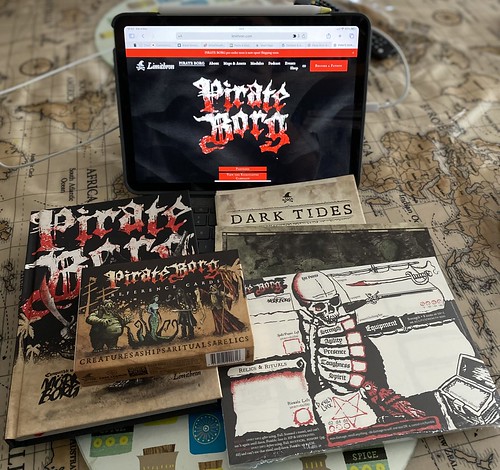
Pirate Borg is a pirate flavoured take on the art-punk Mörk Borg roleplaying game, which I’ve previously covered in its cyberpunk version CY_BORG. Published by Fria Ligan under the Free League Workshop, Pirate Borg is a 168-page small hardcover, packed fill of thematic artwork, with two ribbons. The cover is matte in black, brown, white and red, with some clever use of spot UV to emphasise certain aspects of the images. Written by Limithron (Luke Stratton), it packs a lot into a small space. As usual, the end sheets contain useful reference material. The artwork impacts the readability significantly less than it does in CY_BORG and Mörk Borg; it’s still striking but works much more sympathetically with the eye, not impacting legibility. The book is not yet on general release; my copy was a late pledge on the kickstarter which came with a map, cards, zine and character sheets for use at the table.
TL;DR: Pirate Borg is very well done; it takes the Mörk Borg engine and turns it into an evocative and thematic pirate game. It is beautifully presented and clearly written. You could easily use a large part of this book as a reference for other games, lifting the copious random tables to inspire a game using another system. The example setting is a flavourful sandbox. This deserves to be a big hit when it gets into general release.
The general release has been delayed as one of the zombie images caused concerns as it was being interpreted as racist; as a result, amendments have been made and the retail version will be a different printing. Stickers will be made for the the remaining stock. It’s a solid response to an unintended situation, as it’s clear from the credits page that the author is well aware of the potential for elements of the setting’s source to cause distress.
“Pirate Borg is a game about grog-swilling pirates, undead galleons, arcane treasures found in ancient temples, and high seas adventure. It's not a game about slavery, sexual violence, genocide, or any of the other abhorrent real parts of our history. Please treat these topics with the respect they deserve, or leave them out of the game altogether and go hunt some skeletons.” (from the first page)
The book is set in the Dark Caribbean, a twisted echo on our worlds. It is a paradise threatened by the Scourge, a rising wave of undead and horrific monsters which have emerged from the sea. The burnt remains of undead are used as a psychedelic drug called ASH. The pirate faction, the Brethren of the Coast, formed the Republic of Pirates based out of the ruins of Nassau Town on New Providence Island and Tortuga. The old colonial powers are there: the British with a weakly supported Royal Navy supporting the Machiavellian West India Company; the French remain, decadent, dissolute and corrupt, everything is for sale in the French Indies; the Viceroyalty of New Spain has its heart in Cuba, but the Inquisition also resides in a citadel on the mainland. The Yucatan keeps its secrets close and expeditions such as Cortes’ just disappear, but the rumours of gold endure. Finally, sailors tell tales of The Sunken One returning, as foretold in the Necronomicon, and the Abyss opening up. It’s a well constructed mix ready for the player characters to light the spark.
There is a d66 table, detailing how the Dark Caribbean will move towards the Apocalypse (unless the players intervene). Unlike its sibling games, there is less direction on how to apply the history of events and happenings to drive the plot; it is left to the choice of the scurvy dog who runs the game. There are six threads, with six stages of escalation each. It does remind me a little of a simplified Dungeon World adventure or campaign front. There’s a lot to inspire an extended campaign; this is one of the strengths of the book. There are a lot of ideas and tables which could easily be lifted to run with other engines in a setting (for example D&D or the long out of print Pirates of the Spanish Main).
Character generation starts with the player rolling for the basic equipment they have; a container (which could range from a bucket to a dinghy), something cheap, and something fancy. Next up are ability scores; these are rolled on 3d6 and modified by class (unless you’re a classless landlubber and roll 4d6 and drop the lowest dice). A table turns these into a modifier from -3 to +3. The abilities are strength, agility, presence, toughness and spirit.
Tests are made by rolling a d20 and adding the ability modifier. The base difficulty rating is DR12 - a target number of 12 to roll above (ie a 40% chance of success for a character with zero modifier). The game is player-facing for tests that affect characters (but GM can roll if appropriate - for example a creature climbing up a mast after a character). The failure rate is something to be aware of; if you want more competent - dare I say heroic? - characters they’ll need to gain experience (but the modifiers top out at +6, so there will always be a 30% chance of failing a DR12 roll). Starter characters do have a risk of being like the comedy duo from Pirates of the Caribbean if they aren’t careful.
The next rule presented is ‘holding your breath’, as drowning is likely to be a commonly present danger.
Combat is pretty similar to its siblings; there are initiative options for group or individual rolls. You critical for double damage and degrade armour on a natural 20 attacking or can make a free attack if defending, and you fumble on a natural 1 (breaking or losing your weapon if attacking and taking double damage and armour degradation if defending). Fumbling a black powder weapon has its own table.
Core character classes start with the Brute, a rough melee combatant whose trick in trade is violence; they cannot use arcane rituals. There’s the Rapscallion, a sneaky, backstabbing thief and swindler, with the luck of the devil until the devil comes to take them to hell. The Buccaneer is a skilled tracker and survivalist, and a specialist sharpshooter with a musket. It wouldn’t be a pirate game without a swashbuckler; they’ll have their own flamboyant fighting style and a feat that brings out their swagger and bravado. Zealots are often members of the clergy, but could be a cultist or a shaman. They have prayers (spells), an affinity to arcane rituals and relics and plenty of luck from whoever they serve. The final core class is the sorcerer, a conduit for spirits and necromancies entities. They too have an affinity for arcane spells and rituals, but cold iron and metal inhibits their powers.
There are also optional character classes which are slightly more offbeat in flavour. They each add something a little different, which may not be for everyone. The first option is the "Haunted Soul" which I mentioned earlier. This includes all manner of different supernatural creatures including ghosts, spiritual conduits, zombies, vampires, skeletons and eldritch minds (you're drawn to the deep and have visions of antediluvian horrors). All these classes are twinned with a core class. Hence, if you die, you could come back as a zombie or ghost.
The other optional class is the "Tall Taled". You can be a merfolk (fish-tailed, but with an additional core class); an aquatic mutant (some kind of union between man & the sea, also gaining a core class) or a sentient animal (no additional class). Drawing on a variety of genre appropriate sources, all of these give a chance to be something a little different.
Base hit points are d10 + toughness if you’re a landlubber, or class dependent. Zero hit points breaks you - negative hit points kills you. If you’re unlucky you may be allowed to bring a dead character back as a haunted soul. Otherwise you recover some HP from a short rest (d4) of around 10 minutes or more (d8) from a longer rest overnight. There are reaction tables for creatures (which mean they won’t always attack) and also morale rules to see when they will break.
There are random tables for backgrounds (which give you starting cash and additional equipment), distinctive flaws, physical trademarks, idiosyncrasies, and then unfortunate incidents and conditions that you have suffered from in the past. Finally, your character gets a 'thing of importance', an item that means a lot to them, but you'll have to decide why. All of these are decent hooks to hand a character around. I hope that there will be an online generator for characters, similar to those for CY_BORG and Mausrítter.
Experience can boost or reduce your ability modifiers (but they’ll never go down so long as they’re at +1 or less), raise your hit points, give you a new class feature and a new item. There’s no set trigger for experience.
Weapons range from blunt force implements like Belaying Pins through swords and axes to black powder weapons like flintlock pistols and muskets.
Magic is approached via arcane rituals and ancient relics. There are twenty example relics, drawing on all manner of inspirations (Christian relics, Mayan and Lovecraftian artefacts are all included). Arcane rituals can produce quite powerful effects (for example summoning the Kraken or controlling the weather) but failure results in a roll on the mishap table, which can be quite devastating at both a personal and regional level (for example, causing a significant earthquake, breaking the laws of physics, going insane, or being attacked by creatures).
Sea Shanties are a more subtle form of magic; if a ship’s crew can manage to sing them together harmoniously (or at least by passing a skill test), then they can get a benefit. The Captain’s Spirit Ability rating influences the number of shanties a crew can use in a day. Effects range from changing the weather through, to helping carry out tasks to affecting other vessels.
Alchemy is also available as an option, with tables for the kind of potion, effect and the DR (difficulty rating) to resist (should you want to). You can roll randomly or just choose the outcome.
Naval combat is covered in detail, with a simple but effective hex based system. Ships are defined with a simple set of statistics, and hit points scale between people and vessels by a factor of five (so a 20HP ship has 100HP if attacked with a personal weapon, and a ship’s cannon doing d8 damage to another ship would do d8x5 to a PC if it hit them). Rounds are typically 30 seconds long, although there’s some flex in that. Ships move, then non-Captain PCs can take a crew action. Crew action examples include firing a broadside, raking a ship with small arms fire, coming about, dropping and weighting anchor or sending a boarding party to capture another vessel. Crew actions cannot be taken once a ship is in close combat.
As well as combat, other maritime operational aspects are covered such as speciality crew, skills and morale, and all manners of operational needs such as careening the hull to remove barnacles and carry out repairs. There are rules for wether and wind, plus a good selection of random tables for encounters and events and the flotsam and jetsam your ship encounters when travelling around the Dark Caribbean. There are plenty of example ships ranging from the raft you escape from your shipwreck on, through to a Ship of the Line that you may encounter from the Royal Navy or French fleet. Of course, there are also more mysterious vessels such as Ghost Ships and Vessels that have risen from the Deeps.
There’s a decent bestiary with a variety of interesting examples, and then procedures for creating your own enemies. Skeletons, Zombies, and Ghosts all get their own spreads and are nicely illustrated. There are more esoteric and weird creatures, including drowned sailors, Sirens, Deep Ones and the fearsome Coral Shoggoth. Of course, all these pale into insignificance in the face of the fearsome Kraken when it rises from the depths, and the less said about the Leviathan or Davy Jones, the better. There are also examples of Naval crews and the Inquisition, along with more unnatural enemies such as necromancers and the Sunken Ones. A more unique option is for ‘marrow cannons’, sentient undead cannons, created by necromancers. There’s a lot in this to sustain an extended campaign without needing to create more.
Ship encounters are covered by random tables including their cargoes. Derelict vessels are also covered with extensive options, as is buried treasure (what pirate game would be complete without this?) and treasure maps (including riddles and clues). There’s a section written by Jacob Hurst [Swordfish Islands] to generate Uncharted Islands. This is done in a similar style to the Dark of Hot Spring Island, which is great (and you should check out those books if you get a chance). The plethora of GM material rounds out with a random pirate generator and a section giving random jobs and quests, plus rumours that could be rife in the port the crew find themselves in.
The book concludes with ‘The Curse of Skeleton Point’, a 33-page ambitious sandbox setting to kick off a campaign, set on the small pirate run island of Black Coral Bay. There are multiple sites to explore, factions to provoke and ally with, and plenty of hooks. There’s a basic plot line that will develop if the characters don’t interfere which raises the stakes tremendously. Will the characters work with the Governor or ally with Captain Davies?
The book concludes with a reference spread for character generation on a single spread and indexes for the book and for creatures. The end sheets have useful material for encounters at the front of the book, and for naval combat, abilities and tests and violence at the back.
So what do I think?
Pirate Borg is done very well; it takes the Mörk Borg engine and turns it into a evocative and thematic pirate game. It is beautifully presented and clearly written. You could easily use a large part of this book as a reference for other games, lifting the copious random tables to inspire a game using another system. The example setting is a flavourful sandbox. This deserves to be a big hit when it gets into general release.
19 March 2023
18 March 2023
Curse of Strahd - Initial thoughts on ending

The campaign ended this week with an appropriately brutal finale, which I will write up later.
We started on 20th November 2019, before the pandemic, and ended on 15 March 2023. We started off with a session every two weeks and then a one to two month break between seasons, but accelerated for the last few seasons to mostly weekly, adopting the rule that we would run if three of the four players were available.
We had four players make it all the way through; Paul (Ser Adon), Tom (Ser Alys), Graham (Kelwarin) and Alex (Gaddock). Jag (Roscoe) played in the early campaign and his character returned for a cameo at the Amber Temple towards the end.
We ran using Roll20 as the VTT throughout (as I bought the module) but used Discord for the audio for the first few seasons (and ironically for the last session as audio was flaky).
I clocked 345 hours on the VTT, as there was a fair bit of prep work that I did. By the end of the campaign I'd upgraded to a paid for Roll20 membership and had started using scripts. I'd also picked up most of the core Dungeons and Dragons 5E books on the platform (except Tasha's which had very poor reviews). Roll20's core engine was solid and there were continuous improvements throughout. It's not my favourite VTT but it does the job well. I used two different Chromebooks and later a MacBook Pro for running.
I used the Beast of Graenseskov as an introduction to take the characters from Level 1 to 3 and enter Barovia. I also drew upon The Stygian Library when the characters visited the Abbey of St Markova. When they returned, I also worked in The Carnival using a modern reinterpretation and the original AD&D2e book as references. I also drew heavily upon the MandyMod and DragnaCarta remixes for Curse of Strahd from the r/CurseofStrahd Subreddit and they added a depth and flavour beyond the core book. If anything, I followed MandyMod for the treatment of the Fanes and leaned into DragnaCarta for some of the set-pieces. The subreddit was an invaluable source of ideas and maps for the VTT.
I ended up buying the campaign on DNDBeyond (along with core books) as it was an easier way to reference it when travelling with work. I was generally happy with that, until Wizards started the whole OGL shenanigans and that kind of put me off fifth edition for a bit (it delayed our restart by about six weeks after Christmas).
I went into the campaign owning the core D&D books, Curse of Strahd and Tomb of Annihilation, and by the end of it I had ended up buying a lifetime worth of books for the pace that I run. I may well want to revisit some of these campaigns, perhaps the shorter ones.
 |
| Too many D&D 5E books (and some stray troubleshooters)? |
The final combat was full on; Alex recorded Strahd (and his armour) taking around 542 hit points damage. But how is that the case? The first 100+ hit points damage went into the armour which they full on attacked assuming it was Strahd. The Heart of Sorrow absorbed another 100 hit points (yes, that’s upgraded from the core book). Strahd himself had 161 hit points (again, using the CR27 version). However, he could regenerate 30 hit points per round if he didn’t get hit by sunlight or radiant damage, which I made liberal use of. In some ways, forcing the battle to the larger outdoor space of an island gave Strahd the opportunity to disengage. The lake wasn’t enough to be running water, and he didn’t need to breathe, and there was plenty of mist around, even before you consider the potential for greater invisibility. In honesty, I’m confident I could have engineered an escape from the island (easy enough when the villain can summon a huge cone of bats and transform into one) but I’d realised the players wanted to end this. Redoing it at the Castle would have been frustrating. The ending, with a ennui laden Strahd challenging Ser Adon to a fight felt very apt. He didn’t expect the Paladin to try to cheat.
Several of the characters went down, and were on death saves, but the others brought them back and generally made it difficult for Strahd to take them out via massive damage (despite the significant levels of necrotic damage they’d taken) by being in the way. Luck played a part, but that’s a good thing.
It was a strange feeling when they took Strahd down, but I enjoyed that they way that they did it left a hint of ambiguity. More on that when I write up.
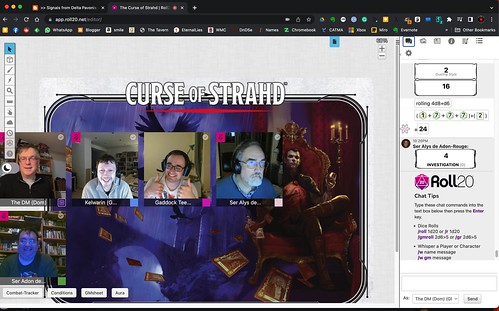
Last screenshot from the campaign is below… mostly all smiles.
I’m sure I’ll think of more as I write this up.
18 March 2023
 |
| The end of the road. |
08 March 2023
Games update
 |
| The latest doughnut of games |
Have started slowly, Revelation helped my game count for the year considerably. The mix looks very different at the moment with a single D&D5e game (today) as I returned to Curse of Strahd after a couple of months hiatus (thanks to OGL casting a shadow and some work and life complications). We're very close to the end now.
My most played game remains the Yellow King, but City of Mist is close behind. Just under half the games have been face to face. I expect that we will have another few sessions of Strahd, and then D&D5e will fade away for a while, but Trail of Cthulhu will reappear as Eternal Lies is restarting this month.
I've a few sessions of Graham's Heroic Fantasy 2nd edition Playtest to do as well, which should be fun.
The next big question for me is what will I replace the tent pole in my gaming that Strahd has been with. I suspect that it may be a shorter form campaign, but what exactly I'm not sure.
8th March 2023
04 March 2023
Books in February 2023
 |
| Reading Track |
February 2023 saw me read 10 books with a total of 1,932 pages. 3 novels, 1 graphic novel and 6 roleplaying books. I managed to read every day again. So that's 17 books in the first two months of the year.
The novels included a re-read of The Silmarillion (which has been by audiobook over January and February), the first of First Age's reading challenges. This was a delightful re-read of a favourite; the audio book brought out aspects of the story that my natural reading style doesn't, and also embarrassed me about nearly four decades of mispronunciations with certain characters! I also read the first book in Joe Abercrombie's First Law trilogy (again thanks to First Age's February challenge) and enjoyed it a lot more than I expected. I also returned to an SF favourite (Neal Asher, the David Gemmell of SF for me), with a new standalone novel, Weaponized. There a subtle hints on how it is a prequel to some already published books that are later in the Polity Timeline. I enjoyed all the books for different reasons so there's not really a standout this month.
The graphic novel was the sequel to the Blade Runner - Black Lotus anime, which was enjoyable, but not really earth shattering. However, it's lore to draw upon with the roleplaying game.
I read Godbound, the demi-god level roleplaying game by Kevin Crawford with was excellent. I do find his writing hard going; there's a lot of text and I think I'll definitely need to go through this again and make notes if I want to run it (which I do). The MÖRK BORG supplements Heretic and Feretory were great additions and both of Chris Bissette's scenarios for the same (Treasures of the Troll King and Into the Bluelight) were excellent and I can imagine getting them to the table.
I didn't really connect with Lukas Rolim's Pacts and Blades, a Moorcockian flavour micro-roleplaying game. It didn't really work for me; I've passed it on to First Age to see if he gets some more from it.
Overall, a good month for reading.
Overview here - https://app.thestorygraph.com/books-read/cybergoths?month=2&year=2023
4 March 2023

Subscribe to:
Posts (Atom)