28 July 2014

First Impressions - Port Royal

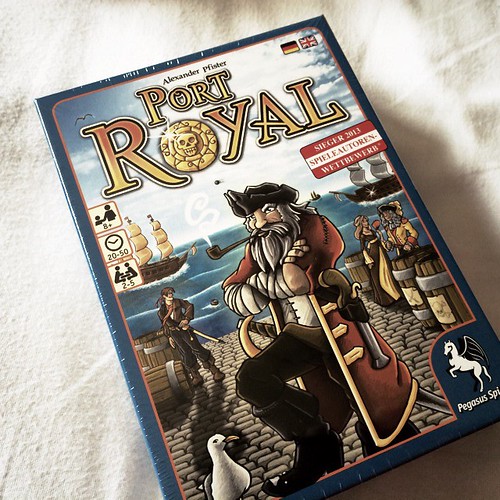
Port Royal Box

I first heard about Port Royal via a post that Tim G made either on the Tavern, or on Facebook, talking about his board gaming evenings. I was intrigued, as the idea of a game set in the golden age of sail with expeditions, trading and the like seemed right up my street. Anyway, I subsequently managed to play it 4 times at Continuum 2014 at the end of July and ended up ordering a copy before the convention had ended. This is a short review of the game.

  • The game is entirely card based, and the only thing it is lacking is a first player token.
  • It is an interesting combination of a trading game, with missions and a push your luck element.
  • The back of the cards serve as game currency. As you spend these they go back in the discard pile, which cleverly keeps the deck mixed up.
  • The setting is either the Caribbean or old Europe, and you represent a harbour owner building for expeditions by trading and getting the right people together.
  • Your aim is to win the game by getting 12+ Victory Points.
  • Each turn, you draw cards into a hand (‘your harbour’ ). There is no limit to the number of cards you can draw but you can go bust or end up really helping your opponents.
  • Cards are either ships, people or more rarely an expedition card or a taxation card.
  • Ships generate income. They are distinguished by flag colour, the number of coins that you will gain from them if you allow them to trade in your harbour, and the strength of their forces (rated from 1-5 swords or a skull-and-crossbones). Draw two ships of the same colour flag and you go bust, ending your go.
  • People come in a variety of types. They include: sailors (useful as they come with swords that can repel ships with a force strength less than the total rating the harbour has from sailors) and traders (who boost the number of coins you get from certain flagged ships); settlers, captains, priests (useful as groups of them can be traded in to complete expeditions); and higher cost cards such as the governor (allows you to take more cards than usual), the fraülein (makes each subsequent card purchase cheaper) and others that generally make it easier for you later in the game. Most people cards give you Victory Points.
  • Expedition cards must be played into the centre of the table when you draw them. They each have a pre-requisite number of people cards that need to be exchanged to gain them (for example, two settlers and a priest), but in return you get an increased number of Victory Points (VP) and some extra gold. You can only do this exchange in your own turn.
  • Taxation cards act as a control element in the game, with anyone with more than 12 coins being forced to half the number they have. Then someone will benefit (for example the player with the lowest number of VP, or the biggest army of sailors) with an extra coin.
  • Once you have drawn as many cards as you want into your harbour without going bust, you can take one of the cards if you can afford them, gaining coins from ships and spending coins to buy a person. You then pass the hand to the next person around the table, and they can also take a card. If they do, they must also pay you 1 coin in tax (so everything costs slightly more to do out of your own turn). This continues until the harbour runs out of cards or no one can afford or wants what is left.
  • The next player then takes their turn. When someone hits 12 VP, they must declare it. The game enters its end-phase then and play continues until every player has completed the same turn. At this point VP are compared and the winner declared.
  • The game has a very Euro-game feel. This is unsurprising as it is German, but what it means is that the game stays very close until the very end. Unlike some more US style games it is not obvious early on who will win, and early expedition success does not guarantee victory.

In conclusion, I loved it.
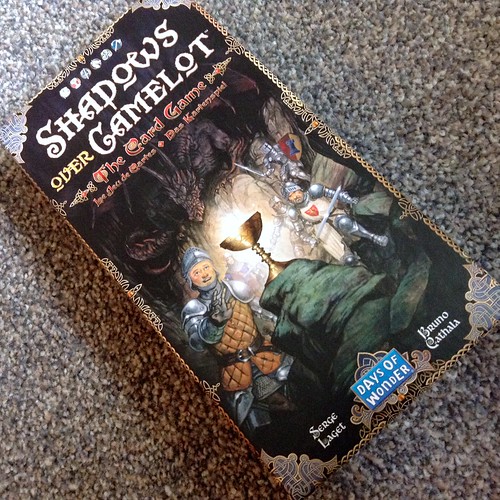
First Impressions - Shadows over Camelot (Card Game)

Shadows over Camelot: The Card Game

Shadows over Camelot, in its original boardgame form, is recognised as a classic of the genre of cooperative game with hidden traitors. I’ve never actually played it, as I also own Battlestar Galactica: the Boardgame which follows a very similar path (and is very enjoyable).

However, I love the Arthurian setting, and have long enjoyed it as a gaming setting with the Pendragon RPG. Admittedly, I always went for the more Roman flavour of the Mary Stewart Merlin series, rather than full on Mallory, but I love the mythic, historic, tragic feel. So when a quick to play card game variant of Shadows over Camelot came out, I was quick to snap it up.

The game is produced by Days of Wonder, and has very good quality production values. It is a card game, but has a number of counters used to represent quests that Merlin has decided to intervene in, and swords (double-sided, black and white to represent success and who it aligns with).

The core game comes with a Quest deck (split into a variety of threats/quests facing Camelot such as Picts, Saxons, Dragons, The Holy Grail, and finding Excaliber), a deck of Knights, and a loyalty deck.

The Loyalty deck is used to determine whether or not there is a traitor present. Traitors win if 7 or more black swords are accumulated, whereas normal, loyal, Knights win if 7 or more white swords are gained. It is possible that there is no traitor or even two traitors if you have a higher number of players.

The Quests are rated in Swords that you will gain when they are resolved. If you are successful, you gain white swords, else they are black, traitorous, blades.

Each player draws a card from the Quest deck on their turn. The card is placed on top of the other cards drawn so far so they can’t be seen, as the core mechanic involves your memory of the cards that have been played. Most cards are Quest cards - they have one of the Quests shown, and a number from 1 to 5 or a ‘?’ variable number. So, as cards accumulate for each quest in the played deck, the sum of the difficult of each gets higher. The players need to cooperate and use their memories to decide when to try and resolve the quests and which one to do.

This cooperation could make things simple if it wasn’t for the character cards in the Quest deck. Merlin appears, and his effect tends to be to reduce the threat level of each quest. Mordred appears, and he will strengthen the Picts and Saxons. Vivian appears, and she can cause a shift in loyalties. And then, there is Morgan. Morgan is the big bad. When you draw her card, the players may no longer talk to each other until a Merlin card is drawn again. Morgan will also either modify the final scoring or change the ways the quests work, normally to the detriment of the loyal players. These impacts include the quest cards being played face down so you can lie what you have drawn through to changes in the strengths of each quest itself.

Success in a Quest is a finely balanced thing. To succeed, you need to resolve the quest when the total points sum to 10, 11, 12 or 13. Any higher, and you have left it so late and it hurts the kingdom. Any lower, and you have responded with force too earlier and it hurts the kingdom. Failure gives black swords, success white. So a traitor will be trying to steer towards black swords…
Another complication is the variable cards. They score the same number of points as there are variable cards in that quest. So a single card scores 1 x 1 point and three cards would score 3 x 3 points. If you lose count, it is very easy to underestimate the impact of these.

Resolution is simple. You pick a quest as the primary one, then sort the cards out. The Morgan cards affect the results as they indicate. The Merlin cards typically remove the highest card in a pre-selected quest. Mordred boosts the Saxons and Picts. You then check the score. You also resolve the other quests - the secondary quests. All you want to happen here is to make sure that they each sum to thirteen or less, else you gain the black swords from them as the threat was ignored while you dealt with the primary Quest.

The game is really quite simple, and quick to play, so you could get several games in an hour.

I had a chance to play this (albeit a brief one) at Continuum, which I enjoyed thoroughly despite it being after 1am in the morning. The interaction with the different players definitely worked well and made the game more fulfilling than the solo variant. There is also an advanced version of the game where characters such as Arthur can intervene. However, I’ve not tried that yet as I wanted to get the basics firmly understood first. I’ll update this when I try it.

29 June 2014

Person of Interest


When I was converted from a Blackberry to a Nokia Windows Phone at the end of last year, I was fortunate that there was a promotion running at the time that gave you a free subscription to Netflix for six months. It’s proved useful, especially with the kids on rainy days! Lego Ninjago and Chima have been favourites.
I’ve mainly used it - so far for catching up on films that I missed when they came out originally, and also when I can’t be bothered to find the DVD. It’s on all the TVs in the house (one as a Smart TV, the others via AppleTV) and also works well on the iPads.


Anyway, I had been on a bit of a spy/thriller kick, and having watched
The Numbers Station and The Expatriate, I decided to try the recommendation from Netflix for Person of Interest. This was a TV series, with the first two seasons online already. I went with it on the theory that I could just bin it if I wasn’t bothered with it.

Anyway, I was more than pleasantly surprised by the serious. The basic plot is simple. Mr Reese (ex-CIA) works for Mr Finch (billionaire software engineer recluse) in New York. They are sent social security numbers by the Machine, an expert system, which represent people who will be either a victim or perpetrator of violence in the immediate future. This kicks off a variation on the Police Procedural Crime Thriller where first of all the ‘detectives’ need to work out who is the victim and why, before they stop it. The numbers are from the Machine’s ‘Non-relevant’ list which is deleted every night, the ‘Relevant List’ being related to Terrorism.
It’s very well written, with good characterisation. This shouldn’t surprise me really, as it is written by Jonathan Nolan, who was the writer behind the film
Memento, and others directed by Christopher Nolan.

It’s also very apt, especially post-Snowdon, and touches a lot of my interests - the spy drama, corruption, AI, surveillance state and so on. I’m pleased to know that there are another 2 series to watch after this one!

The overarching plot arcs are interesting - the corruption of the police through an organisation-known-as-HR set against the rising gangland control of the criminal Elias, and the interactions with the government owners of the machine and those that want to control or destroy it. There are two cop characters who support Reese and Finch - one a very straight laced detective, the other moving on from a corrupt past life.

I recommend this highly - you can get the first two series on Netflix, or on DVD right now.

23 June 2014

Hamburg Photoset

Hamburg: Bridge framing

I mentioned Hamburg before. These are my photos from the two weeks I spent there:
https://www.flickr.com/photos/cybergoths/sets/72157640222141336/

Coming out of the Swamp

It’s been a hard six months at work. Started off well, with me refocussing following handing over the maternity cover role that I had done for most of 2013. It even became inspirational, as I spent two weeks away in Hamburg on a training course which defined a programme for safety management that I fundamentally believe in and can see the opportunity to reduce the number of people who get hurt substantially. It’s perhaps the way to break through the plateau that our performance has been at for the last few years.

And then reality started to bite. There was the small matter of the COMAH report to complete (see
Milestone Revisited for more details) which consumed a huge amount of time and effort, and on top of that the revised lean manufacturing programme for the factory. Now, about a decade ago I was trained in the JIPM’s TPM process, a child of the Toyota Production System, and I fundamentally believe in the rigour and logic that such a system requires. My company has now adopted a new, improved, focussed evolution of this system that promises a substantial, sustained reduction in cost combined with substantial performance improvements. Now, this is fantastic, music to my ears, but it has been a completely demoralising and exhausting process.

The level of rigour is substantially higher, and there is a huge pressure on time. The system is new, and the core company processes and procedures aren’t fully aligned. Officially they are, but they’re working out the bugs and contradictions at the moment, and the goalposts are moving as we play the game. Indeed, I commented to a colleague that it felt like we used to play football, and have now moved to play rugby, only to find out that while we’ve been learning Union we’re actually playing League. As a result, it’s hard, and I’ve taken too much home that should have stayed in the office. Over the last month we’ve had two harrowing audits, and are now picking up the pieces to move things back to a more normal footing. The plus side is that we are in a better position than we were before!

Jill and the boys have been fantastic, and very patient with me, and I owe them a big thank-you.

Anyway, tonight I’ve been sorting out photos that I’ve taken for people so I can share them, clearing my personal email account and generally getting things done. This follows an afternoon where Jill and I got on with essential maintenance in the garden. Slowly, normality is returning...

21 May 2014

Milestone revisited

Today was one of those days that feel good, as my team and I completed a significant amount of work, and handed it into the regulator responsible. I don’t talk work very often here, but I’m kind of proud of this, so indulge me.

Those of you that know me well, know that while I am an engineer by training I work in health and safety at a high hazard site governed by the Seveso II directive (implemented in the UK as the Control of Major Accident Hazard Regulations 1999, as amended) usually called
COMAH. This is a piece of European legislation, designed to minimise the risks to society from the consequences of major accidents and threats to environment.

It came about from major incidents at
Flixborough in the UK (large fire and explosion) and Seveso in Italy (Toxic release). It’s not “health and safety gone mad”, as David Cameron and his chums are so fond of ranting on about, but a very serious attempt to protect people and the environment from harm. A recent example of this in the UK was the fire and explosion at Buncefield in 2005, estimated as being the largest fire in Europe since the Second World War. The regulations consider flammability, toxicity and eco-toxicity (potential harm to the environment), and are governed by the Competent Authority (HSE and the various versions of Environment Agency across the UK).

Anyway, the site that I work at became a site covered by the higher requirements of COMAH – an 'upper tier' site – back in 2009, due a planned increase in the levels of 'dangerous substances' under the directive. Becoming upper tier requires you to have on and off-site emergency plans, and to produce a safety report that demonstrates that you meet the stringent requirements of the legislation to take 'all measures necessary' to prevent a major incident. This is more demanding than the usual UK requirement from the
Health and Safety at Work, etc. Act 1974 places on an employer. That duty is defined as 'so far as is reasonably practicable', whereas COMAH has the duty of 'as low as is reasonably practicable', a significant advance. But when you are dealing with events that can have a significant affect on society, this makes sense.

Every five years, you have to resubmit the safety report, and that's the milestone we achieved today. Having led the production of the report initially, I can confirm that doing it a second time is no easier. It was a great feeling when we handed it in at the HSE offices in Leeds today, six months, 733 pages and 230,000 words of detailed quantative and qualitative risk assessment later. I was proud of the way that my team had pulled together to make this happen.

Now I guess that it's back to reality!

17 May 2014

Children are Strange

I do find it bizarre that all through the week we have to drag the seven year old out of bed to go to school, yet at the weekend I get up to find that he has been downstairs playing since around 7am.

He tells me that it is because “there’s lots to do”.