21 May 2014

Milestone revisited

Today was one of those days that feel good, as my team and I completed a significant amount of work, and handed it into the regulator responsible. I don’t talk work very often here, but I’m kind of proud of this, so indulge me.

Those of you that know me well, know that while I am an engineer by training I work in health and safety at a high hazard site governed by the Seveso II directive (implemented in the UK as the Control of Major Accident Hazard Regulations 1999, as amended) usually called
COMAH. This is a piece of European legislation, designed to minimise the risks to society from the consequences of major accidents and threats to environment.

It came about from major incidents at
Flixborough in the UK (large fire and explosion) and Seveso in Italy (Toxic release). It’s not “health and safety gone mad”, as David Cameron and his chums are so fond of ranting on about, but a very serious attempt to protect people and the environment from harm. A recent example of this in the UK was the fire and explosion at Buncefield in 2005, estimated as being the largest fire in Europe since the Second World War. The regulations consider flammability, toxicity and eco-toxicity (potential harm to the environment), and are governed by the Competent Authority (HSE and the various versions of Environment Agency across the UK).

Anyway, the site that I work at became a site covered by the higher requirements of COMAH – an 'upper tier' site – back in 2009, due a planned increase in the levels of 'dangerous substances' under the directive. Becoming upper tier requires you to have on and off-site emergency plans, and to produce a safety report that demonstrates that you meet the stringent requirements of the legislation to take 'all measures necessary' to prevent a major incident. This is more demanding than the usual UK requirement from the
Health and Safety at Work, etc. Act 1974 places on an employer. That duty is defined as 'so far as is reasonably practicable', whereas COMAH has the duty of 'as low as is reasonably practicable', a significant advance. But when you are dealing with events that can have a significant affect on society, this makes sense.

Every five years, you have to resubmit the safety report, and that's the milestone we achieved today. Having led the production of the report initially, I can confirm that doing it a second time is no easier. It was a great feeling when we handed it in at the HSE offices in Leeds today, six months, 733 pages and 230,000 words of detailed quantative and qualitative risk assessment later. I was proud of the way that my team had pulled together to make this happen.

Now I guess that it's back to reality!

17 May 2014

Children are Strange

I do find it bizarre that all through the week we have to drag the seven year old out of bed to go to school, yet at the weekend I get up to find that he has been downstairs playing since around 7am.

He tells me that it is because “there’s lots to do”.

Back again

Not that I’ve ever really been away.

Apologies for the silence here, but the last 12 months ending up quite fraught with a large number of complications from work that meant that updating this blog was one of the things that got dropped. That’s not to say that I didn’t write stuff - rather, it never got to the point of being uploaded. Some of that will appear going forward.

08 May 2014

Keyboards for iPad

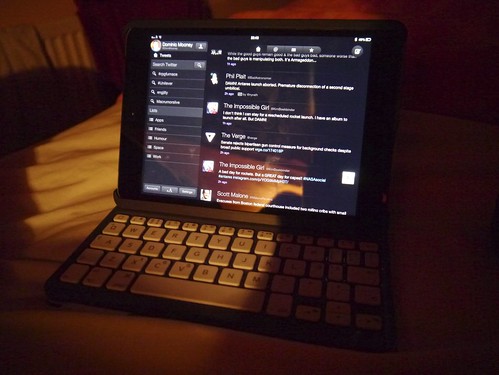
Logitech Folio - iPad Mini
I've used an iPad since they were released in the UK back in 2010, and I am convinced that they are not just consumption devices as some people would suggest. However, if you want to do any serious typing then I would recommend getting hold of a Bluetooth keyboard.

I initially started with the Apple Bluetooth keyboard. This is very nice to type on, but not the lightest of devices. However, it met my needs for over a year. Unfortunately, I then managed to drop it onto a hard surface (a concrete floor), and broke it. Although it is built from Aluminium, the tube around the on/off switch can be bent so it cannot work anymore.

I briefly tried a Zagg Keyboard case, but rapidly found it too much of a compromise for my liking. Fortunately, it was an eBay purchase and I passed it onto a friend. I didn't like the keys and the limited positioning for the iPad in the case. It also gave limited protection, and I preferred the combination of a full case for the tablet and separate keyboard.

My next keyboard was a Logitech Tablet keyboard. This is made of plastic, but has satisfying keys to use, and a good pitch. The first one of these lasted 11 months, and then a bank of the keys stopped working. It was replaced promptly by Logitech under the warrantee. The second is still going strong and is always a good option for longer pieces.

Jill had the next keyboard; this was another Zagg one. I can't remember the exact one, but it was an aluminium keyboard with feel like the Apple one, and it clipped into a full case like a folio. It was very impressive, but died a few days close to the year that we'd had it. After several battles with Zagg's customer support interface we finally got hold of a human on the other end and got a warrantee replacement. Unfortunately, this was pretty cheap and nasty, as the model had been replaced with a plasticky one, and there was no option to upgrade to a more robust unit. To say Jill hated this was an understatement. As she uses her iPad much more than me for work as well as pleasure, this was not good.

However, a solution soon presented itself. After three years, I had my second iPad - an iPad mini - and whilst fully functional, the Logitech Tablet keyboard was far too big. I wanted a solution just like Jill's folio.

Belkin were the early movers here. The keyboard folio case was slim, with a finish not unlike the old-school time manager international organisers. However, within 5 months I changed it. "Why?", you ask. Quite simply, it was the non-standard key positions that required an odd combination of keys to be pressed to get an apostrophe. It drove me mad.

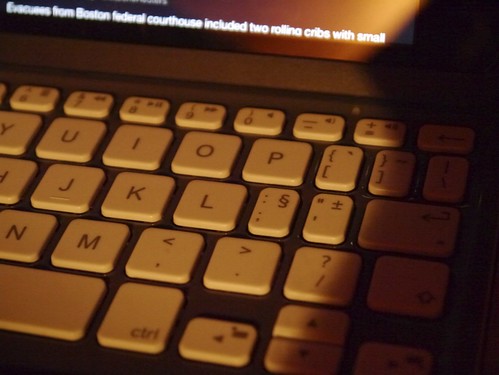
Logitech Folio for iPad Mini - Detail

I switched to a Logitech Keyboard Folio Case which has great keys and good battery life. It's plastic, but well built. Battery life is good. And more importantly, as you can see from the photo above, it has a normal apostrophe key!

This ended up as Jill's solution too - Logitech soon released one for the full size iPad 2/3/4, in shocking pink and white. Lovely keys and typing action.

And that's were we are now.

07 April 2014

First Impressions - Zero Point, Neal Asher

(Important - spoilers if you haven't read The Departure, but no worse than those in the blurb on the back of the book.)

ZeroPoint

Zero Point is the second book in Neal Asher's Owner Series, and continues with the strong - and somewhat unpalatable - themes that he developed in the first book, The Departure. The dedication at the start of the novel really sums it all up: "To all you steady researchers and developer of our technology, for recognising the optimistic road to the future, rather than seeing a slippery slope to doom."

Of course, the Owner Series is about a society that has been on the slippery slope to doom, both societally and ecologically. At the end of the first novel, the protagonist, an anti-hero called Alan Saul, was escaping from Earth on board the Argus Station having decapitated the global bureaucratic dictatorship of 'the Committee' whilst taking the station, and finishing off local controls by dropping their own satellite network on them. The 'zero asset' citizens are freed from Committee oversight, at the cost of the collapse of infrastructure, which potential could lead to their starvation.

This novel meshes three tales together - the emergence of Serene Galahad to reestablish the power of the Committee and the infrastructure of the Earth whilst pursuing a more radical path than her predecessors, the events at the Mars Colony which had effectively declared independence from Earth in the first book, and the events aboard the Argus Station. The plots are brutal, and don't show the nicer side of humanity.

Technology ramps forward without the control of the Committee, as Saul develops his abilities and others have the limits on what they can do released, and the plot twists and turns. Some of the characters - for example Galahad - feel quite two dimensional, but the energy and darkness of the plot drive you forward.

I found that it was quite hard to put down as it draws you in quite effectively, despite finding whole elements somewhat unpleasant. The story goes into areas that few other SF stories do except in the more literary side of the genre (such as The Handmaid's Tale or Nineteen Eighty-Four), with a dark dystopian vision and characters that match. It won't be everyone's cup of hot beverage, but I recommend it for its energy and dark flavour. It directly provides of vision that contrasts technology used for good and for ill, with the difference being the morals of those that wield it.
01 April 2014

There's something about (Luc Bresson's) Lucy

 spoiler warning[1]

I watched Luc Bresson's Lucy last night, and whilst it's not the best of his films, it has had me pondering off and on today. Visually, the film is very distinctive, with style that is noticeably Bresson's own; if you've seen the Fifth Element, Leon, or Nikita then you will feel visual echoes as you watch this. The interplay he uses with nature film footage at the start is very cleverly done.

The essence of the story (spoilers hereafter) is a singularity event, but in this case it is not a computer or a machine that is involved. Rather, this is a biological singularity where the eponymous protagonist is caught up in an unfortunate event that results in the unwitting expansion of her mental capacity. The  plot hangs around humans only using 15% of their mental capacity and a drug unlocking Lucy's and expanding it steadily upwards towards 100% capacity, which threatens death as the human body is not built to take this.

Morgan Freeman plays a University Professor who has speculated on the form that such a growth in mental capacity could take plays a kind of mentor to Scarlett Johansen's character as she embarks on a path of revenge and mental development. The story heads away from hard science, bringing in telepathy and increasingly extensive psionic powers, but it works as a fun, but lightweight, thriller.

The bit that has had me wondering is on how this could be used for ideas in a harder SF setting, perhaps with human/machine hybrids. The growth in capability and understanding, and the complications (cranial overheating, the need to provide enough energy to drive the brain) all are nice details to hang characterisation, strengths and vulnerabilities around.

Certainly, it gave me a feeling for what it could be to become one of the Conjoined in Alastair Reynolds' Revelation Space universe. Johansen also does a great job at changing how her character behaves as her mental capabilities ramp up. She becomes colder, yet in some ways desperate to find ways to hang onto her humanity, even though she can see the weaknesses and flaws that it has.

Overall, a enjoyable film that I'll probably watch again (although it does leave me wanting to watch Nikita for the first time in years, as it riffs on the same kind of theme of someone being drawn into a totally different world). The area I felt could have worked better was the ending, which
was a bit flat compared to the build that had been going on. It made sense, but it didn't give the level of satisfaction that the rising tension had suggested was coming. I'm not actually certain that the plot could actually do that, though, as transcendence was really the only way out without the protagonist dying from the biological singularity that she was undergoing.

1 April 2014

Update: And having re-watched Nikita the night after I watched Lucy, I had forgotten just how strong that film is. Naturally, it needs to be watched in French with subtitles rather than dubbed, or you lose part of the fun. I'd forgotten how ambiguous the ending is! If you haven't seen it recently, or even haven't seen it, and you like thrillers, then you must watch Nikita.


____
[1]: To be honest, the spoilers are no worse than the back of the DVD box.

07 April 2013

On Iain (M) Banks

I was sad to hear the news that Iain Banks is suffering from terminal cancer, as he is an author who has meant a lot to me since I first discovered him during a meal break whilst at the University of Southampton. It was when I was working at Silica Shop, unsuccessfully(*) selling PCs in the eyes of the manager, discovering the joys of the back passages and rooms frequented by the staff of the Debenhams in which Silica existed.

(*)I was 'unsuccessful' mainly because I tended to sell people a computer that met their needs and desires rather than a fully loaded and overpriced top end Compaq. Anyway, I digress.

I first encountered Banks through his SF epic Consider Phlebas, which I found near impossible to put down after I discovered it on the shelf in WHSmiths. I can remember sitting outside on a bench in the cold, unwilling to move as I was gripped by the story, and getting annoyed that I had to go back in. It was glorious, enchanting and fast-paced space opera and so different to the norm of SF from the late seventies and eighties. Absolutely brilliant. I then went and bought everything that he had written at that point - The State of the Art, The Player of Games and then Use of Weapons. That book has the distinction of being one of the few that I've reached the end of and immediately re-read, as I never saw it coming. I moved onto his contemporary novels (published without the ‘m’ ), which are equally good and larger in number. The Wasp Factory was dark, macabre and I couldn't put it down despite intensely disliking it. Few books since have evoked that emotion, much like a film where you want to look away but can't. The Crow Road and Complicity are both great thrillers (and check out the TV series and the film respectively) and Espedair Street is a great rock novel (likewise the BBC Radio 4 version was excellent).

Banks quickly became one of the few authors I bought in hardcover (along with William Gibson and more recently Alastair Reynolds), and someone whose books I really looked forward to. Excession is a personal favourite in his SF, and the surreal The Bridge in his 'literature'. Feersum Endjinn messed with my head when I read it, as the alternative phonetic and English chapters forced a meshing of gears.

I think his books went off the boil a bit about a decade ago, but even a weaker novel from him was worth a read, often surpassing other writer's best works. I think his work had been back on an upward improving trajectory over the last few years.

And now his next book is almost certainly his last unless there is some kind of reprieve or remission, which he states is unlikely. I'll miss his work, it has brought me great enjoyment. It also holds several unique places in my heart.

Thank you, Iain (M) Banks. You've thrilled me, inspired me and entertained me, not to mention set me on a journey in gaming that I hope I can complete this year.

Coda.
Reflecting, what makes it even worse is that another of my favourite authors, John le Carré, is 82 this year, so I suspect there are a limited number of books left from him too.