Not that I’ve ever really been away.
Apologies for the silence here, but the last 12 months ending up quite fraught with a large number of complications from work that meant that updating this blog was one of the things that got dropped. That’s not to say that I didn’t write stuff - rather, it never got to the point of being uploaded. Some of that will appear going forward.
17 May 2014
08 May 2014
Keyboards for iPad
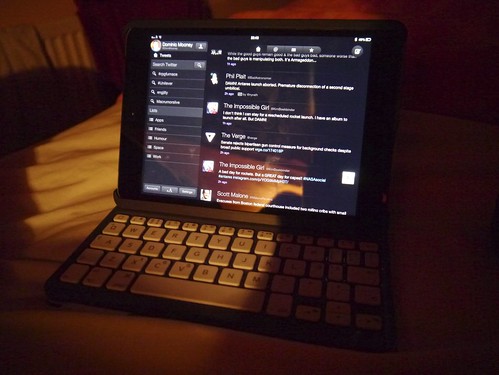
I've used an iPad since they were released in the UK back in 2010, and I am convinced that they are not just consumption devices as some people would suggest. However, if you want to do any serious typing then I would recommend getting hold of a Bluetooth keyboard.
I initially started with the Apple Bluetooth keyboard. This is very nice to type on, but not the lightest of devices. However, it met my needs for over a year. Unfortunately, I then managed to drop it onto a hard surface (a concrete floor), and broke it. Although it is built from Aluminium, the tube around the on/off switch can be bent so it cannot work anymore.
I briefly tried a Zagg Keyboard case, but rapidly found it too much of a compromise for my liking. Fortunately, it was an eBay purchase and I passed it onto a friend. I didn't like the keys and the limited positioning for the iPad in the case. It also gave limited protection, and I preferred the combination of a full case for the tablet and separate keyboard.
My next keyboard was a Logitech Tablet keyboard. This is made of plastic, but has satisfying keys to use, and a good pitch. The first one of these lasted 11 months, and then a bank of the keys stopped working. It was replaced promptly by Logitech under the warrantee. The second is still going strong and is always a good option for longer pieces.
Jill had the next keyboard; this was another Zagg one. I can't remember the exact one, but it was an aluminium keyboard with feel like the Apple one, and it clipped into a full case like a folio. It was very impressive, but died a few days close to the year that we'd had it. After several battles with Zagg's customer support interface we finally got hold of a human on the other end and got a warrantee replacement. Unfortunately, this was pretty cheap and nasty, as the model had been replaced with a plasticky one, and there was no option to upgrade to a more robust unit. To say Jill hated this was an understatement. As she uses her iPad much more than me for work as well as pleasure, this was not good.
However, a solution soon presented itself. After three years, I had my second iPad - an iPad mini - and whilst fully functional, the Logitech Tablet keyboard was far too big. I wanted a solution just like Jill's folio.
Belkin were the early movers here. The keyboard folio case was slim, with a finish not unlike the old-school time manager international organisers. However, within 5 months I changed it. "Why?", you ask. Quite simply, it was the non-standard key positions that required an odd combination of keys to be pressed to get an apostrophe. It drove me mad.
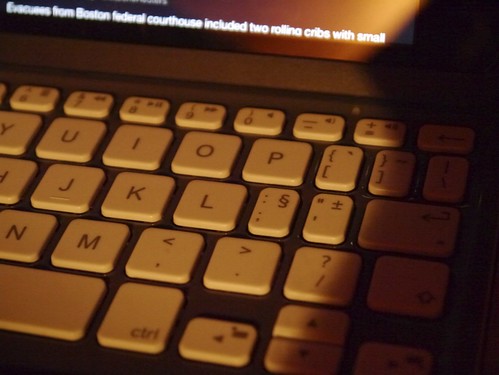
I switched to a Logitech Keyboard Folio Case which has great keys and good battery life. It's plastic, but well built. Battery life is good. And more importantly, as you can see from the photo above, it has a normal apostrophe key!
This ended up as Jill's solution too - Logitech soon released one for the full size iPad 2/3/4, in shocking pink and white. Lovely keys and typing action.
And that's were we are now.
07 April 2014
First Impressions - Zero Point, Neal Asher
(Important - spoilers if you haven't read The Departure, but no worse than those in the blurb on the back of the book.)

Zero Point is the second book in Neal Asher's Owner Series, and continues with the strong - and somewhat unpalatable - themes that he developed in the first book, The Departure. The dedication at the start of the novel really sums it all up: "To all you steady researchers and developer of our technology, for recognising the optimistic road to the future, rather than seeing a slippery slope to doom."
Of course, the Owner Series is about a society that has been on the slippery slope to doom, both societally and ecologically. At the end of the first novel, the protagonist, an anti-hero called Alan Saul, was escaping from Earth on board the Argus Station having decapitated the global bureaucratic dictatorship of 'the Committee' whilst taking the station, and finishing off local controls by dropping their own satellite network on them. The 'zero asset' citizens are freed from Committee oversight, at the cost of the collapse of infrastructure, which potential could lead to their starvation.
This novel meshes three tales together - the emergence of Serene Galahad to reestablish the power of the Committee and the infrastructure of the Earth whilst pursuing a more radical path than her predecessors, the events at the Mars Colony which had effectively declared independence from Earth in the first book, and the events aboard the Argus Station. The plots are brutal, and don't show the nicer side of humanity.
Technology ramps forward without the control of the Committee, as Saul develops his abilities and others have the limits on what they can do released, and the plot twists and turns. Some of the characters - for example Galahad - feel quite two dimensional, but the energy and darkness of the plot drive you forward.
I found that it was quite hard to put down as it draws you in quite effectively, despite finding whole elements somewhat unpleasant. The story goes into areas that few other SF stories do except in the more literary side of the genre (such as The Handmaid's Tale or Nineteen Eighty-Four), with a dark dystopian vision and characters that match. It won't be everyone's cup of hot beverage, but I recommend it for its energy and dark flavour. It directly provides of vision that contrasts technology used for good and for ill, with the difference being the morals of those that wield it.
01 April 2014
There's something about (Luc Bresson's) Lucy
spoiler warning[1]
I watched Luc Bresson's Lucy last night, and whilst it's not the best of his films, it has had me pondering off and on today. Visually, the film is very distinctive, with style that is noticeably Bresson's own; if you've seen the Fifth Element, Leon, or Nikita then you will feel visual echoes as you watch this. The interplay he uses with nature film footage at the start is very cleverly done.
The essence of the story (spoilers hereafter) is a singularity event, but in this case it is not a computer or a machine that is involved. Rather, this is a biological singularity where the eponymous protagonist is caught up in an unfortunate event that results in the unwitting expansion of her mental capacity. The plot hangs around humans only using 15% of their mental capacity and a drug unlocking Lucy's and expanding it steadily upwards towards 100% capacity, which threatens death as the human body is not built to take this.
Morgan Freeman plays a University Professor who has speculated on the form that such a growth in mental capacity could take plays a kind of mentor to Scarlett Johansen's character as she embarks on a path of revenge and mental development. The story heads away from hard science, bringing in telepathy and increasingly extensive psionic powers, but it works as a fun, but lightweight, thriller.
The bit that has had me wondering is on how this could be used for ideas in a harder SF setting, perhaps with human/machine hybrids. The growth in capability and understanding, and the complications (cranial overheating, the need to provide enough energy to drive the brain) all are nice details to hang characterisation, strengths and vulnerabilities around.
Certainly, it gave me a feeling for what it could be to become one of the Conjoined in Alastair Reynolds' Revelation Space universe. Johansen also does a great job at changing how her character behaves as her mental capabilities ramp up. She becomes colder, yet in some ways desperate to find ways to hang onto her humanity, even though she can see the weaknesses and flaws that it has.
Overall, a enjoyable film that I'll probably watch again (although it does leave me wanting to watch Nikita for the first time in years, as it riffs on the same kind of theme of someone being drawn into a totally different world). The area I felt could have worked better was the ending, which
was a bit flat compared to the build that had been going on. It made sense, but it didn't give the level of satisfaction that the rising tension had suggested was coming. I'm not actually certain that the plot could actually do that, though, as transcendence was really the only way out without the protagonist dying from the biological singularity that she was undergoing.
1 April 2014
Update: And having re-watched Nikita the night after I watched Lucy, I had forgotten just how strong that film is. Naturally, it needs to be watched in French with subtitles rather than dubbed, or you lose part of the fun. I'd forgotten how ambiguous the ending is! If you haven't seen it recently, or even haven't seen it, and you like thrillers, then you must watch Nikita.
____
[1]: To be honest, the spoilers are no worse than the back of the DVD box.
I watched Luc Bresson's Lucy last night, and whilst it's not the best of his films, it has had me pondering off and on today. Visually, the film is very distinctive, with style that is noticeably Bresson's own; if you've seen the Fifth Element, Leon, or Nikita then you will feel visual echoes as you watch this. The interplay he uses with nature film footage at the start is very cleverly done.
The essence of the story (spoilers hereafter) is a singularity event, but in this case it is not a computer or a machine that is involved. Rather, this is a biological singularity where the eponymous protagonist is caught up in an unfortunate event that results in the unwitting expansion of her mental capacity. The plot hangs around humans only using 15% of their mental capacity and a drug unlocking Lucy's and expanding it steadily upwards towards 100% capacity, which threatens death as the human body is not built to take this.
Morgan Freeman plays a University Professor who has speculated on the form that such a growth in mental capacity could take plays a kind of mentor to Scarlett Johansen's character as she embarks on a path of revenge and mental development. The story heads away from hard science, bringing in telepathy and increasingly extensive psionic powers, but it works as a fun, but lightweight, thriller.
The bit that has had me wondering is on how this could be used for ideas in a harder SF setting, perhaps with human/machine hybrids. The growth in capability and understanding, and the complications (cranial overheating, the need to provide enough energy to drive the brain) all are nice details to hang characterisation, strengths and vulnerabilities around.
Certainly, it gave me a feeling for what it could be to become one of the Conjoined in Alastair Reynolds' Revelation Space universe. Johansen also does a great job at changing how her character behaves as her mental capabilities ramp up. She becomes colder, yet in some ways desperate to find ways to hang onto her humanity, even though she can see the weaknesses and flaws that it has.
Overall, a enjoyable film that I'll probably watch again (although it does leave me wanting to watch Nikita for the first time in years, as it riffs on the same kind of theme of someone being drawn into a totally different world). The area I felt could have worked better was the ending, which
was a bit flat compared to the build that had been going on. It made sense, but it didn't give the level of satisfaction that the rising tension had suggested was coming. I'm not actually certain that the plot could actually do that, though, as transcendence was really the only way out without the protagonist dying from the biological singularity that she was undergoing.
1 April 2014
Update: And having re-watched Nikita the night after I watched Lucy, I had forgotten just how strong that film is. Naturally, it needs to be watched in French with subtitles rather than dubbed, or you lose part of the fun. I'd forgotten how ambiguous the ending is! If you haven't seen it recently, or even haven't seen it, and you like thrillers, then you must watch Nikita.
____
[1]: To be honest, the spoilers are no worse than the back of the DVD box.
07 April 2013
On Iain (M) Banks
I was sad to hear the news that Iain Banks is suffering from terminal cancer, as he is an author who has meant a lot to me since I first discovered him during a meal break whilst at the University of Southampton. It was when I was working at Silica Shop, unsuccessfully(*) selling PCs in the eyes of the manager, discovering the joys of the back passages and rooms frequented by the staff of the Debenhams in which Silica existed.
(*)I was 'unsuccessful' mainly because I tended to sell people a computer that met their needs and desires rather than a fully loaded and overpriced top end Compaq. Anyway, I digress.
I first encountered Banks through his SF epic Consider Phlebas, which I found near impossible to put down after I discovered it on the shelf in WHSmiths. I can remember sitting outside on a bench in the cold, unwilling to move as I was gripped by the story, and getting annoyed that I had to go back in. It was glorious, enchanting and fast-paced space opera and so different to the norm of SF from the late seventies and eighties. Absolutely brilliant. I then went and bought everything that he had written at that point - The State of the Art, The Player of Games and then Use of Weapons. That book has the distinction of being one of the few that I've reached the end of and immediately re-read, as I never saw it coming. I moved onto his contemporary novels (published without the ‘m’ ), which are equally good and larger in number. The Wasp Factory was dark, macabre and I couldn't put it down despite intensely disliking it. Few books since have evoked that emotion, much like a film where you want to look away but can't. The Crow Road and Complicity are both great thrillers (and check out the TV series and the film respectively) and Espedair Street is a great rock novel (likewise the BBC Radio 4 version was excellent).
Banks quickly became one of the few authors I bought in hardcover (along with William Gibson and more recently Alastair Reynolds), and someone whose books I really looked forward to. Excession is a personal favourite in his SF, and the surreal The Bridge in his 'literature'. Feersum Endjinn messed with my head when I read it, as the alternative phonetic and English chapters forced a meshing of gears.
I think his books went off the boil a bit about a decade ago, but even a weaker novel from him was worth a read, often surpassing other writer's best works. I think his work had been back on an upward improving trajectory over the last few years.
And now his next book is almost certainly his last unless there is some kind of reprieve or remission, which he states is unlikely. I'll miss his work, it has brought me great enjoyment. It also holds several unique places in my heart.
Thank you, Iain (M) Banks. You've thrilled me, inspired me and entertained me, not to mention set me on a journey in gaming that I hope I can complete this year.
Coda.
Reflecting, what makes it even worse is that another of my favourite authors, John le Carré, is 82 this year, so I suspect there are a limited number of books left from him too.
(*)I was 'unsuccessful' mainly because I tended to sell people a computer that met their needs and desires rather than a fully loaded and overpriced top end Compaq. Anyway, I digress.
I first encountered Banks through his SF epic Consider Phlebas, which I found near impossible to put down after I discovered it on the shelf in WHSmiths. I can remember sitting outside on a bench in the cold, unwilling to move as I was gripped by the story, and getting annoyed that I had to go back in. It was glorious, enchanting and fast-paced space opera and so different to the norm of SF from the late seventies and eighties. Absolutely brilliant. I then went and bought everything that he had written at that point - The State of the Art, The Player of Games and then Use of Weapons. That book has the distinction of being one of the few that I've reached the end of and immediately re-read, as I never saw it coming. I moved onto his contemporary novels (published without the ‘m’ ), which are equally good and larger in number. The Wasp Factory was dark, macabre and I couldn't put it down despite intensely disliking it. Few books since have evoked that emotion, much like a film where you want to look away but can't. The Crow Road and Complicity are both great thrillers (and check out the TV series and the film respectively) and Espedair Street is a great rock novel (likewise the BBC Radio 4 version was excellent).
Banks quickly became one of the few authors I bought in hardcover (along with William Gibson and more recently Alastair Reynolds), and someone whose books I really looked forward to. Excession is a personal favourite in his SF, and the surreal The Bridge in his 'literature'. Feersum Endjinn messed with my head when I read it, as the alternative phonetic and English chapters forced a meshing of gears.
I think his books went off the boil a bit about a decade ago, but even a weaker novel from him was worth a read, often surpassing other writer's best works. I think his work had been back on an upward improving trajectory over the last few years.
And now his next book is almost certainly his last unless there is some kind of reprieve or remission, which he states is unlikely. I'll miss his work, it has brought me great enjoyment. It also holds several unique places in my heart.
Thank you, Iain (M) Banks. You've thrilled me, inspired me and entertained me, not to mention set me on a journey in gaming that I hope I can complete this year.
Coda.
Reflecting, what makes it even worse is that another of my favourite authors, John le Carré, is 82 this year, so I suspect there are a limited number of books left from him too.
20 January 2013
How I spent my Sunday Afternoon (DomCon Report)
Crushed to death twice in a lost Incan Temple, narrowly escaping a sinking island with its treasures on a helicopter, dying horribly as we failed to find the cures to a global pandemic, and then engaging in titanic expansionist space exploration only to be crushed by a galactic economic superpower. That's how I spent my Sunday afternoon...
After fearing that the snow would sabotage things, a group of friends (Andy, Graham and Simon), all TomCon veterans rendezvoused at my house in Wetherby from places as far afield as Sheffield and Settle. Our objective was simple - to play some of the many boardgames that had built up unplayed at my house. We called the event "DomCon", a resurrected title from the days that I ran my Stormbringer RPG campaign.We were accompanied through the afternoon by my 6 year old, Nathan, who joined in some games, bailed out of others, and complicated one even more than the rules did.
I'd shared links to the excellent Dice Tower reviews of the games we planned to play the night before. I recommend these if you're coming old to a game as they give a feel for the mechanics.
We started with Escape: The Curse of the Temple, recommended to me as a fun cooperative game suitable for kids by Steve Hatherley around the time I tried out Forbidden Island for the first time. The premise is simple; think of the sequence at the start of Raiders of the Lost Ark when Indiana Jones has to escape the temple/tomb where he steals the golden idol. The game has square tiles of the temple rooms which you explore by rolling a set of five dice and getting the right icons come up. If you roll a black skull, that dice is frozen, but two black skulls can be released by throwing one of their golden counterparts, which come up just as often. You need to find the way out,and along the way as many jewels as possible. The jewels are important, as they make it easier to carry out the final escape as the number unfound relates directly to the number of icons that you have to roll to escape.
There are three catches. The first is that you will need more than one player working together to release some of the jewels as they need more icons than you have dice. The second is that the whole game is played real time, against a soundtrack that lasts just over ten minutes. This results in a frenetically paced set of dice rolls, and a good deal of self-pressurisation. The final catch is that on two occasions a gong sounds, meaning you have one minute to get back to the starting room otherwise you will lose a dice permanently. On top of this, if anyone is left in the temple after it collapses after ten minutes, then you all lose. Cooperation is vital.
I enjoyed the game, and will look forward to playing again.When I'm not sure, as Nathan got scared by the game and bailed out leaving me to take his dice. We failed to beat this twice, but I think that it feels achievable.
Next up was Forbidden Island, a game about which I have blogged previously. Suffice it to say that we were successful in winning the game, and Nathan was very happy with the outcome. Graham had got a copy of the game on the basis of my past review and enjoyed it, so it was useful having three experienced players. This was the third time I've played this at Novice level, so I think I'll be raising the difficulty next time to make it feel more challenging.
Then we moved on to a game that takes the clever mechanic of shuffling the discard pile and putting it back on the top of the draw pile to another level. We played Pandemic, a game by the same author which I have reviewed before. This was my first outing with the game with other players, and – as I mentioned at the start of the piece – we failed. We found one cure and had two more about to be delivered when we ran out of the player cards, which is an instant loss. We spent far too long trying to nobble the disease rather than concentrating upon the cure. Of course, this is the sleight of hand the game throws you with all those disease blocks looking so tempting to fight. Unfortunately, we realised we had lost two turns before the end, which left quite an anti-climax. I'd like to try this one again though.
Our final game was Eminent Domain, which started life as a Kickstarter project, but I bought it from retail. This is a deck building game of interstellar conflict. What does that mean then? Essentially, this is a battle to gain influence points, which can be obtained by conquering or colonising planets, or through trade or other actions.
We did find the game a struggle at the start, but this was partly due to Nathan's fascination with the model spaceships, coupled with his insistence that Andy was called Dave!
The game revolved around a deck of role cards, which include areas such as warfare, survey, colonisation, production or trade, and research. Each player starts with an identical hand of cards, which is tailored either consciously or unconsciously to the strategy that they have adopted through card draws and deliberate permanent discards from the hand. Players also start with a world located on survey, which needs to be colonised or conquered.
Eminent Domain game turns have a simple structure. You have a hand of cards, which is limited to five at the end of your turn, which comprises role cards and later technology cards. Initially, half your deck is in play so you know what can be gained from drawing from the remaining cards. As you tailor the deck, this becomes more and more effective. At the end of the turn you can discard any or all of your cards and draw back to the maximum hand size (which can be increased by acquiring certain planets).
The first phase of your game is optional - you can play a role card or a technology card as an action. This usually is more limited than playing it in the role phase of the game, but can also be very useful. Cards usually have two descriptions on effects dependent on phase. For example, a survey card will allow you to bring two cards out of your unused pile (exceeding deck limits if necessary) when played as an action, or permits you to look and choose a planet card for a settlement target in the role phase. You can use this first phase to prepare for the second.
The second, role, phase means you select a role card type and draw it into your hand from the central deck pile. You can then play it, backed up with other cards, to gain an effect. For example, if a planet requires four colonisation counters to settle, you could pick colonisation, add a further four colonisation cards from your hand, and land colonies and settle to capture a planet. As 'leader' in the role phase, you get advantages over the other players. Once you have acted, the other players each get a chance to either follow the action you have played by using the same role card(s) without the leader's bonus, or to dissent and pick a card from their unused pile to add to their hand. Thus, it is possible to have a hand bigger than the deck hand limit right up to the end of your turn.
Once all other players have decided whether to follow or dissent, you then get to clean up your deck, discarding and drawing ready for the future. The turn moves clockwise around the table, with the Action/Role/Clean-up cycle starting for a new player.
Using the research action can gain you extra advantages with technology cards in your hand that give special effects for the action phase, or reduced costs for certain role actions by acting as role cards. Some technology cards cycle through your hand in the same way as role cards, whereas some have permanent effects.
Planets also give an advantage when colonised or conquered as some can produce resources (which can be converted to Influence Points by a produce/trade card), some have the same effect as a role card (for example acting as if an additional production card was played), and they also have a basic value in influence just from ownership.
The game is actually quite simple, but the follow/dissent mechanic was new to us, which caused some confusion. It was no surprise that Simon – who grasped the mechanics first – went to win through a huge production and trade programme.
You can't directly attack another player, but you can hamper them through your choice of roles. For example, had we realised how close Simon was to winning earlier then we could have deliberately avoided choosing the role that benefited him most – Production/Trade – thus starving him of opportunities to extend his hegemony.
There are a huge number of options and approaches to the game, and I'd love to try it again to see where it goes to. I think that was the feeling around the table, with a replay of this being the most popular to return to in the future.
Thanks to all present for a great afternoon, and to Jill for her patience!
--
Links to Dice Tower Reviews
Escape the Curse of the Temple http://youtu.be/precx0zmetg
Pandemic http://youtu.be/A5V8q-Su8iM
Eminent Domain http://youtu.be/hbq7r0LgX6Q
After fearing that the snow would sabotage things, a group of friends (Andy, Graham and Simon), all TomCon veterans rendezvoused at my house in Wetherby from places as far afield as Sheffield and Settle. Our objective was simple - to play some of the many boardgames that had built up unplayed at my house. We called the event "DomCon", a resurrected title from the days that I ran my Stormbringer RPG campaign.We were accompanied through the afternoon by my 6 year old, Nathan, who joined in some games, bailed out of others, and complicated one even more than the rules did.
I'd shared links to the excellent Dice Tower reviews of the games we planned to play the night before. I recommend these if you're coming old to a game as they give a feel for the mechanics.
We started with Escape: The Curse of the Temple, recommended to me as a fun cooperative game suitable for kids by Steve Hatherley around the time I tried out Forbidden Island for the first time. The premise is simple; think of the sequence at the start of Raiders of the Lost Ark when Indiana Jones has to escape the temple/tomb where he steals the golden idol. The game has square tiles of the temple rooms which you explore by rolling a set of five dice and getting the right icons come up. If you roll a black skull, that dice is frozen, but two black skulls can be released by throwing one of their golden counterparts, which come up just as often. You need to find the way out,and along the way as many jewels as possible. The jewels are important, as they make it easier to carry out the final escape as the number unfound relates directly to the number of icons that you have to roll to escape.
There are three catches. The first is that you will need more than one player working together to release some of the jewels as they need more icons than you have dice. The second is that the whole game is played real time, against a soundtrack that lasts just over ten minutes. This results in a frenetically paced set of dice rolls, and a good deal of self-pressurisation. The final catch is that on two occasions a gong sounds, meaning you have one minute to get back to the starting room otherwise you will lose a dice permanently. On top of this, if anyone is left in the temple after it collapses after ten minutes, then you all lose. Cooperation is vital.
I enjoyed the game, and will look forward to playing again.When I'm not sure, as Nathan got scared by the game and bailed out leaving me to take his dice. We failed to beat this twice, but I think that it feels achievable.
Next up was Forbidden Island, a game about which I have blogged previously. Suffice it to say that we were successful in winning the game, and Nathan was very happy with the outcome. Graham had got a copy of the game on the basis of my past review and enjoyed it, so it was useful having three experienced players. This was the third time I've played this at Novice level, so I think I'll be raising the difficulty next time to make it feel more challenging.
 |
| Pandemic before it went horribly wrong |
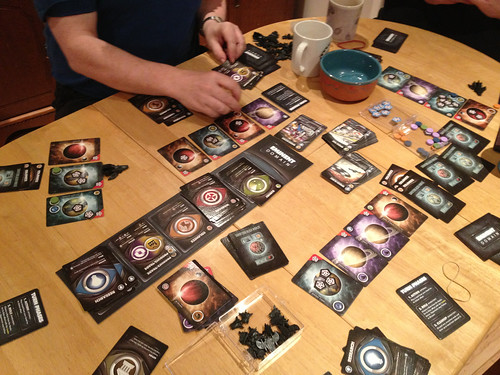 |
| Lots of cards in Eminent Domain |
Our final game was Eminent Domain, which started life as a Kickstarter project, but I bought it from retail. This is a deck building game of interstellar conflict. What does that mean then? Essentially, this is a battle to gain influence points, which can be obtained by conquering or colonising planets, or through trade or other actions.
We did find the game a struggle at the start, but this was partly due to Nathan's fascination with the model spaceships, coupled with his insistence that Andy was called Dave!
The game revolved around a deck of role cards, which include areas such as warfare, survey, colonisation, production or trade, and research. Each player starts with an identical hand of cards, which is tailored either consciously or unconsciously to the strategy that they have adopted through card draws and deliberate permanent discards from the hand. Players also start with a world located on survey, which needs to be colonised or conquered.
Eminent Domain game turns have a simple structure. You have a hand of cards, which is limited to five at the end of your turn, which comprises role cards and later technology cards. Initially, half your deck is in play so you know what can be gained from drawing from the remaining cards. As you tailor the deck, this becomes more and more effective. At the end of the turn you can discard any or all of your cards and draw back to the maximum hand size (which can be increased by acquiring certain planets).
The first phase of your game is optional - you can play a role card or a technology card as an action. This usually is more limited than playing it in the role phase of the game, but can also be very useful. Cards usually have two descriptions on effects dependent on phase. For example, a survey card will allow you to bring two cards out of your unused pile (exceeding deck limits if necessary) when played as an action, or permits you to look and choose a planet card for a settlement target in the role phase. You can use this first phase to prepare for the second.
The second, role, phase means you select a role card type and draw it into your hand from the central deck pile. You can then play it, backed up with other cards, to gain an effect. For example, if a planet requires four colonisation counters to settle, you could pick colonisation, add a further four colonisation cards from your hand, and land colonies and settle to capture a planet. As 'leader' in the role phase, you get advantages over the other players. Once you have acted, the other players each get a chance to either follow the action you have played by using the same role card(s) without the leader's bonus, or to dissent and pick a card from their unused pile to add to their hand. Thus, it is possible to have a hand bigger than the deck hand limit right up to the end of your turn.
Once all other players have decided whether to follow or dissent, you then get to clean up your deck, discarding and drawing ready for the future. The turn moves clockwise around the table, with the Action/Role/Clean-up cycle starting for a new player.
Using the research action can gain you extra advantages with technology cards in your hand that give special effects for the action phase, or reduced costs for certain role actions by acting as role cards. Some technology cards cycle through your hand in the same way as role cards, whereas some have permanent effects.
Planets also give an advantage when colonised or conquered as some can produce resources (which can be converted to Influence Points by a produce/trade card), some have the same effect as a role card (for example acting as if an additional production card was played), and they also have a basic value in influence just from ownership.
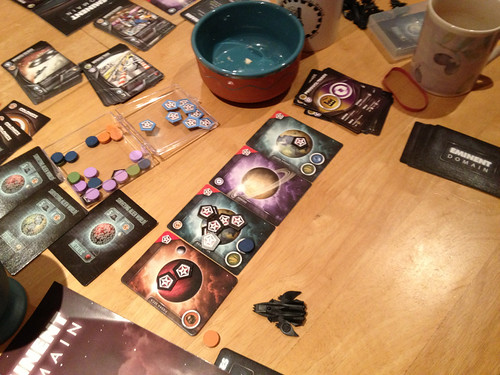 |
| The winning hand |
The game is actually quite simple, but the follow/dissent mechanic was new to us, which caused some confusion. It was no surprise that Simon – who grasped the mechanics first – went to win through a huge production and trade programme.
You can't directly attack another player, but you can hamper them through your choice of roles. For example, had we realised how close Simon was to winning earlier then we could have deliberately avoided choosing the role that benefited him most – Production/Trade – thus starving him of opportunities to extend his hegemony.
There are a huge number of options and approaches to the game, and I'd love to try it again to see where it goes to. I think that was the feeling around the table, with a replay of this being the most popular to return to in the future.
Thanks to all present for a great afternoon, and to Jill for her patience!
--
Links to Dice Tower Reviews
Escape the Curse of the Temple http://youtu.be/precx0zmetg
Pandemic http://youtu.be/A5V8q-Su8iM
Eminent Domain http://youtu.be/hbq7r0LgX6Q
06 January 2013
Amazon - killing reading
I own a Kindle, and it's a wonderful thing. It stores hundreds of books, displays them well, allows instant gratification if you want to read a novel you have heard of (mostly), has a good form factor and excellent battery life.
I fear that the Kindle – and its ilk – will kill reading.
Beyond my parent's love of books – reading with and to me, and the fantastic Children's Book Club my mother joined – two things drove my passion for reading .
The first was the fantastic public libraries that the UK has had for years. In my teenage years I consumed up to 8 books a week, and slightly less when younger. Sadly, this is a system under threat as the present austerity measures, and fall in usage of libraries, take a toll. I have some guilt here, as I don't really use the library these days as the backlog of books I own is too big. Nathan does, through school.
The second was discovering the books that rested on my parent's shelves. I explored, sneaked looks at, and devoured the contents avidly. It drove some of my tastes in literature, which is probably a fusion between my father's love of SF and my mother's love of more literary and historical novels.
The Kindle kills this. No browsing. No exploring. No discovery without purchase.
I worry.
I fear that the Kindle – and its ilk – will kill reading.
Beyond my parent's love of books – reading with and to me, and the fantastic Children's Book Club my mother joined – two things drove my passion for reading .
The first was the fantastic public libraries that the UK has had for years. In my teenage years I consumed up to 8 books a week, and slightly less when younger. Sadly, this is a system under threat as the present austerity measures, and fall in usage of libraries, take a toll. I have some guilt here, as I don't really use the library these days as the backlog of books I own is too big. Nathan does, through school.
The second was discovering the books that rested on my parent's shelves. I explored, sneaked looks at, and devoured the contents avidly. It drove some of my tastes in literature, which is probably a fusion between my father's love of SF and my mother's love of more literary and historical novels.
The Kindle kills this. No browsing. No exploring. No discovery without purchase.
I worry.
Wedding +10

Esquires
I'm writing this in Esquires coffee shop in Ambleside in the Lake District. Jill and I have been away on a child-free weekend (with my parents looking after the little tykes), staying at very nice hotel with a spa to celebrate our tenth wedding anniversary. It's been a while since we last got time together like this, and every time we do I end up thinking that we must do this more often. I guess the living 100 miles away from family takes its toll here. Anyway, perhaps I should make a resolution to try and do this every few months, as its great to be away as a couple.

The very nice hotel
Jill is at the hotel, pampering herself with a 'treatment', whilst I've been wandering through Ambleside, browsing at shops and generally chilling out. The hotel has been excellent (Best Western Ambleside Salutation), living up the recommendation from the Wetherby Methodist Church 'Bootbashers' society. Rooms were good, with a decent swimming pool, hot tubs and steam room.We didn't sample the food beyond breakfast, mainly as we had other places we wanted to be.

Zeffirellis - Perfection?
Friday night saw a lovely Italian meal at Zeffirelli's Jazz Bar, following by a showing of The Hobbit. That was great too, but we left with a headache from the 3D. I'm tempted to arrange another showing to see it in 2D, as I think that the film will look better. Although the shots were lovely, I can't help but think that some of them suffered from being 3D, as they moved too fast to allow the eye to linger and appreciate the spectacle. As a big Tolkien fan, I was more than happy with the way that the film had been treated, but I do wonder how they will manage to stretch it to another two films.

Lots more on the set from Ambleside at Flickr
Saturday started lazily, with a breakfast nearly as late as we could achieve, and then we went for a wander around town. Bizarrely, we spent a good chunk of time wandering around the parish church grounds and graveyard. Like a muppet, I had forgotten to bring my camera, so I was using my iPhone. The light was just right for black and white, with not enough contrast for colour so I used the Hipstamatic app (my favourite iPhone camera app); I'm pretty pleased with the results, but I was reminded how power demanding the post-processing is, with nearly half my battery going.
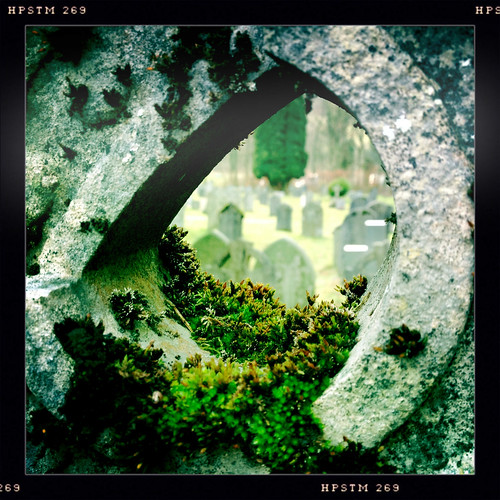
OK, some in colour too, deliberately to saturate blue & green. You can see more on the set from Ambleside at Flickr
It's funny how looking at all the grave inscriptions makes you feel more in touch with what has happened in a community. I guess it's the little things that it draws out, the human day-to-day triumphs and falls.

Gorgeous
We chilled out at the spa when we got back to the hotel, and celebrated back out our room with a very nice bottle of Champagne that my parents had given us. Then we headed out to Doi Imtanon (which sounds like a place in Middle Earth) Thai restaurant for dinner. The service was great, and I must confess that we probably over indulged in wine because we found a nice bottle of Shiraz-Cabernet from the same Vineyard (Wakefield, South Australia) that had supplied the wine for our wedding breakfast.

Same vineyard and very close to the wine from our Wedding breakfast, glug.
Fortunately, I was much less delicate this morning than I expected, so am feeling quite chilled out. We were going to try and watch 'the life of Pi' this afternoon, but have decided against it so we aren't back too late, as reality intrudes again tomorrow with a return to work and school. It's been lovely getting time with Jill without other pressures, and I'm fortunate to have such a wonderful wife.
30 December 2012
Belkin Keyboard Case for iPad mini - review
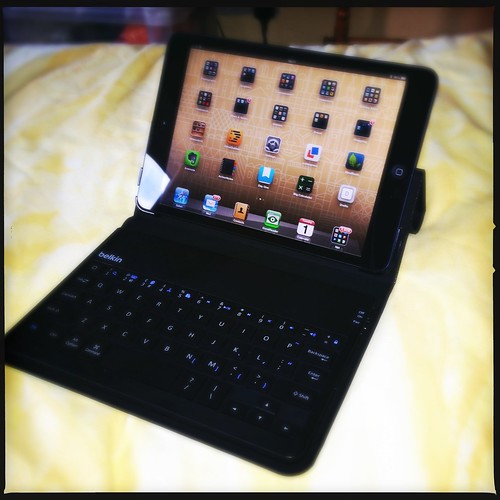
Yes, it does like a ZX-81 (as pointed out by Neil Ford)!
My new iPad mini was bought with the knowledge that it would be used for work as well as pleasure, so I bought myself a Belkin keyboard case as well as a Smart Cover.
The keyboard case looks very good - the effect is of an old style paper organiser (if you remember those by 'Time Manager' then you'll have a good analogy but it is much thinner). It should give moderate impact protection. There is a micro-USB port for power, plus an on/off switch, a pairing button for bluetooth, and an LED to indicate charge status. Pairing is no different to any other bluetooth keyboard under iOS and I had no difficulties. The keyboard is tailored for iOS: there is a Fn function key to allow keyboard access to search, show/hide keyboard, cut/copy/paste, music and volume and screen lock. The home key is also dedicated on the keyboard.
The keyboard is made of plastic, but quite solid. The build is better than the Zaggmate keyboard cover for my older iPad 1 (which had a habit of loosing keys) but noticeably less solid than Zagg's keyboard folio for the better half's iPad 2, probably as that has an aluminium chassis. The Logitech Tablet keyboard (which is close to full size), feels more solid but is far larger.
The keyboard pitch is tight and needs some getting used to, altogether understandable due the size of a 7.9" tablet like the mini. While typing this, I've repeatedly pressed "/" due to the truncated nature of the spacebar which it is adjacent too. I also find the backspace to be out of position, and keep on hitting the "=" button instead. However, both of these are noticeably becoming less of an issue as I get more familiar with the keyboard layout and action.
However, there is one design flaw, related to apostrophes. These are positioned where you'd expect them (near the enter key) but they both need to be accessed with the Fn button rather than a clean press for the single apostrophe, and a shifted press for the double quotes. This is the biggest let down about the whole device, and I've not yet convinced myself that I will get used to it. It suggests that although the keyboard case was 'designed in California' it was designed by someone that rarely does any extended typing. I would rather have the semi-colon and colon key operated by the function key and have the apostrophes directly accessible.
Overall, I do like the keyboard, but how well that I adjust to the apostrophe design decision will determine if I ever love it.
Updated 13/1 to reinstate missing key names.
Subscribe to:
Posts (Atom)