This has been a busy few months so here’s an amalgamated set of books that I’ve read. I’ve also included a couple of audiobooks which I’ve enjoyed.
Reservoir 13 (Jon McGregor)
This effectively picks up where The Reservoir Tapes – which I read last month – finishes. It’s a very different book; the former comprised fifteen different points of view about the disappearance of Becky Shaw, a 13 year old girl, with the conceit that they were all stories told to a reporter in the immediate aftermath of her disappearance. There is no denouement; instead, you have to piece together connections to try and work out what was going on. This book takes a different form; it is a tale of the years for the village that the girl was staying at when she disappears. We are voyeurs who see the changes and ripples of the event going forward as the seasons remorselessly change. The people of the village are transient compared to the reservoirs and hills of landscape.
Structurally, the book has no chapters as such. Text runs together over periods of time, like a series of notes. It’s not stream of consciousness, but rather a stream of events. We can pick up on an individual for a line, a number of sentences or even a page, but then the text - rejecting conventional paragraphs - just flows into the next event. When you reach a break, it’s always at some natural pause. The structure draws you through and I found it very effective. You also feel the rhythm of the seasons, with the repeated events and the changes that come through as people grow old, move away, fall in and out of love, or die. It’s all set in the context of Bex, or Becky or Rebecca Shaw’s disappearance and the impact that it has on the lives of everyone in the village.
I really enjoyed this book; you are drawn into the lives of the people in it, a passive voyeur, all the while hoping, just hoping, that some kind of conclusion will be found. But eventually, whether or not it is ceases to be a real concern as you find yourself caring more for the lives of the people left behind as they live on set against the slow time of landscape.
Delta Green Handler’s Guide (Dennis Detwiller)
I printed out a copy of the Handler’s Guide to read as part of my preparation for North Star. I’m really impressed with the quality of the book; it’s very usable, well written and beautifully laid out. This is in effect the setting book for Delta Green.
Stranger Things - The Ultimate Guide (Stephen Smith)
Reading in preparation for North Star. This was a very usable reference while I was preparing the game to run.
Delta Green - The Way it Went Down (Dennis Detwiller)
Flash fiction set in the Delta Green universe, much of it culled from mood pieces in the game material. Lots of flavour that leaves you wanting more.
Delta Green Agent’s Handbook (Dennis Detailer)
I re-read the player’s book (which contains much of the rules) for Delta Green just before North Star. Very well done.
The Trinity Six (Charles Cumming)
The story tells about an academic who has stumbled into evidence that there may well have been a sixth agent in the Cambridge Spy Ring, one who has been protected by the UK Government. The discover places him at risk as he searches to discover the truth. I found this an enjoyable read; Cumming definitely has a claim to be trying to be a successor to le Carré.
The Forbidden Lands Player’s Guide (Beta)
This is the retro-styled fantasy heartbreaker from Fria Ligan. I’m impressed with what I’ve read; it definitely lifts from other sources such as the resources dice in the Black Hack along with shades of Dungeon World’s play agendas. It may be a little on the lethal side; I need to explore this a bit more and maybe play it.
The Letter for the King (Tonke Dragt)
This is a Danish Young Adult classic. A young squire is called to adventure the night that he should be completing his vigil to become a knight. It’s a simple story, told well, one that I would have appreciated more when I was younger.
Dogs of War (Adrian Tchaikovsky)
Rex is a Good Dog, a bioengineered corporate soldier who leads a team with a bioengineered crocodile (‘Dragon’), bear (‘Honey’) and Bee Swarm (‘Bees’). Master is a corporate troubleshooter, deployed to fight a war in Mexico against insurgents. Atrocities have been committed and Rex and his team have to deal with the conflict between morality, feedback chips and the fact that although they are sentient yet property. I enjoyed this.
Rupture (Dark Iceland #4) (Ragnar Jónasson)
I had an urge for some more Icelandic noir for the minimalist difference so I decided to read the Ragnar Jónasson books that are sitting on my Kindle waiting for the right mood. The fourth of the books with Ari Thór in, this sees Siglufjördour isolated and quarantined because of a dangerous ‘flu case. Thór spends part of the time digging into a closed case from the 1950s when new evidence is brought to him. In the mean time, a reporter contact in Reykjavik helps him out by checking details, and also gets drawn into a separate, brutal investigation. Again, enjoyable, but perhaps failing to land the feel of the quarantine’s isolation and the fear of disease fully.
Whiteout (Dark Iceland #5) (Ragnar Jónasson)
There’s a shift in the style of the series with this book, as it spends more time at the start in the set up to the story without the protagonists. Ari Thór is called in to support his former boss investigating a suicide with suspicious circumstances just before Christmas. Set on an isolated headland with a lighthouse, a farm and a well-to-do family home, you can really feel the remoteness of the place. I really enjoyed this one; the atmosphere builds well.
Noumenon (Marina J. Lostetter)
A SF novel about the journey to another star which has shown anomalous readings to astronomers. Is it an unusual Oort Cloud, an alien mega-structure or something else? Earth is sending of multiple missions into space to explore the galaxy, and this is one of them. It starts with the pitch for a slot in the mission rosters and ends thousands of years later. This is a generation ship tale with a twist; it follows the mission from its inception to its arrival at the target star, but then goes further to explore the changes in society that two thousand observed years of travel brings to both on the ship and Earth itself. Another slight variation to the genre is that, although this is a generation ship, each new generation is born artificially from clones of the first generation. I really enjoyed this; it reminded me of some of the great thought experiments and extrapolations of early SF.
Lifeboat (Marina J. Lostetter)
A collection of three short stories from the author of Noumenon. I enjoyed them, but not as much as the main novel.
The Cthulhu Hack (Paul Baldowski)
Sixth revision printing of the Cthulhu Hack, which features a significantly improved layout with a new font that makes it far more readable with a cleaner look. I think that this is one of the cleverest evolutions of The Black Hack and well worth the time. I need to get this to the table.
The Dark Brood (Paul Baldowski)
A new supplement for the Cthulhu Hack, focussing around the mythos of Shub Niggurath. This gives plenty of interesting material, plot ideas and options for you game. It would be usable with other Cthulhu games and more Lovecraftian D&D. It does link back to an earlier book, From Unformed Realms.
Lyonesse 1: Suldrun’s Garden (Jack Vance)
Lyonesse 2: The Green Pearl) (Jack Vance)
Lyonesse 3: Madouc (Jack Vance)
I spent the best part of two months listening to the audiobook versions of the Lyonesse trilogy by Jack Vance as published by Audible. These are really well done (although the narrator does have some affectation in how he says a few of the words) and listening to the whole - unabridged - work in one fell swoop as definitely worth it. Recommended
07 July 2018
25 June 2018
The One Ring - Season 6 - The Werewolf of Mirkwood
 |
| The thing about meddlesome elves is that they're meddlesome. |
We returned to our One Ring campaign today, run by the excellent Paul Mitchener. This is the latest 'season' we've been in (Paul runs 4-6 sessions over hangouts and they always seem to finish pretty climatically).
Today we set about ensnaring and slaying the Werewolf of Mirkwood; we'd killed it before only to have it come back. This time we'd sought advice from Saruman, and had the assistance of Radagast, and an ancient artefact. The plan went swimmingly (clearly the dice were paying us back for the multiple Eyes of Sauron we rolled on a trek to Angmar some seasons ago), right up to the point when our wood elf Miriel (who can now go full Legolas) deciding to try out the use of the Black Speech that she'd learnt when visiting Saruman. Sadly, the werewolf's spirit took this as an invitation and decided to take up residence inside her.
She assures us it's all under control, but Radagast looks worried and the GM keeps smiling and asking for Wisdom checks. Next stop is a visit to Beorn to try and get some advice...
The One Ring image - By Xander - own work, (not derivative from the movies), Public Domain, https://commons.wikimedia.org/w/index.php?curid=1953341
02 April 2018
Books in March 2018
The Sword, The Crown and the Unspeakable Power (Todd N. & Tom J.)
This was an RPG I backed indirectly last year on Kickstarter thanks to Steve Ellis pulling together a group order. It promised a ‘Powered by the Apocalypse’ engined game aimed to create the kind of power politicking seen in Game of Thrones, as endorsed by Niccolò Machiavelli. On an initial read through, it may well have achieved that aim. Of course, the proof of the pudding will be in the playing, and unfortunately this arrived too late for me to try at Revelation 2018.
The default setting is the traditional western world take on fantasy, but there are notes on using other settings and mythologies. Playbooks have a variety of archetypes who can be common or elite, and may be patrons or agents of others. You can be Crown in this game, but it does expose you nicely. The initial play defines mythology and also who controls what resource. Some moves are powered by spending your honor (effectively a stat that shows your reputation with the faction to whom you are aligned). Each character will have a faction (which may not entirely overlap with their core activities).The Unspeakable Power is magic, from whatever source it comes from.
The game is definitely PVP, across all areas (social and physical) and there is guidance for making sure that the players are all comfortable with this. The X-card gets a run out, as do lines and veils. As one of the playbooks is effectively the Palace Torturer, this is probably a good thing. In conclusion, on initial read this is one of those games that makes me want to get it to the table. I hope it delivers.
Alice (Christina Henry)
I’d seen this book on Amazon a while ago, and had dropped it on my wish list to pick up at some point. When I saw it on the daily deal for Kindle, I snagged a copy straight away. I’m really glad that I did. Lewis Carroll’s Alice in Wonderland is one of those books which I read, repeatedly, at a young age. Partly because it was one of the few books suitable for me at my grandparent’s house, but I enjoyed the story as well, especially the clever dark edges to it as reality turns out to be something different to what you expected.
Christina Henry’s take on this is delicious. Alice is locked up in an asylum after a terrifying experience with the Rabbit and more. Her next door cell-mate is Hatcher, an insane murderer who becomes her friend. Events ensue that leads to them escaping the asylum, and heading off to seek revenge on the Rabbit and find Hatcher’s family. They travel deep into the Old City, a dystopian urban nightmare of competing gangs, violence and abuse run by bosses like the Rabbit and the Caterpillar. Although the magicians were banished from both the Old and New City years ago, magic remains, and the Jabberwocky is stalking Hatcher.
I really enjoyed this book; there’s an energy to it, and a darkness that pulls you on. It’s not a nice book; violence and abuse are everyday events in the Old City and both of the protagonists are broken and quite brutal when provoked. If anything, this is partly a journey of them finding what remains of their humanity. I really enjoyed this book, and found it hard to put down.
The Red Queen (Christina Henry)
Having finished Alice, I immediately bought the sequel. Rather than being an urban dystopian nightmare of gang violence, this book is a quest. Hatcher and Alice travel beyond the City to try and find Hatch’s daughter, entering the lands of the White Queen and Black King.
This is not as strong a book as the first novel, as it is far more traditionally linear, more conforming to classical fairy tales. What happens is far less of a surprise and less twisted than the first book. That said, it was satisfying and enjoyable, and I’d love to see more in this setting.
Elysium Fire (Alastair Reynolds)
A new Alastair Reynolds story is always something to look forward to. A story set in the Revelation Space universe even more so. This tale is set in the Yellowstone system (featured in Chasm City, The Prefect (now Aurora) and more), at the height of the Glitter Band. The character Prefect Dreyfus is, once again, at the heart of the story (although it’s more of an ensemble piece with his team this time), and Panoply tries to prevent an existential threat to society whilst dealing with agitation from member communities to secede. I guessed part of the reveal towards the end but not the whole thing. I’m hoping that there are more books about Dreyfus and colleagues.
The Princess Diarist (Carrie Fisher)
I picked this up on impulse; it’s the late and sadly missed Carrie Fisher’s diaries from the filming of Star Wars. The more recent commentary has a lovely, relaxed, almost conversational tone. This is the book where she revealed the truth about ‘Carrison’ as she called the relationship between her and Harrison Ford.
Notes from the Upside Down (Guy Adams)
This was prep for running the Delta Green/Stranger Things mash-up I have planned for North Star in late April. Best reviewed of the various ‘Unofficial Guides’, this seems to be more focussed around the influences on the show rather than the show itself. It’s fair to say that I’ve learnt a lot about John Carpenter, Stephen King and media trivia from the Eighties, but I’m not convinced that I got out of this what I was looking for in terms of material to plumb. Certainly an interesting read.
The Reservoir Tapes (Jon McGregor)
I picked up the novel of the BBC Radio 4 series written by Jon McGregor. It’s an interesting concept. The author describes it as a ‘who dun-what’ rather than a ‘who dun nit’. There are 15 different points of view, supposedly from interviews by a reporter, all about the disappearance of a 13 year old girl while on holiday in a small village in Derbyshire. The book is quite literally the script for the BBC version (which can be downloaded as I write this), and each chapter is an episode. I was hooked from the first interview, which takes the form of an overheard conversation. I have picked up the linked novel Reservoir 13 to read later. It has to be said that I really enjoyed McGregor’s first novel – “If no-one speaks of remarkable things” – but somehow missed the work that he has done since. Something that I need to remedy.
Stranger Things - The Companion (Nick Blake)
A very concise and focused overview of both series of Stranger Things which was much more what I was looking for, yet still managed to cover many of cultural references that Notes from the Upside Down focussed on. Think of this as the gruff Northern version, not wasting its words yet providing more information in a more easily usable state. That said, it didn’t have the edge of dry humour and wit that its competitor had, but it also lacked the many digressions. I preferred this book.
This was an RPG I backed indirectly last year on Kickstarter thanks to Steve Ellis pulling together a group order. It promised a ‘Powered by the Apocalypse’ engined game aimed to create the kind of power politicking seen in Game of Thrones, as endorsed by Niccolò Machiavelli. On an initial read through, it may well have achieved that aim. Of course, the proof of the pudding will be in the playing, and unfortunately this arrived too late for me to try at Revelation 2018.
The default setting is the traditional western world take on fantasy, but there are notes on using other settings and mythologies. Playbooks have a variety of archetypes who can be common or elite, and may be patrons or agents of others. You can be Crown in this game, but it does expose you nicely. The initial play defines mythology and also who controls what resource. Some moves are powered by spending your honor (effectively a stat that shows your reputation with the faction to whom you are aligned). Each character will have a faction (which may not entirely overlap with their core activities).The Unspeakable Power is magic, from whatever source it comes from.
The game is definitely PVP, across all areas (social and physical) and there is guidance for making sure that the players are all comfortable with this. The X-card gets a run out, as do lines and veils. As one of the playbooks is effectively the Palace Torturer, this is probably a good thing. In conclusion, on initial read this is one of those games that makes me want to get it to the table. I hope it delivers.
Alice (Christina Henry)
I’d seen this book on Amazon a while ago, and had dropped it on my wish list to pick up at some point. When I saw it on the daily deal for Kindle, I snagged a copy straight away. I’m really glad that I did. Lewis Carroll’s Alice in Wonderland is one of those books which I read, repeatedly, at a young age. Partly because it was one of the few books suitable for me at my grandparent’s house, but I enjoyed the story as well, especially the clever dark edges to it as reality turns out to be something different to what you expected.
Christina Henry’s take on this is delicious. Alice is locked up in an asylum after a terrifying experience with the Rabbit and more. Her next door cell-mate is Hatcher, an insane murderer who becomes her friend. Events ensue that leads to them escaping the asylum, and heading off to seek revenge on the Rabbit and find Hatcher’s family. They travel deep into the Old City, a dystopian urban nightmare of competing gangs, violence and abuse run by bosses like the Rabbit and the Caterpillar. Although the magicians were banished from both the Old and New City years ago, magic remains, and the Jabberwocky is stalking Hatcher.
I really enjoyed this book; there’s an energy to it, and a darkness that pulls you on. It’s not a nice book; violence and abuse are everyday events in the Old City and both of the protagonists are broken and quite brutal when provoked. If anything, this is partly a journey of them finding what remains of their humanity. I really enjoyed this book, and found it hard to put down.
The Red Queen (Christina Henry)
Having finished Alice, I immediately bought the sequel. Rather than being an urban dystopian nightmare of gang violence, this book is a quest. Hatcher and Alice travel beyond the City to try and find Hatch’s daughter, entering the lands of the White Queen and Black King.
This is not as strong a book as the first novel, as it is far more traditionally linear, more conforming to classical fairy tales. What happens is far less of a surprise and less twisted than the first book. That said, it was satisfying and enjoyable, and I’d love to see more in this setting.
Elysium Fire (Alastair Reynolds)
A new Alastair Reynolds story is always something to look forward to. A story set in the Revelation Space universe even more so. This tale is set in the Yellowstone system (featured in Chasm City, The Prefect (now Aurora) and more), at the height of the Glitter Band. The character Prefect Dreyfus is, once again, at the heart of the story (although it’s more of an ensemble piece with his team this time), and Panoply tries to prevent an existential threat to society whilst dealing with agitation from member communities to secede. I guessed part of the reveal towards the end but not the whole thing. I’m hoping that there are more books about Dreyfus and colleagues.
The Princess Diarist (Carrie Fisher)
I picked this up on impulse; it’s the late and sadly missed Carrie Fisher’s diaries from the filming of Star Wars. The more recent commentary has a lovely, relaxed, almost conversational tone. This is the book where she revealed the truth about ‘Carrison’ as she called the relationship between her and Harrison Ford.
Notes from the Upside Down (Guy Adams)
This was prep for running the Delta Green/Stranger Things mash-up I have planned for North Star in late April. Best reviewed of the various ‘Unofficial Guides’, this seems to be more focussed around the influences on the show rather than the show itself. It’s fair to say that I’ve learnt a lot about John Carpenter, Stephen King and media trivia from the Eighties, but I’m not convinced that I got out of this what I was looking for in terms of material to plumb. Certainly an interesting read.
The Reservoir Tapes (Jon McGregor)
I picked up the novel of the BBC Radio 4 series written by Jon McGregor. It’s an interesting concept. The author describes it as a ‘who dun-what’ rather than a ‘who dun nit’. There are 15 different points of view, supposedly from interviews by a reporter, all about the disappearance of a 13 year old girl while on holiday in a small village in Derbyshire. The book is quite literally the script for the BBC version (which can be downloaded as I write this), and each chapter is an episode. I was hooked from the first interview, which takes the form of an overheard conversation. I have picked up the linked novel Reservoir 13 to read later. It has to be said that I really enjoyed McGregor’s first novel – “If no-one speaks of remarkable things” – but somehow missed the work that he has done since. Something that I need to remedy.
Stranger Things - The Companion (Nick Blake)
A very concise and focused overview of both series of Stranger Things which was much more what I was looking for, yet still managed to cover many of cultural references that Notes from the Upside Down focussed on. Think of this as the gruff Northern version, not wasting its words yet providing more information in a more easily usable state. That said, it didn’t have the edge of dry humour and wit that its competitor had, but it also lacked the many digressions. I preferred this book.
20 March 2018
The One Ring - Season 5 - Confrontation at Woodman Hall
|
| Ringwraiths. No sense of humour. |
 |
| Finally, the Dice are kind... |
2 March 2018
03 March 2018
Books in January and February 2018
I’ve added in the roleplaying games now, as I share this entry on The Tavern forum as well and that place includes RPGs in the ‘books read’ section unlike the late lamented UK Roleplayers site. I won’t be including part read RPGs.


The Journal of Reginald Campbell Thompson (Cthulhu Britannica)
This is a prop for the Cthulhu Britannica: London setting’s Curse of Ninevah campaign. I’d owned the PDF version for a while, and decided to pick up a physical copy when Cubicle 7 sold off their stock when their licence from Chaosium ended. Of course, as I was ordering the book, it went out of stock so I ended up tracing a new copy down on eBay. Hardbound, it’s the same kind of size as a Moleskine and tells the tale of an ill-fated expedition to Nineveh by a team from the British Museum. It isn’t the full story, but it does a grand job of teasing what went wrong. It’s enjoyable, and I think that players will lap it up if they get the chance to find and read it in the game. It’s not essential, but it’s a lovely extra.
Tremulus (Sean Preston)
This was a re-read of a ‘Powered by the Apocalypse’ game which I backed on Kickstarter some time after I picked up Dungeon World. I’m planning to run it at Revelation, a roleplaying convention in Sheffield which will be over by the time that I post this. Tremulus is a game of Lovecraftian horror; it has a very bleak feel and the characters are very much expendable. I like the simplicity of the approach, which combines effectively with a structured playset approach where the scenario is built by asking questions.
The Journal of Neve Selcibuc (Cthulhu Britannica)
This is the second journal made as a prop for the Curse of Nineveh campaign. This time, it is the journal of Neve, a young American woman which has travelled to the UK to spend time with relatives. Along the way, she stumbles into dubious activities which are linked to the Campbell expedition. It’s a teaser; Neve is meant to tell the characters much of this, but it fleshes out the backstory. Again, you don’t get anything near the full story; it’s a hook into the adventure. It is an enjoyable read through.
Madouc (Jack Vance)
The third book in the Lyonesse trilogy, this tale picks up and weaves together happenings from the previous stories. Princess Madouc is one of the key protagonists in the tale, as she grows up and resists the King’s aim of marrying her off for a politically beneficial marriage. Along the way she discovers that her ‘pedigree’ is not what she expected, and that she has Faerie blood… I really enjoyed this trilogy. I wanted to pick it up and read it all again, straight away, which I may do quite soon.
The Sprawl (Hamish Cameron)
I had to re-read the Sprawl because I was running the game at Revelation 2018. I really like the way this one works; chrome slick adaptation of ‘powered by the apocalypse’ principles with the tools to let you run heists and general illegality so they have the feel of a good movie. You do the legwork, and the mission is affected by the outcome. Good stuff. I may have to get a print of the black on white version though as my eyes aren’t quite what they were.
Ironclads (Adrian Tchaikovsky)
Set in decades after Brexit, the UK has become a frontline state in the battle of corporate owned America with the Europeans. The protagonists are an American unit fighting in Scandinavia, normal infantry in a high tech war with robots, biological weapons and Scions. Scions are a form of mech armour, which is effectively invulnerable to infantry, and usually used by board members and owners of companies. The team are sent to find out what happened when a Scion goes missing deep in enemy territory. I really enjoyed this - a cyberpunk war story.
Witches of Lychford (Paul Cornell)
Lychford is a small market town in the south of the UK which also happens to be at a juncture between worlds. A supermarket plans to build a new store, rearranging the geometry of the town’s roads, a decision which will break the protections that have been in place for centuries. An elderly local witch seeks allies to protect reality including the local Vicar and the New Age shop owner. I enjoyed the pace of this, and will be looking at more in the series. Unfortunately, my play experience showed issues with the moves and the balance of the stats.07 January 2018
The Madcap Laughs
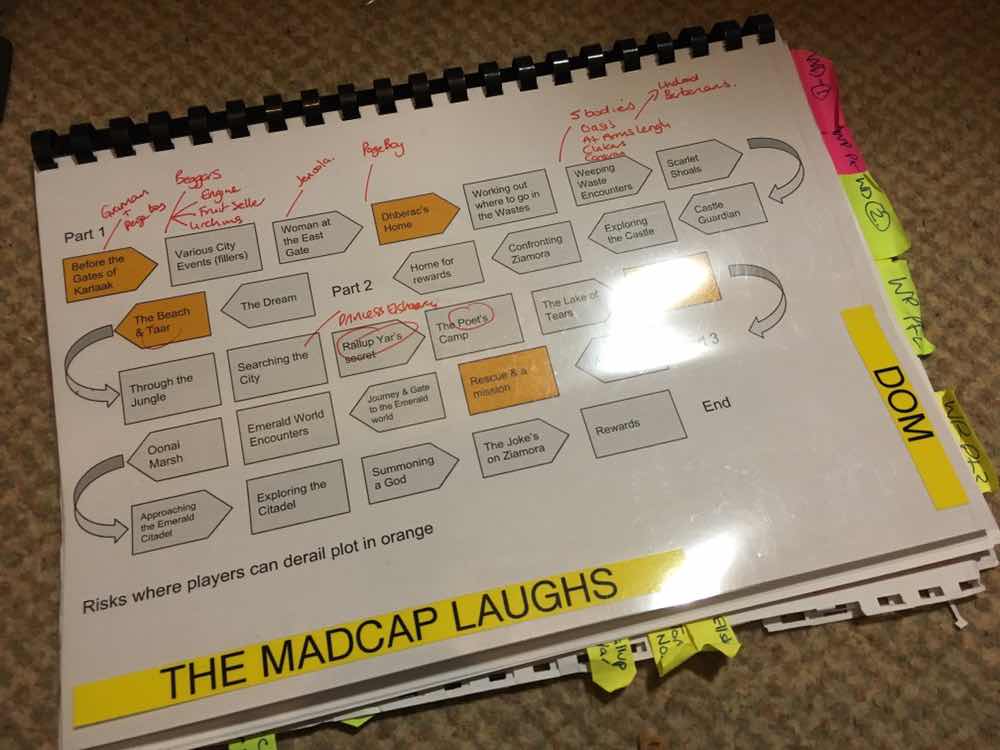 |
| Bound working copy for 3 convention slots |
Just found the bound copy of the conversion of The Madcap Laughs, which Graham Spearing and I ran at #Furnace a few years ago. We converted the Stormbringer 2nd scenarios to Wordplay, then ran it over three sessions of the five at the convention. My copy has ripped out pages as Graham misplaced his during the con, and he needed the reference.
It was great fun and foreshadowed the current trend to multi-slot sessions. The only difference is that each slot had the potential for different players so each part was standalone.
It was also interesting, as we co-GMd. One of us led the narrative, the other played the NPCs and helped the players out with any issues.
The characters were developments of the ones played by Duncan, Derrick, Sarah-Jo, Clive, Charles and Andrew in my old home campaign.
Good times.
7/1/2018
It was great fun and foreshadowed the current trend to multi-slot sessions. The only difference is that each slot had the potential for different players so each part was standalone.
It was also interesting, as we co-GMd. One of us led the narrative, the other played the NPCs and helped the players out with any issues.
The characters were developments of the ones played by Duncan, Derrick, Sarah-Jo, Clive, Charles and Andrew in my old home campaign.
Good times.
7/1/2018
03 January 2018
Books in December 2017
Quite unintentionally, December became a bit of a SF month for me.
On reflection, I do think that some of the criticisms are justified; the novel - stylistically - is not sophisticated. It is more akin to the old juvenile SF that I loved growing up. The style is the same as The Martian, but this time the info-dumps tend to come in the form of letters between the protagonist and a pen-friend, something that actually meshes very tightly to the plot at the end of the novel. Like The Martian, it carries itself along with the energy that the main character has in overcoming the problems that they are faced with. That in itself harkens back to an older form of SF.
I really enjoyed this book, probably because of the nostalgia for a style that it engenders. Traveller is, after all, my favourite SF-RPG and that is grounded in the same roots. It isn’t as good as The Martian, but is definitely worth a look.
The prize is hidden in the form of a quest that brings in a mixture of 70s and 80s tropes; video games, D&D, music and pop culture. As Parsifal progresses, the pace and the risks step up, and he finds that there are those who will take action in the real world to enable them to succeed at the quest. Like video game, the tempo at the end made me read the last third of the book in a single sitting, not wanting to put it down. It isn’t the best book I’ve read recently – I only gave it four stars on Goodreads – but I really enjoyed it. I’m looking forward to seeing what the film version will make of it[1].
The other area that is a little lacking is on the environmental hazards of the journey through the swamp. I feel that there was an opportunity lost to present some none creature and combat based encounters; however, this may well have been influenced by the ongoing play I have had in a One Ring campaign where travel is much more significant. As it stands, the longer you travel in the swamp, the more likely you are to catch a disease. The drag of the environment itself - coldness, wetness, dirt - is left to the GM to improvise.
That said, this is a competent, well presented, well organised and useful setting. It just doesn't scream "run me" in the way that others like Crypts of Indormancy, Slumbering Ursine Dunes and Hot Springs Islands have.
[1]: Especially if the D&D module reference makes it into the plot.
Artemis (Andy Weir)
So, the sequel to The Martian, a book (and film) that I enjoyed immensely. I made the mistake of reading the Adam Roberts’ review in The Guardian (https://www.theguardian.com/books/2017/nov/15/artemis-andy-weir-review-the-martian) before I started this. My initial impression of that was that it felt like sour grapes about the success of the first, self-published novel. But was he right?On reflection, I do think that some of the criticisms are justified; the novel - stylistically - is not sophisticated. It is more akin to the old juvenile SF that I loved growing up. The style is the same as The Martian, but this time the info-dumps tend to come in the form of letters between the protagonist and a pen-friend, something that actually meshes very tightly to the plot at the end of the novel. Like The Martian, it carries itself along with the energy that the main character has in overcoming the problems that they are faced with. That in itself harkens back to an older form of SF.
I really enjoyed this book, probably because of the nostalgia for a style that it engenders. Traveller is, after all, my favourite SF-RPG and that is grounded in the same roots. It isn’t as good as The Martian, but is definitely worth a look.
Ready Player One (Ernest Cline)
This one is so grounded in geek culture that sometimes it almost tries too hard. The concept is simple; with climate change and a thirty year recession that shows no sign of going away, the world is a much less pleasant place than it is today. The protagonist - Wade - is a student, growing up in trailer stacks (imagine a 3D trailer park) and attending school via OASIS, an interactive 3D virtual reality that much of the population retreats into to escape a world with far too few opportunities. Wade - or Parzifal, as his avatar is known, is hunting for a huge prize in his spare time; the chance to inherit the fortune of the founder of the company who created OASIS.The prize is hidden in the form of a quest that brings in a mixture of 70s and 80s tropes; video games, D&D, music and pop culture. As Parsifal progresses, the pace and the risks step up, and he finds that there are those who will take action in the real world to enable them to succeed at the quest. Like video game, the tempo at the end made me read the last third of the book in a single sitting, not wanting to put it down. It isn’t the best book I’ve read recently – I only gave it four stars on Goodreads – but I really enjoyed it. I’m looking forward to seeing what the film version will make of it[1].
Fever Swamp (Luke Gearing)
A short sandbox hexcrawl setting compatible with most OSR rules, set in swampland that can only be realistically traversed by boat. Nicely presented (there is something that reminds me of the old Ladybird books in the small hard cover format) and clearly laid out, this is a setting that could be dropped into other fantasy campaigns quite easily. Even though there are some plot hooks that can be used to draw characters in (the search for a missing - and wanted - scholar, for example) the direct engagement to another campaign is less obvious than the previous Melsonian Arts Council book, the Crypts of Indormancy.The other area that is a little lacking is on the environmental hazards of the journey through the swamp. I feel that there was an opportunity lost to present some none creature and combat based encounters; however, this may well have been influenced by the ongoing play I have had in a One Ring campaign where travel is much more significant. As it stands, the longer you travel in the swamp, the more likely you are to catch a disease. The drag of the environment itself - coldness, wetness, dirt - is left to the GM to improvise.
That said, this is a competent, well presented, well organised and useful setting. It just doesn't scream "run me" in the way that others like Crypts of Indormancy, Slumbering Ursine Dunes and Hot Springs Islands have.
Persepolis Rising (James S.A. Corey)
The seventh book in the Expanse series (so this would equate to something like series 8 and 9 on TV at the rate that they are converting the books). This book does something radically different; it advances the timeline of the story thirty years further into the future, allowing us to discover the long term consequences of the events in Babylon’s Ashes. Holden and the Rocinante are still around, but some of the old alliances and power structures have realigned, as might have been expected after the cataclysmic events in the preceding books. It’s interesting to see the shifts in motivation that have occurred; everyone is recognisable but they’ve also moved on. The story builds on elements from the previous books, things that have been left there hanging, and the ending, while satisfactory, leaves me wanting more. I enjoyed this a lot, but you don’t carry on reading up to the seventh book of a series if you don’t enjoy it.[1]: Especially if the D&D module reference makes it into the plot.
02 December 2017
Books in November 2017
Reading this month has suffered a little from the Stranger Things effect - catching up on two series of that excellent show has eaten into available time.
I enjoyed the story[2], although it was a little slow to start with. It showcased different parts of the Imperial Radch universe to the Ancillary trilogy. I certainly would like to revisit the universe again.
Austral is a child of the last generation of ecopoets[4], despised and discriminated against because of her ‘husky’ heritage. Orphaned at a young age, she fell into crime, served time but now works as a corrections officer in the labour camps that are used to drive development of the peninsula. An opportunity presents itself and she ends up kidnapping her teenage cousin, the child of a neoconservative politician who refused to acknowledge her side of the family, looking for a ransom and a way out of the Antarctic to somewhere that she won’t face the same discrimination.
I enjoyed this book; it blends an interesting thought exercise on the consequences of adapting to global warming with a kidnapping and deeper history of friction between two branches of a family. It’s not McAuley’s best, but it is different and interesting and held my attention all the way through for a late night finish.
[1]: The ‘Ancillary’ books.
[2]: I think that the Adam Roberts review (https://www.theguardian.com/books/2017/oct/13/provenance-ann-leckie-review-ancillary-justice) of this in the Guardian is a touch unfair, perhaps because of the commercial success that the previous books had.
[3]: Like the ‘Station’ novels, this book is worth reading if you ever want to run the ’Cold City’ RPG.
[4]: Interestingly, my spellcheck tries to change that to ‘cop-outs’. The Ecopoets tried to address global warming by adapting species to build new ecosystems in the face of climate change. They became outlawed and exiled.
Provenance (Ann Leckie)
A new novel set in the same universe as her first trilogy[1], this story takes up the tale of a young woman from a politically influential family who has just spent her life’s savings breaking out someone sentenced to ‘Compassionate Removal’, a form of prison from which no-one every returns. She does this to try and secure her position in the future, but the plan does not go as expected.I enjoyed the story[2], although it was a little slow to start with. It showcased different parts of the Imperial Radch universe to the Ancillary trilogy. I certainly would like to revisit the universe again.
Grandville: Force Maejure (Bryan Talbot)
This is the (sadly) final instalment of the lusciously illustrated set of graphic novels featuring Inspector LeBrock of the Yard. Set in a world of anthropomorphised animals that parallels our own, LeBrock, a working class detective, the best in the Police forces becomes embroiled in foiling a gangland war. I loved this and read it in one sitting; I heartily recommend the whole series.Ashes of Berlin (Luke McCain)
Set in 1947, this is the third of the books featuring Reinhardt, a German Police Officer. This story sees him back in Berlin, working in in the Kripo when he gets involved in a double murder investigation which soon escalates to bring in the conflicts between the four powers. Unlike the previous novels (which were set in the Balkans during the war), this has a different feel. Sponsored by the Americans for his job, Reinhardt is seen as both a dinosaur and at odds with the Soviet influenced Police force. However, he’s one of the most experienced detectives and one of the few who follows due process. He has to face his own demons as the investigation starts to shine a light onto the scramble of the various Allies to gain control of personnel, technology and records developed by Nazi Germany[3]. The ending went a different way to I anticipated, and it was excellent. Sadly, just like the Grandville book, this is the last of the series.Austral (Paul McAuley)
Dedicated to the memory of his wife, Georgina, who died unexpectedly earlier this year, this is Paul McAuley’s latest. Set in Australia once global warming has brought about sea level rise, it tells the story of Austral Morales Ferrado, a genetically edited human, adjusted to survive in low temperatures. Geo-engineering has failed to hold back climate change, suffering from the same short term political will that prevented the reduction of greenhouse gas emissions. The ice is retreating, and the Antarctic Peninsula has become an independent Republic.Austral is a child of the last generation of ecopoets[4], despised and discriminated against because of her ‘husky’ heritage. Orphaned at a young age, she fell into crime, served time but now works as a corrections officer in the labour camps that are used to drive development of the peninsula. An opportunity presents itself and she ends up kidnapping her teenage cousin, the child of a neoconservative politician who refused to acknowledge her side of the family, looking for a ransom and a way out of the Antarctic to somewhere that she won’t face the same discrimination.
I enjoyed this book; it blends an interesting thought exercise on the consequences of adapting to global warming with a kidnapping and deeper history of friction between two branches of a family. It’s not McAuley’s best, but it is different and interesting and held my attention all the way through for a late night finish.
[1]: The ‘Ancillary’ books.
[2]: I think that the Adam Roberts review (https://www.theguardian.com/books/2017/oct/13/provenance-ann-leckie-review-ancillary-justice) of this in the Guardian is a touch unfair, perhaps because of the commercial success that the previous books had.
[3]: Like the ‘Station’ novels, this book is worth reading if you ever want to run the ’Cold City’ RPG.
[4]: Interestingly, my spellcheck tries to change that to ‘cop-outs’. The Ecopoets tried to address global warming by adapting species to build new ecosystems in the face of climate change. They became outlawed and exiled.
04 November 2017
Books in October 2017
A fair bit of gaming reading[1] this month has eaten into the available time. That, along with Furnace and family weekends. That said, I’ve passed through the target of 52 books that I set myself on Goodreads this year.
[1]: The new Paranoia RPG, Swordfish Isles, November Metric, Coriolis and more.
Nightblind (Ragnar Jónasson)
The second of the Dark Iceland sequence. This continues the story of a young Police Officer, recently passed over for promotion in favour of one of his colleagues. All of a sudden, the colleague is shot, and the town comes under the spotlight from the media as firearm related crimes are rare. Against this backdrop, the investigation continues, set against a backdrop of the normalcy of life, and the challenge of relationships. I didn’t enjoy this as much as the first book, but I liked it enough that I will read the third.The Furthest Station (Ben Aaronovitch)
The latest entry in the PC Grant series, this one is a novella rather than a comic book or a full length novel. Grant is drawn north, following up reports of hauntings on the Underground. His cousin tags along as Nightingale thinks that giving a nearly 16 year old with the potential for magic an internship is a good idea. This was fun, but it never really got going in the way that the novels do. In that respect it was a little disappointing. However, it was nice to touch base with all the familiar characters again.Blackout (Ragnar Jónasson)
Set after the recent volcanic eruptions in Iceland, this is the third in the series, but second in the timeline. A construction worker building a tunnel to the town that the protagonist works as a police office in is killed, and the story follows the investigations of both the police and a journalist. Dark secrets from the past are revealed before the police have their murderer, but was the act really a cruel one? I will be reading the fourth in the series, but someday I need to find a book with happier stories about Iceland.The Corporation Wars: Emergence (Ken MacLeod)
The final part of MacLeod’s latest trilogy; the conflict between the AI of the Direction, the AI of the Discorporates, the human minds stored and upload into combat mechanoids and the free Robots (those that have evolved AI naturally) escalates to a conclusion which while satisfying verges on confusing. There are multiple factions, and alliances shift, and the references change from the ‘real’ world to simulations. The story wraps up more quickly and simply than I expected, but it fits well with the preceding plot. I enjoyed this series, but find myself wanting to know more about the backstory.[1]: The new Paranoia RPG, Swordfish Isles, November Metric, Coriolis and more.
Subscribe to:
Posts (Atom)