01 November 2014

Ten books which have stayed with you

Ten Books that have stayed with you.
Only missing “Rendezvous with Rama”, which is on Kindle as I foolishly lent out the original.

1. “The Hobbit" (JRR Tolkien)
I'm sure this book will feature in many people's top ten. "The Hobbit” was one of the first books that I read and reread regularly. Yes, its style is not as adult as "The Lord of the Rings", but it is full of joy and adventure, whereas the trilogy has always felt dark and doomed. I have to confess that "The Silmarillion" came very close to taking this spot as the shear epic feel of the sweep of history really hit the mark for me, despite it being difficult to read in some parts.

2. ”Downbelow Station" (CJ Cherryh)
CJ Cherryh writes character driven novels where the science fiction is almost incidental. "Downbelow Station" won the Hugo and the Nebula awards and is a book that I have returned to again and again, and is probably my favourite SF novel. Cherryh writes from the perspective of the character she is voicing, so you only ever know what they know. "Downbelow Station" is a story about the impact of war on people living at Pell's Station during the conclusion of a conflict between different human factions. Space battles, refugees, politics, and love are all in this, and I found the book nearly impossible to put down when I got it one Christmas. I can remember being at my grandparent's house and being unable to put it down. I can also recommend the audiobook, which - despite my having read the novel many times - revealed little details and nuances of the plot that I hadn't really dwelt on when I read it normally. Oh, and once you've read this, "Cyteen" is a must.

3. ”Rendezvous with Rama" (Sir Arthur C Clarke)
My Australian Second Cousin Kathy F gave me this book (along with another cracking tome on aircraft) when she left from staying with us, and it has stayed with me ever since. It's a story about humanity encountering an alien vessel and trying to work out what it is, what it does and whether the entry into the Solar System is just a coincidence. It's short compared to modern novels, and a great story of discovery. My only regret is that the original copy that I had was lost by someone who borrowed it. The BBC radio adaptation is also worth a listen if you can find it.

4. “Postmarked the Stars" (Andre Norton)
When I discovered Andre Norton at Holmes Chapel library as a young lad, I discovered science fiction and fantasy. The first novel in her free traders books "Sargasso of Space" had me hooked from the start with a tale of a young man joining a merchant trader and seeking his fortune in the stars. However, it's the third book in the series that stays with me and so I have named it here. This involved a colony world where all was not as it seemed. I still have the copy that I found at a bookshop in Cornwall or Devon on holiday, and I know that it has heavily influenced my love of the Traveller RPG. I have re-read this many times.

5. ”Winter's Tale (Mark Helprin)
Again, a book that I stumbled upon at the library, probably when I worked there as a Saturday assistant. Sadly, I've subsequently lost the glorious hardcover I had, but I have paperback and Kindle versions. This is a tale of love, of loss and of magic, set in a mythical version of New York. Peter Lake is a burglar who meets Beverly, a girl terminally ill, when he is breaking into her family's house and falls in love with her. Beautifully written, dreamy and evocative, it's not a book that I can read very often but it's one that I love very much. Recently filmed as 'A New York's Winter's Tale', which was a nice adaption.

6. “Neuromancer" (William Gibson)
I found this book - which I'd been looking for following reading a review in Dave Langford's column in White Dwarf - on a book stand while I was away at a Scout Camp. I think it may have been in Bala in Wales. It has stayed with me ever since (and got me into trouble with my father when I got it, as he didn't think it entirely appropriate for my age). It was the novel that crystalised a change in SF and I loved it. The vision it presents is bleak, but less technology obsessed than many of the roleplaying games in the same genre. The plot twists and Gibson's prose crackles with energy. I recently re-read this and had the chance to listen to the BBC Radio adaption which is fantastic.

7. "The Earthsea Sextet" (Ursula K Le Guin)
Le Guin's fantasy series is superb, and very different to many other fantasy series. I read this while at secondary school and loved it. I was even more excited when a further three books emerged over the years since I read it first, and one of my happiest book purchases was when I found the hardback edition so now I have a lovely set. It has meant that the original, well worn and loved, paperbacks can be passed onto Nathan when he is old enough.

8. "The Dark is Rising" Sequence (Susan Cooper)
I'm naming the whole sequence here, but if I had to choose one, it would be "The Dark is Rising". This is a darkly-lensed fantasy tale of a young boy who discovers that he isn't like the rest of his family and has special powers, and is drawn into an age-old conflict between the Light and the Dark. Starting in a family farmhouse, at the onset of winter, in our modern world, this novel was really evocative for me as it reminded me of the Cheshire countryside where I lived. This was an optional text for English at secondary school, but I went out and read all five books, and have done repeatedly. The film adaption, 'The Seeker', isn't brilliant. The film makers were a bit too influenced by Harry Potter.

9. The Merlin Trilogy (Mary Stewart)
This is the sequence "The Crystal Cave", "The Hollow Hills" and "The Last Enchantment". I was introduced to these by my paternal grandmother who was fascinated by the Arthurian legends, the Celts and history. The books very strongly influenced my view of the Pendragon RPG, which I always ran in a more gritty, less Mallory inspired mode. Mary Stewart weaves the Arthurian legend well, telling it from the perspective of Merlin. Her setting is in Greater and Lesser Britain as the Romans retreated, with the island threatened by the Saxons. It is epic, and - whilst told from the perspective of Merlin - the magic is mysterious and low key. It is almost believable. I have read this many times and will do again. There are two linked books; "The Wicked Day" which continues the story after "The Last Enchantment" with a somewhat sympathetic Mordred as a focus, and "The Prince and the Pilgrim", which I have yet to read, and is set within Arthur's reign.

10. "Mythago Wood" (Robert Holdstock)
A magical book, set just after the Second World War beside and inside a tract of primal woodland called Ryhope Wood in the south of England. The wood interacts and generate myth imagos representing the fears and hopes of the people who have lived in and around it. The world inside the wood is far bigger than it appears from the outside, stretching in space and time back thousands of years. The Huxley family get drawn into the world of the wood, full of conflicts and discoveries. The book is beautifully written, evocative and one I love to dip back into. There are a number of sequel/prequels which are also worth considering.

Ten Books... the shortlist
Missing the original Foundation Trilogy, which I am not sure where I’ve stored it!

This post grew from a meme on Facebook, which I found very difficult to finish as there are so many books that have meant so much to me over the years. There were several that - had I been in a different mood - would have made the cut, so I decided to give them an honourable mention.

The first was “Eagle of the Ninth” and its various sequels (“The Silver Branch”, “The Lantern Bearers”, “Frontier Wolf” ) written by Rosemary Sutcliff. Set in Roman Britain, these really fired my imagination (especially with the Legionnairy Fortress of Chester nearby) and impacted upon both my interpretation of Glorantha and the Pendragon game settings.

John le Carré didn't make the cut because although I love his work and will seek out and buy a new novel the moment it is released, I rarely re-read his books. However, his recent novels starting from “Absolute Friends” have been on fire, and he has been griped with a passion and anger that was absent post Cold War.

Isaac Azimov's Foundation Trilogy was a huge influence on me from an early age. My father had a copy of the Pan release with black covers and abstract shapes, and the epic scale of the tales resonated with me. Yes, the characters can be cutouts, but the overall scope is great. The expanded books are also good, but not in the same league for me.

Much as Chester influenced my love of Rosemary Sutcliff's Roman Britain books, another part of Cheshire is entwined in my love of some books. Alan Garner's wonderful, distinct “The Weirdstone of Brisingamen” and its sequel “The Moon of Gomrath” are long time favourites. I loved walking on the Edge at Alderley, and his books capture it and embue the place with even more magic than it naturally has.

Another author whose books have had a great influence on me is Guy Gavriel Kay. Kay is a true gem amongst authors, as most of his books eschew the traditional trilogy favoured in the fantasy genre. He writes well, and creates stand-alone stories in near historical analogues to our past history. One of my favourites is “A Song for Arbonne” but I could easily have picked any of his books.

Finally, how can I end this list without mentioning M. John Harrison's epic “In Viroconium” sequence. He writes beautifully; the sets of linked tales, gradually becoming more and more unfocussed from the dreamy, almost Moorcockian, technological fantasy they open with, shift and twist until they end up in a cafe in Yorkshire. The book is brilliant, and the audiobook even more so.

Actually, mentioning that, I have surprised myself that Michael Moorcock hasn't made this list with at least “Stormbringer”’s brightly paint, fast moving sorcerous war between law and chaos with the albino prince and his demon blade. Visual, probably drug-influenced, colourful and engaging text, worthy of a mention.
November 2014
07 September 2014

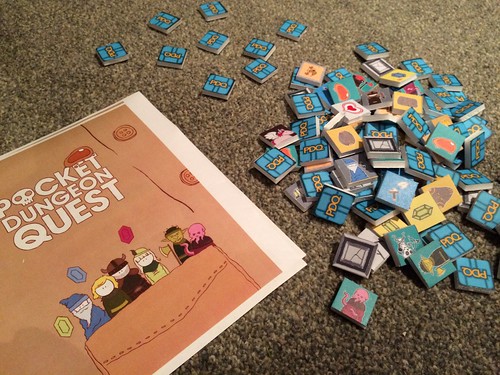
First Impressions - Pocket Dungeon Quest

Pocket Dungeon Crawl - game
The Game, by Jeff Dehut
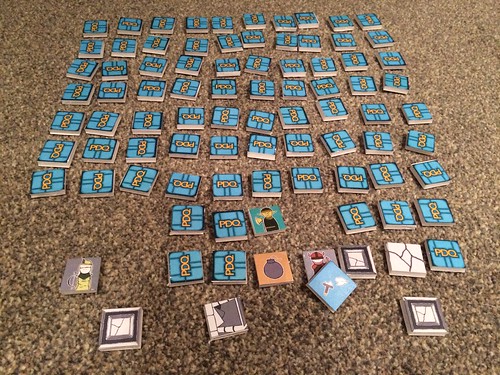
Pocket Dungeon Quest (or PDQ) is a short, simple game which should be easily playable with younger children created and designed by Jeff Dehut. It is a collaborative game, but like any dungeon adventure, there is a risk that your hero may die. The game has recently finished on Kickstarter, where I backed the Print & Play (PnP) version for $5 as the shipping to the UK was somewhat eye-watering. You can buy the PnP for slightly more ($8) on Gumroad here (https://gumroad.com/l/PDQgame). It took about 30 minutes to mount the game on 5mm foam board using 3M Spray Mount and cut it out. The artwork in the game has a gorgeous playful cartoon style, giving it real character and making it far more child-friendly.

Pocket Dungeon Crawl - Warrior faces a Goblin
Starting a fight

The PnP has four different characters that you can play - the Warrior, the Rogue, the Archer and the Wizard. The Kickstarter had an extra Hero (‘the Adventurer’, an Indiana Jones style character) which won’t be available anywhere else, not even on the PnP file for backers. Each Hero has a special feature; the Warrior does more damage; the Rogue can steal items and use them before fighting a monster; the Archer can re-roll their attack and the Wizard can use two spells or items per turn rather than one.

Pocket Dungeon Crawl - dungeon near the start
It’s bigger than it looks!

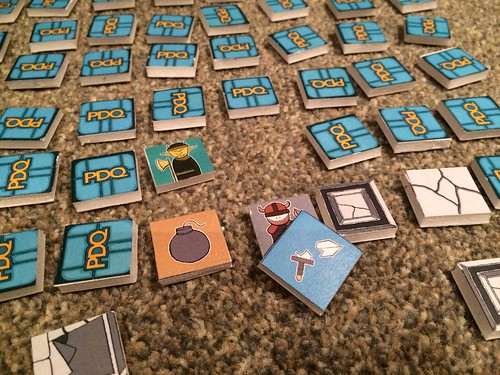
The core of the game is a 10 x 10 matrix of tiles which represent the contents of the dungeon that you are exploring. The tiles include walls (blocking movement), floors (no real effect), spike traps (doing a point of damage), monsters of various types, the dungeon boss, items, spells, bonus/penalty effects for combat, the Pegasus (flies over walls), gems, the Merchant, and three Relics.

The Heroes all start at the edge of the matrix and the turns are very simple. Move, turn over the tiles that you can see (effectively all the unturned tiles adjacent to you). If a monster (or monsters) are revealed, you must fight them before you can grab any loot (items, gems, spells and so forth). Combat is made with a modified d6 with the following results.

1. Red Skull - critical miss, you lose a health point and suffer an additional effect based upon the monster you are facing.
2. Yellow flash - you lose 1 health.
3. Yellow flash (again)
4. 1 Sword - this doesn’t kill the monster, but you don’t lose health. If you’re a warrior then you get an extra sword so this will be a kill.
5. 2 Swords - kills any monster with a direct hit. Can be reduced by a broken sword effect back down to 1 sword.
6. 3 Swords - kills any monster, even with a broken sword.

It’s fast and brutal.

Assuming you kill the monsters, you can take an item from those that you have revealed, and all the others go face down into a discard pile (separate from the discarded monsters). When you turn over the Merchant’s tile, you can exchange 30 gems to buy tile (item or spell) back from this pile. Two tiles are turned over and you choose one of them.

A bad thing is when you reveal the boss. At that point, the party rolls to see how many henchmen he has. These are drawn from the monster discard pile or by revealing tiles on the dungeon if there are not enough monsters discarded. You have to fight your way to the boss through the henchmen to kill him. If the party is down on health then this can be pretty nasty.

There are three different sets of victory conditions defined, each increasingly harder to achieve:

1. Find all 3 relics and exit the Dungeon in one piece.
2. Kill the boss and escape the Dungeon alive.
3. Clear the floor, revealing all tiles and killing all the monsters.

Before I tried this with Nathan, I had two quick tester games. In the first game, I had two Heroes in play, and found the Boss very early after some poor rolls in the first few turns. The four henchmen that he came with were too much much for the poor Heroes who had already been injured and had very little in the way of items or spells. They managed to kill three of them before they all died.

Pocket Dungeon Crawl - Battle hardened and Victorious
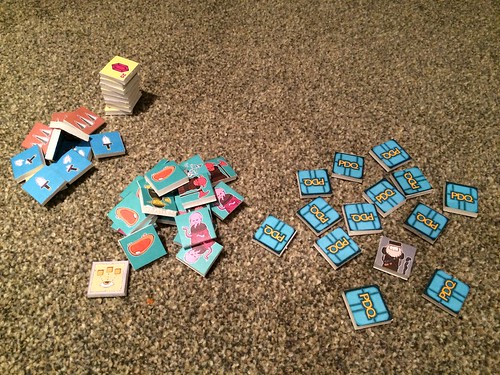
The surviving Heroes at the end of the second game.
Pocket Dungeon Crawl - Spoils of War
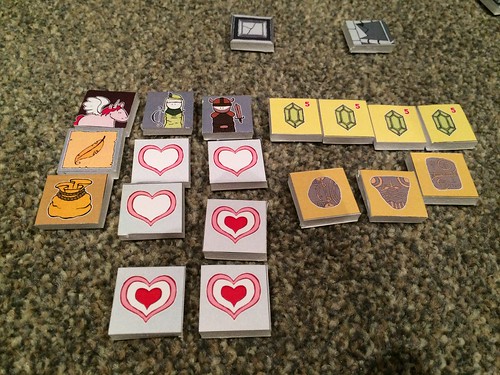
From left to right: traps, sword effects, gems; pile of dead and escapees; Merchant and his wares.

In the second game, the one of the two heroes (a Rogue) died on the first turn when she[1] turned over three tiles including a Minotaur that did 2 health damage on a critical miss. Ouch. She couldn’t heal herself in the combat (as no-one had a healing potion and the Warrior didn’t find the Phoenix Feather spell to resurrect her) and so was gone. I decided to immediate start a third character. As the threats in the game are the same no matter how many players are involved, it may be work allowing the players to have all four heroes in use even if there are only two or three players involved. That, or alternatively boost the health of the characters in play with the spare counters.

[1]: The Hero counters have male and female sides, no game effect and I just picked them up randomly, so ‘she’.

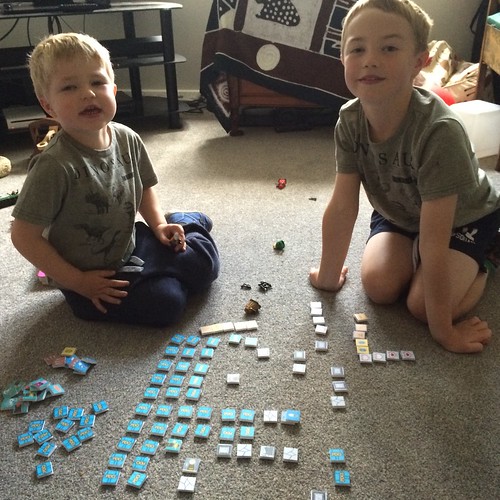
The next game was with Nathan (7) and Aidan (3). Aidan was mainly doing what his brother told him, and was the Warrior. Nathan was a Wizard and I was the Rogue. We had a fun game, playing for the basic ‘find the three relics and escape’ objective. We ended up turning over most of the tiles but fortunately not the boss. I had opted to split the unused Archer’s health between the three of us, and that was good, because we were down to a single health point several times (i.e. dead if we’d played as designed - but we did have a Phoenix feather). Nathan got the idea quickly, and Aidan was happy just playing along and doing what his big brother suggested. We prevailed, just, and they had big smiles on at the end.

Pocket Dungeon Crawl - The Players
Still smiling!

Nathan (7):
“Brilliant. It was really really good and adventurous. We got to kill all the monsters. We didn’t get to the Boss, but I almost was in with the Boss and I would have died if I had. I’d play it again, a million times if I had time.”


Aidan (3):
“It was good. I enjoyed it. I was the Warrior. I didn’t nearly die like my brother”


In conclusion - a fun, quick, cooperative game that understands the essence of the Dungeon crawl and is easily accessible to kids and adults alike. Recommended.

31 August 2014

#RPGaDay - 31 - Favourite RPG of all time


I’m sure you’ve all guessed this already, even if you don’t know me that well. My favourite RPG of all time is… drum roll… Traveller.

I have loved this game in all its incarnations from that first set of Starter Edition which I finally managed to get hold of after several attempts of ordering and reordering using the old Games Workshop credit note system.

Okay, I’m lying here. I didn’t really love GURPS Traveller, although some of the source material was superb and amongst the best ever written for the game (Interstellar Wars, Rim of Fire, Far Trader, First In, Ground Forces, Starports and Sword Worlds are all excellent).

I also wasn’t partial to Traveller: The New Era, GDW’s reboot, mainly as I didn’t like the core game engine, and I was upset about the violence that the Virus did to the setting. However, I’m much more sanguine about that now as I can see that Virus was just described badly - the mistake was made to use technology descriptions from the 1990s. The pain and sadness of the obliteration of the Imperium have gone now, and in many ways I like the way forward it gave. The 1248 extension to the setting was truly epic and had far too much compressed into too short a time. There were too many collapses and recoveries and major wars to be credible, especially when the limitations of travel time by jump were added to the mix. Had it been 1448 then I’d have seen it as far more believable.

Traveller T20. Well, again this had some good material (the Gateway supplement was an excellent expansion of work done for MegaTraveller) but the Dungeons & Dragons engine being used for Traveller just left me cold.

But I have loved deeply Classic Traveller, MegaTraveller, Marc Miller’s Traveller (T4) and Mongoose Traveller. Traveller T5 isn’t on this list yet as I need to read it fully yet. Across these games the system remains recognisable and the settings remain true.

What makes Traveller stand out to me?
  • Character generation that gives you a history (and could kill or maim you in early editions).
  • Starship and Star System design sequences that just encourage you to play with them and create vessels and worlds to adventure in.
  • The trade rules that mean you can be more than mercenary thugs looking for the next ticket or bank-job.
  • A d6 based mechanic with a task engine integrated to handle different difficulties (this was revolutionary with it was introduced). Ideally this is 2d6 based, but the T4 and T5 Nd6 engine also works well. I know, I ran it a lot.
  • The jump technology that means communications are limited to the speed of travel between stars.
  • A system of Tech(nology) Levels that define the capability of cultures.
  • Limited Psionics, with an SF feel. 
  • And the setting.

It is fair to say that the setting in Traveller reflects the time that it was released (1977). The Third Imperium feels very like 60s and 70s harder SF. The tropes are there from Andre Norton, Isaac Azimov, E.C. Dumarest, Sir. Arthur C. Clarke, Robert Heinlein and many, many more. This is only natural, and the influence of Star Wars (which came out at the same time) can also be seen. As the different waves of style have washed through SF, Traveller has adjusted ever so slightly. The setting has cultural memes that explain why cyborg-style upgrades and AI are frowned upon. Nanotechnology is far beyond the Tech Level of the Third Imperium. And computer tech is more in keeping with the old ‘Big Iron’ that was seen in the 1970s and earlier[1]. This is not out-and-out Transhumanism, with the huge reaches of scale that can imply. You want a different game for that.

However, because the feel of society is similar to ours, because it is so recognisable, it makes the stories of the characters so much more believable. I play to the harder SF end of Traveller, whereas other run out-and-out Space Opera. There’s room for both in the Third Imperium and the game system is content with either.

Over the last 30 years, Traveller has given me much joy. I hope that in some little ways the work that I’ve done with BITS (http://www.bitsuk.net/) and the scenarios I’ve run and written have passed that back to others. Marc Miller, Loren Wiseman and the rest of the team from GDW have huge thanks from me for creating this game which has endured. Andy Lilly also deserves my thanks for letting me get involved in BITS.

And if you haven’t tried Traveller, coming up very soon is the Traveller: Lift Off starter set Kickstarter, or you can dive in with Mongoose Traveller, or pick up the entire back catalogue electronically via DriveThruRPG (http://rpg.drivethrustuff.com/browse.php…) or on CD via FarFuture Enterprises (http://www.farfuture.net) (the best way if you want a lot of the books). FFE also stock the Traveller T5 book.

[1]: Although personally I have never found an issue using more advanced tech like we see today and avoiding violence to the setting’s integrity.

[2] A note on the picture - I couldn't find my copy of TNE (I think it's in the eBay pile) nor my paperback T4 (well worn and stashed on a shelf somewhere) and I sold T20 a long time ago...

30 August 2014

#RPGaDay - 30 - Rarest RPG Owned


There is - of course - one flaw in this. The measure of rareness is not a consistent thing, as it depends upon the size of the publisher.

So, for example, if you own the original BITS printing of *The Long Way Home* for *Traveller*, and you have an unsigned copy, then you have a truly rare book as most of the hundred or so copies were signed (in return for a donation to charity). Mine is signed, so not quite so rare. BITS is a very small press publisher compared to most of the rest of the market.

If you look at books from the majors, I have *Ringworld* and its companion volume, Chaosium’s d100 BRP take on Larry Niven’s epic SF setting. This was rare, possibly due to the cost that it was when it was initially for sale. It also was discontinued pretty quickly.

I also have a copy of the Last Unicorn Games *Dune* RPG. This is a lovely setting book (the system less so) which sets the action before the Frank Herbert novels (kind of the way way that Brian Herbert and Kevin J. Anderson have done but not at all awfully). The entire initial print run sold out quickly, as LUG was acquired by Wizards of the Coast (who had planned a d20 Dune version), but then the licence was pulled by the Herbert family. I keep on flirting with selling this as as sometimes it goes for a small fortune, but haven’t quite got that far.

The thing is, in these days of eBooks and print-on-demand, it is hard for a book to go out of print unless it is a licensed article. Even if a publisher shuts down actively, they may as well leave the book on Drive Thru RPG as a revenue earner as it costs them nothing. Thus, a rare book must be out of print and not available electronically.

Ultimately, I think I will pick *The Lost Supplements* for Classic *Traveller*. Those of you who like classic SFRPGs will remember the Keith Brothers. They were prolific in the early days of the hobby. J.Andrew Keith[1] had produced a whole set of books which became obsolete as the line transitioned to MegaTraveller. John Paul Sanders founded Cargonaut Press[2] (now defunct) to (initially) publish the first of these lost volumes, a book on Piracy in the Imperium called *Letter of Marque*. These were soon expanded to a bigger collection[3] of all the unpublished works called *The Lost Supplements Collection*. The material dripped ideas and captured the feel of the Classic (Golden) Era of *Traveller* perfectly.

[1]: http://wiki.travellerrpg.com/J._Andrew_Keith "J. Andrew Keith Bibliography"
[2]: http://wiki.travellerrpg.com/Cargonaut_Press "Cargonaut Press"
[3]: http://wiki.travellerrpg.com/Lost_Supplements_Collection "Summary of the Collection."


29 August 2014

#RPGaDay - 29 - Most memorable encounter

I found this one incredibly hard, for three reasons. Firstly, I usually end up being the one running the games. Secondly, I don’t actually get to play - or run - that often. Finally, my memory is not so good as it used to be, probably related to the reduced amount of decent sleep I get these days.

I’ve used three examples already; the ballistic bowshot in the *RuneQuest 3 Glorantha* game, the monster that wouldn’t die in the *AD&D 2nd Edition* game with my old Paladin character, and the Werewolves through the Walls incident I mentioned in yesterday’s piece.

So, here is my shortlist:

1. I played in a BITS *Traveller* game quite some time ago (not sure if this was at a *TravCon* or a *GenCon UK*, along with my friend Derrick, and run by Andy. The game - if I remember - was called ‘Family Business’ and from my recollection, it involved a hostage situation. Anyway, it all got a bit out of hand when we wanted to get some information out of a non-player character. I think Derrick managed to completely shock the Referee. We needed information urgently out of a bad guy, and decided to intimidate it out of him. In fact, that was the only skill that we had that was any use.

So Derrick came up with a plan. He had my character drag out the victim tied up. We threatened him, and got told “I’m not going to talk”. So he was blindfolded and dropped on the muddy floor. Del’s character had mine get the spare tyre off the Land Rover analogue that the victim had seen already. The engine was stared, and then Del’s character used the spare tyre and someone revving the engine to pretend his character intended to drive over the person being interrogated. The guy spilled (and Andy was shocked at the approach), and he was returned to his cell blindfolded so he never knew it was a bluff.

2. Technically, the next one wasn’t so much an encounter as an extended set of small encounters. We were playing at the Chester RPG club, playing AD&D 2nd Edition in Jac W’s game. As a party, we were based in a port city and desperate to track down a contact who suspected in a theft. We think he had left the town in a certain ship, so yes, we spent the entire session chasing around town searching for a ship called “The Scarlet Herring”. Oh how the GM laughed when realisation dawned! And how we cringed…

3. Recently, I had great fun in Timothy C’s *Traveller* game at *TravCon 14* where I was playing a very stressed ship’s captain whose crew managed to keep on finding stow-aways. I ended up channelling a combination of Basil Fawlty and the stresses at work I’d been under as the Captain had a meltdown about the incompetents that worked for her. I nearly lost it in giggles towards the end. The other players seemed to enjoy it too. A combination of black humour and management-speak. I think that the scenario was called ‘Three Blind Mice’ and published by a German company.

And the winner?

It has to be the *Beat to Quarters* game I played one Saturday night at Furnace, run by Neil G and including other players such as Michael Reddick. Neil had decided to run a game based loosely on the lyrics of *The Irish Rover*, and he decided (and probably regretted) asking for us to give a number of ‘suggestions’ for plot elements. These included - if I remember correctly - the Holy Grail and possibly Moby Dick. The game sparked, flew around manically and the player all riffed off each other. The encounters are all blurred together now, but it was a truly marvellous game. Neil seemed to be like a rabbit stuck in headlights, trapped between laughter and horror at what we had done to his scenario and game. At the end, he banned us from playing again.

28 August 2014

#RPGaDay - 28 - Scariest Game you’ve played

The scariest game that I have played happened back when I was still in secondary school. One of the things that we did several times was to take part in a 24 hour sponsored role-playing event for charity. We did this at school and I think that we also did this at my home. I think that my parents went out for the evening, but I may be wrong. I’m sure it was at my house, but again, memories have faded a bit.

Now, I know that this happened sometime between being aged 16 (when we moved out to a small village in South Cheshire from Holmes Chapel) and before my year out for University when I was 19. It was either a 24 hour event or some friends were staying over.

We where playing AD&D, probably second edition, and I’m pretty certain that John N was running the game. It was pretty dark fantasy (this was around the time the first Ravenloft boxed set was released) and I can remember us staying in an Inn in a village that had been beset by a monster. In this case at least one Werewolf. Our characters had hired a suite of rooms, and we’d locked the doors (which were sturdy)and put furniture behind them. Classic horror story siege mentality. The atmosphere was amped up by playing with a single light (I can’t remember if it was a candle) and the rest of the house being quiet and dark during the night.

We heard the Werewolf enter the building, there were screams and then we heard snuffling outside our door. Gripping our weapons (we all were lowish level and in a meta-gaming sense knew we needed silver weapons) and keeping very quiet, the tension built up. The door was tried. The lock clicked. The furniture stopped it opening. Then everything went quiet. And then the Werewolves (for there were more than one of them) burst through the walls rather than the door and completely freaked us out. Chaos ensued. Someone’s character jumped out of the window risking death rather than be torn apart.

Anyway, I can’t remember whether we survived or not. Or what else happened. But what sticks with me is that we all felt it necessary to go to the toilet when the game had a break in at least pairs, as no-one fancied walking out into the darkened house on their own…

27 August 2014

#RPGaDay - 27 - Game You’d like to see a new / improved edition of…


Ooh. A new edition of a game that I like.

A more consistent and well edited version of Mongoose *Traveller* is probably too much of an ask based on past experience with the publisher, but it would be a good thing. The expansions have not been coherently done with huge numbers of skills and mechanics added in. So, that aside, what would I love to see a new edition of?

I was disappointed with the new edition of *The EsoTerrorists* which came out recently. The content was good, but a very small font size had been used and it was softcover, unlike pretty much all the rest of the GUMSHOE range which are lovely hardbacks. I would happily pay for the same content again, but done across say 200 pages rather than 160 and in hard cover. But that’s pretty simple for Pelgrane to do, so let's look somewhere else.

*Blue Planet* springs to mind. The 2nd edition was brilliant and - had I still owned it - may have even made the list of game that I want to play that no-one else does from two days ago. If you don’t know the setting, then you’ve missed out on a treat. Humanity has spread to a new world - Poseidon - at the end of a wormhole found at the edge of the solar system. The environment on Earth is fragile after years of abuse. Players are colonists in a new world of opportunity and adventure, a world with superb, detailed, background. In many ways, it was the opposite of *Traveller*. Rather than the whole of the universe to explore, you had one world. And it felt as big as the universe. There was also a plan to release a supplement (or even partner RPG) called *World of Hurt*. This was going to give a very *Blade Runner* style setting back on Earth, but this never happened.

Anyway, I know what I want. I want a version of *Blue Planet* built with the Mongoose *Traveller* engine. I want it as a distinct line with tight quality control, and I want it now!

(Okay, so I realise that I could hack 2300AD to do this reasonably easily, but I'd rather someone else did it for me!)

26 August 2014

#RPGaDay - 26 - Coolest Character Sheet


‘Coolest character sheet’ as a category really seems to be scraping the barrel!

1. Character sheets should be simple.
2. Character sheets should be clear.
3. Character sheets should have enough space for players to make mistakes and to write easily.
4. Pretty character sheets are often missing the point.

I think that the old index card approach of a very simple character sheet used by *Traveller* was excellent. I love the concept of 100 words about your character pioneered by *Hero Wars* (easily replicated in *Wordplay* as well).

If you play in a convention game, the balance there needs to be between clarity and atmosphere. In my case, I more often focus upon clarity. The only time I haven’t was with the *Savage Worlds* conversion of *2300AD*’s *Mission Arcturus*, which I’ll post as examples. I am still quite proud of those.


Damn, now I want to run it again!

(Note that the art is from the original game and copyright resides with Marc Miller and FFE)

25 August 2014

#RPGaDay - 25 - Favourite RPG no one else wants to play

This one really isn’t a problem for me, as I don’t have a regular gaming group, so there’s no-one saying “no” to anything.